


1. Beijing Deploys Legal Tools to Counter U.S. Sanctions
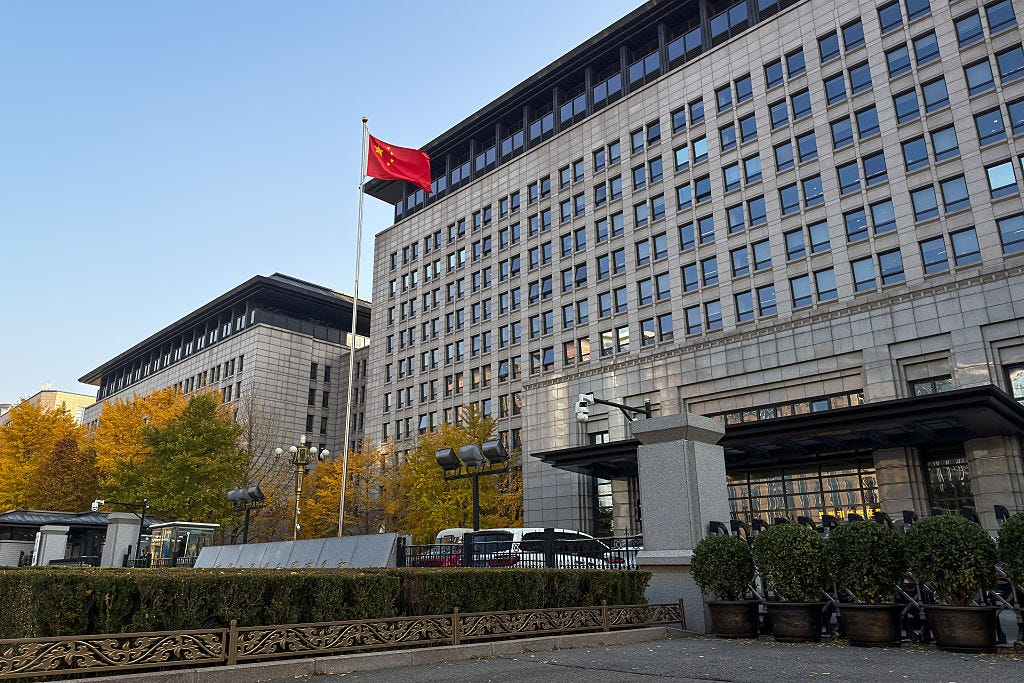
What Happened: On May 2, China’s Ministry of Commerce issued a prohibition order under its 2021 Blocking Rules, ordering domestic companies not to recognize or enforce U.S. sanctions on five Chinese petrochemical firms linked to Iranian oil transactions. The directive shields private Chinese refiners from U.S. sanctions tied to the Iranian oil trade and prohibits domestic compliance. This marks a stark departure from Beijing’s longstanding approach of publicly criticizing U.S. sanctions while often allowing major firms to comply to preserve access to the U.S. financial system.
Why It Matters: Beijing is now using the legal tools it built between 2020 and 2022, including its formalized export control regime, to counter U.S. “long-arm jurisdiction.” This escalation puts pressure on Chinese banks and corporations, leaving them caught between domestic mandates and international financial compliance. Ultimately, both Washington and Beijing are aggressively testing each other’s boundaries, capacities, and economic leverage just one week before the high-stakes Trump-Xi summit in Beijing.
By Shengyu Wang, Research Assistant, Center for China Analysis
Learn More: Read “Guided Autonomy: America Watching in Xi’s China“ by CCA Senior Fellow Guoguang Wu.
2. Wang–Rubio Call Spotlights Taiwan Ahead of Beijing Summit
What Happened: On April 30, China’s Minister of Foreign Affairs, Wang Yi, held a phone call with U.S. Secretary of State Marco Rubio to discuss U.S.-China relations and prepare for the upcoming Trump-Xi summit. The two officials discussed Iran, the war in Ukraine, and U.S. sanctions and technology controls on China, among other hot-button issues. Taiwan, in particular, was discussed at length. Wang Yi reiterated that Taiwan is a non-negotiable “core interest,” warning against U.S. support for Taipei, while Rubio emphasized deterrence and support for Taiwan, framing it in terms of democracy and regional stability.
Why It Matters: Their positions on Taiwan remain fundamentally incompatible, setting up a delicate discussion between Trump and Xi in Beijing. Trump could ease tensions by shifting U.S. rhetoric—for example, by publicly stating that the United States “opposes Taiwan independence” as Beijing desires. Such a move could reduce friction over the thorniest issue in U.S.-China relations by signaling clearer limits on U.S. support for Taiwan independence. However, any rhetorical shift has risks: it would likely face pushback in Congress, draw concern in Taiwan, and could prompt Congress to insert new legislative language pushing back on Trump’s formulation.
By Lyle Morris, Senior Fellow on Foreign Policy and National Security, Center for China Analysis (@LyleJMorris)
Learn More: Read “Xi Travels Less but the World Is Coming to Beijing“ by CCA Fellow Neil Thomas and CCA Intern Yuxuan Wei.
3. Taiwan’s President Lai Visits Eswatini Despite Airspace Disruptions
What Happened: On May 5, Taiwan’s President Lai Ching-te returned to Taipei after completing a state visit to Eswatini, its only African diplomatic ally. China reportedly pressured three Indian Ocean states—Seychelles, Mauritius, and Madagascar—to revoke overflight permission for Lai’s aircraft, delaying the trip by about ten days from its original April 22 start date for King Mswati III’s 40th accession anniversary. Lai ultimately flew aboard the private jet of the King, with the return trip taking a sweeping southern detour through the Indian Ocean. Three Taiwanese Air Force F-16s escorted the aircraft as it re-entered Taiwanese airspace.
Why It Matters: Taiwan’s successful visit demonstrates its resilience in maintaining formal partnerships under pressure, including through the use of “arrive then announce” diplomacy to circumvent interference from China. Meanwhile, China’s pressure on Eswatini reflects its broader strategy to raise the political and reputational costs of maintaining ties with Taiwan. The episode also suggests this competition is extending into more operational domains—such as overflight permissions and transit access—creating a more restrictive environment in which Taiwan’s external engagement increasingly relies on ad hoc arrangements.
By Feifei Hung, Affiliated Researcher, Center for China Analysis
Learn More: Read “Positioning the KMT in the U.S.–China–Taiwan Triangle: Cheng Li-wun’s Early Tenure“ by CCA Senior Fellow Lyle Morris and CCA Intern Sheng-Wen Cheng.
4. Australia and China Advance Jet Fuel Cooperation
What Happened: From April 28 to 30, Australian Foreign Minister Penny Wong traveled to China to meet her counterpart, Wang Yi, China’s Minister of Foreign Affairs. The pair convened the eighth China-Australia Foreign and Strategic Dialogue to foster mutual trust and cooperation. Both sides reaffirmed the importance of their bilateral relationship and commitment to deeper collaboration. Wong also announced that China agreed to cooperate with Australian businesses on jet fuel shipments.
Why It Matters: Amid ongoing instability and energy market volatility from tensions over the Strait of Hormuz, China-Australia cooperation is vital in bolstering energy security for both nations and regional partners. Since March, China has reduced its fuel exports to protect its domestic supply. However, China’s openness to working with Australia lends credibility to reports that it may loosen its restrictions on fuel exports this month.
By Taylah Bland, Fellow on Climate and the Environment, Center for China Analysis (@Taylahbland)
Learn More: Read “The Evolving Politics of Climate Change in China“ by CCA Senior Fellow Guoguang Wu and CCA Fellow Neil Thomas.
5. Xi Urges Youth to Serve National Priorities
What Happened: Ahead of China’s Youth Day, Xi Jinping sent a letter to representatives of Chinese youth, urging them to follow the Party’s guidance and dedicate themselves to frontline sectors like technological innovation, rural revitalization, social services, and border defense. The letter calls on young people to align their personal ambitions with the broader goals of national development. This message comes as 2026 marks the first year of the 15th Five-Year Plan, presenting new opportunities for youth to drive national progress.
Why It Matters: During his first term, Xi introduced China’s first central-level youth development blueprint—the Medium- and Long-Term Youth Development Plan (2016–2025)—which promoted youth advancement across ten key areas, including ideology, education, health, employment, and entrepreneurship. In the ideological sphere, Beijing launched initiatives such as the “Young Marxists Training Project,” aimed at cultivating no fewer than 200,000 young Marxists annually. While the CCP likely does not lack young political loyalists, the more pressing question is whether it faces a shortage of talent capable of driving national strategic priorities. How Beijing plans to cultivate such talent over the next decade will be an important issue to watch.
By Lobsang Tsering, Senior Research Associate on Chinese Politics, Center for China Analysis
Learn More: Read “The 19 Percent Revisited: How Youth Unemployment Has Changed Chinese Society“ by CCA Fellow Barclay Bram.