


1. China Maintains Careful Distance from Middle East Conflict
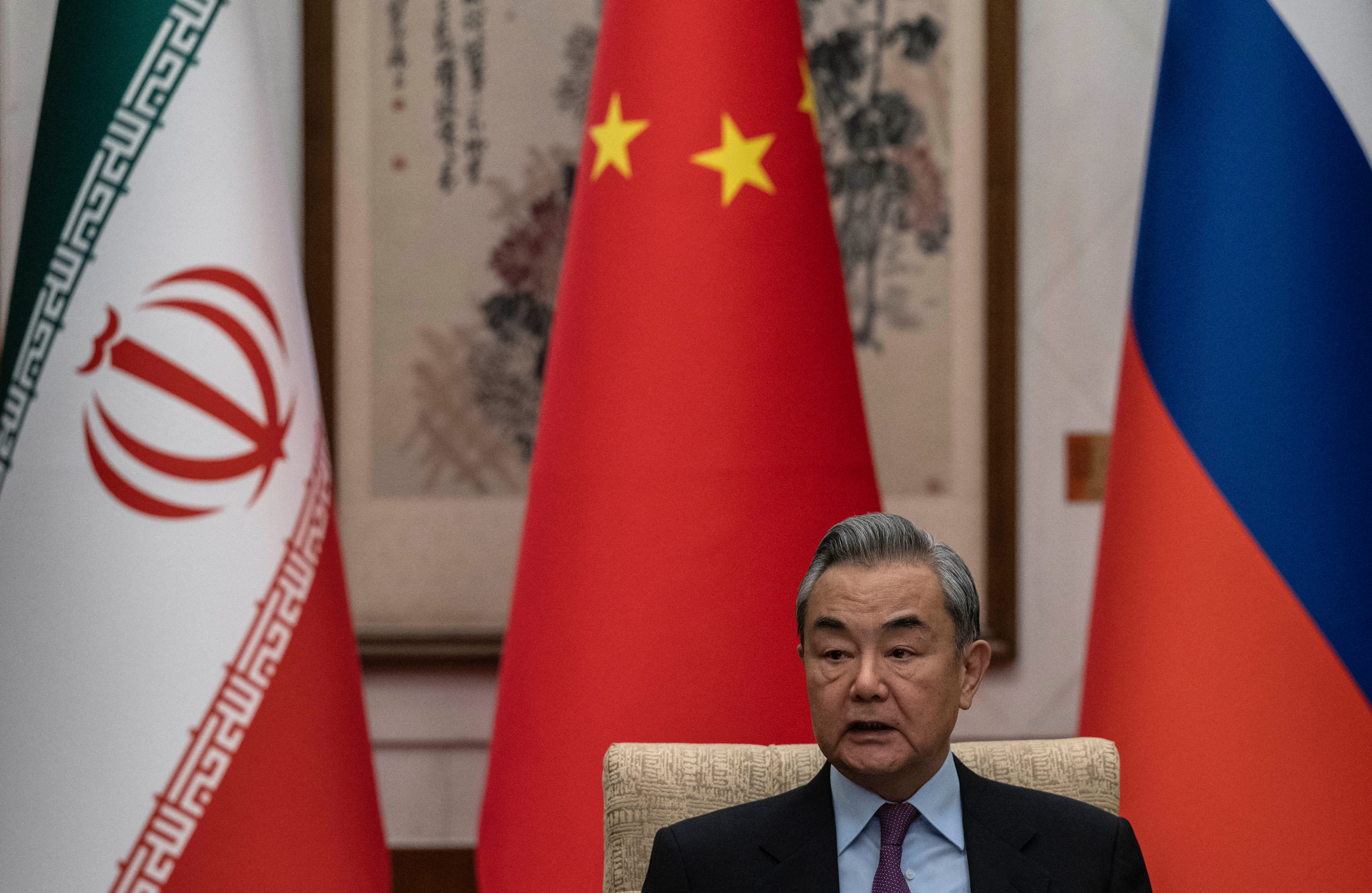
What Happened: Following U.S. and Israeli strikes on Iran, and Iran’s subsequent retaliatory attacks, Beijing has condemned the use of force and supported Tehran in “safeguarding its legitimate rights and interests.” Chinese Foreign Minister Wang Yi has held a flurry of de-escalation calls with regional players and major powers — including the foreign ministers of Russia, Iran, France, Oman, and Israel — urging immediate de-escalation and a return to diplomacy. Notably, according to publicly available readouts, Wang has not yet communicated with his U.S. counterpart since the outbreak of the conflict. Meanwhile, China appears to have avoided visible military involvement by withdrawing its navy from a scheduled joint drill with Iran and Russia ahead of Operation Epic Fury.
Why It Matters: China’s restrained approach reflects its longstanding strategy of avoiding entanglement in other states’ security conflicts. In contrast to U.S. alliances, Beijing’s partnerships with countries such as Iran are flexible and non-binding, intended to promote economic cooperation rather than mutual defense. With a focus on its domestic regime stability and security in its near periphery, China does not view the Middle East as a core interest worthy of military involvement. Beijing is also reluctant to risk escalation with the United States ahead of the Xi–Trump Summit scheduled for April, given the much higher stakes of a U.S.–China strategic stability as compared to Beijing’s lower level of trade and investment with Tehran.
By Jie Gao, Research Associate on Foreign Policy and National Security, Center for China Analysis
Learn More: Watch “Implications of the Escalating U.S.-Iran Conflict,” with Asia Society Trustees Vali Nasr and Hamid Biglari.
2. Beijing’s New Candor on China–U.S. Relations in Li Qiang’s 2026 Government Work Report
What Happened: On March 5, 2026, Premier Li Qiang delivered his annual Government Work Report to the National People’s Congress, declaring that China met its 2025 economic and social development targets and successfully concluded the 14th Five-Year Plan. He acknowledged that progress came amid significant external shocks and domestic pressures. Li highlighted the five rounds of China–U.S. economic and trade consultations, the leaders’ meeting in Busan that produced an important consensus, and continued domestic efforts to stabilize employment, enterprises, markets, and expectations. Looking ahead to 2026, he committed to strengthening coordination between development and security under Xi Jinping’s leadership, continuing to implement the policies outlined in the Fourth Plenum and the 2025 Central Economic Work Conference, while also advancing the goals of the 15th Five-Year Plan.
Why It Matters: As in previous years, the premier again openly acknowledged mounting internal and external challenges while projecting confidence and resolve. What distinguishes this year’s report, however, is its direct reference to “China–U.S. relations” and “U.S. tariffs” in the main text of the report. In the past, the bilateral relationship was typically addressed indirectly — through phrases such as “external challenges” or “global risks” — or discussed later at press conferences or in expert commentary. Li Qiang’s explicit language this year signals Beijing’s more cautious, strategic approach to managing the risks and opportunities posed by the United States to China’s national rejuvenation — especially Xi’s 2035 vision.
By Lobsang Tsering, Senior Research Associate on Chinese Politics, Center for China Analysis
Learn More: Read “What to Watch at China’s Two Sessions in 2026” by CCA Fellow Neil Thomas and Lobsang Tsering.
3. Beijing Signals KPI Reform Beyond GDP in 2026
What Happened: Beijing has signaled that in 2026 it will adjust how local officials are assessed, reducing the singular emphasis on GDP growth. Just ahead of the Two Sessions, it launched a five-month campaign, with party directives urging bureaucrats to prioritize social welfare, consumption, green development, and long-term sustainability, while cracking down on debt-fueled projects, data manipulation, and vanity infrastructure. Zhejiang and several other provinces have hinted at incorporating livelihood indicators into official reviews. Although GDP targets have not been scrapped, the message from Beijing is that promotion will no longer hinge solely on headline growth.
Why It Matters: Cadre incentives have long shaped China’s economic trajectory. When promotions were closely tied to growth rates, local governments competed to expand output, often relying on heavy investment and rising debt. Diversifying KPIs could, in theory, redirect incentives toward consumption and livelihood priorities, aligning with Beijing’s rebalancing goals under the 15th Five-Year Plan. In practice, however, enforcement will be difficult. GDP remains a hard metric, while “people-centered” goals are less measurable. The shift clashes with Beijing’s push to advance manufacturing and technology, which demand resources and deliver faster, more visible results than welfare or consumption.
By Lizzi C. Lee, Fellow on Chinese Economy, Center for China Analysis (@wstv_lizzi)
Learn More: Read Lizzi’s “China’s Total Factor Productivity Is Either Extremely Low or Surging Past the United States” published under CCA initiative “ Reality-Check Check.”
4. Shenzhen Wage-Arrears Fund Highlights Worker Protection Limits
What Happened: In the run up to the Lunar New Year holiday — peak season for wage disputes — a Shenzhen city government decision went viral on Chinese social media: It showed the city had directly paid wages to employees of a firm that had filed for bankruptcy. Shenzhen originally created its wage arrears guarantee fund in 1996, and — alongside Shanghai — remains one of only two cities in the mainland to have such a program. The fund is financed by an annual fee on all local businesses and through attempted recoveries from delinquent employers; but the fee has been largely suspended since 2018, and payouts have far outpaced revenues. The most recent public data shows Shenzhen paid out 73 million RMB in 2024 but recovered only 10 million from delinquent employers — resulting in a 50 million RMB deficit for the year.
Why It Matters: The need for these types of welfare programs is growing in China — especially in the construction sector where wage arrears have been a persistent problem: the sector saw profits drop by 14.1% in 2025, and the eight major state-owned construction conglomerates were carrying 4.25 trillion RMB in receivables at the end of 2024. A recent Xinhua report found that non-payment issues are increasingly common outside the construction sector in many localities. As China’s flexible and migrant workforce continues to expand, more of China’s workers will fall outside the existing social safety nets. The 2026 No. 1 Central Document called for strengthening wage protections for these workers, but Shenzhen’s experience suggests that even wealthy cities may lack the fiscal capacity to deliver on that goal.
By Jeremiah May, Research Assistant, Center for China Analysis
Learn More: Read “China’s Gambit: Assessing Beijing’s Consumer-Driven Economic Strategy,” by CCA Senior Fellow on Chinese Economy, Diana Choyleva.
5. China Tightens Air Quality Standards
What Happened: On February 24, China’s Ministry of Ecology and Environment released the updated Ambient Air Quality Standard. The new standard, replacing the 2012 version, targets fine particulate matter (PM2.5 and PM10) alongside sulfur dioxide and nitrogen dioxide and enforces stricter daily and annual concentration limits. Under the updated secondary standards, the annual average concentration limit for PM2.5 will fall from 35 to 25 μg/m³. Implementation will take two phases: from March 2026-2030, transitional limits will apply with full implementation happening in 2031.
Why It Matters: This is the first time in 14 years that China has updated its Air Quality Standard. The update acknowledges China’s longstanding efforts to address air pollution while underscoring that there is more work to be done. Over the last decade, China has worked to address air quality concerns through targeted policies and efforts to reduce carbon emissions. These tighter restrictions reflect Beijing’s continued commitment, bringing the limits closer to international norms and safeguarding public health by reducing exposure to harmful pollutants that can trigger respiratory conditions such as asthma.
By Taylah Bland, Fellow on Climate and the Environment, Center for China Analysis (@Taylahbland)
Learn More: Read CCA’s new report, “The Evolving Politics of Climate Change in China,” by Neil Thomas, CCA Fellow on Chinese Politics, and Guoguang Wu, CCA Senior Fellow on Chinese Politics.