


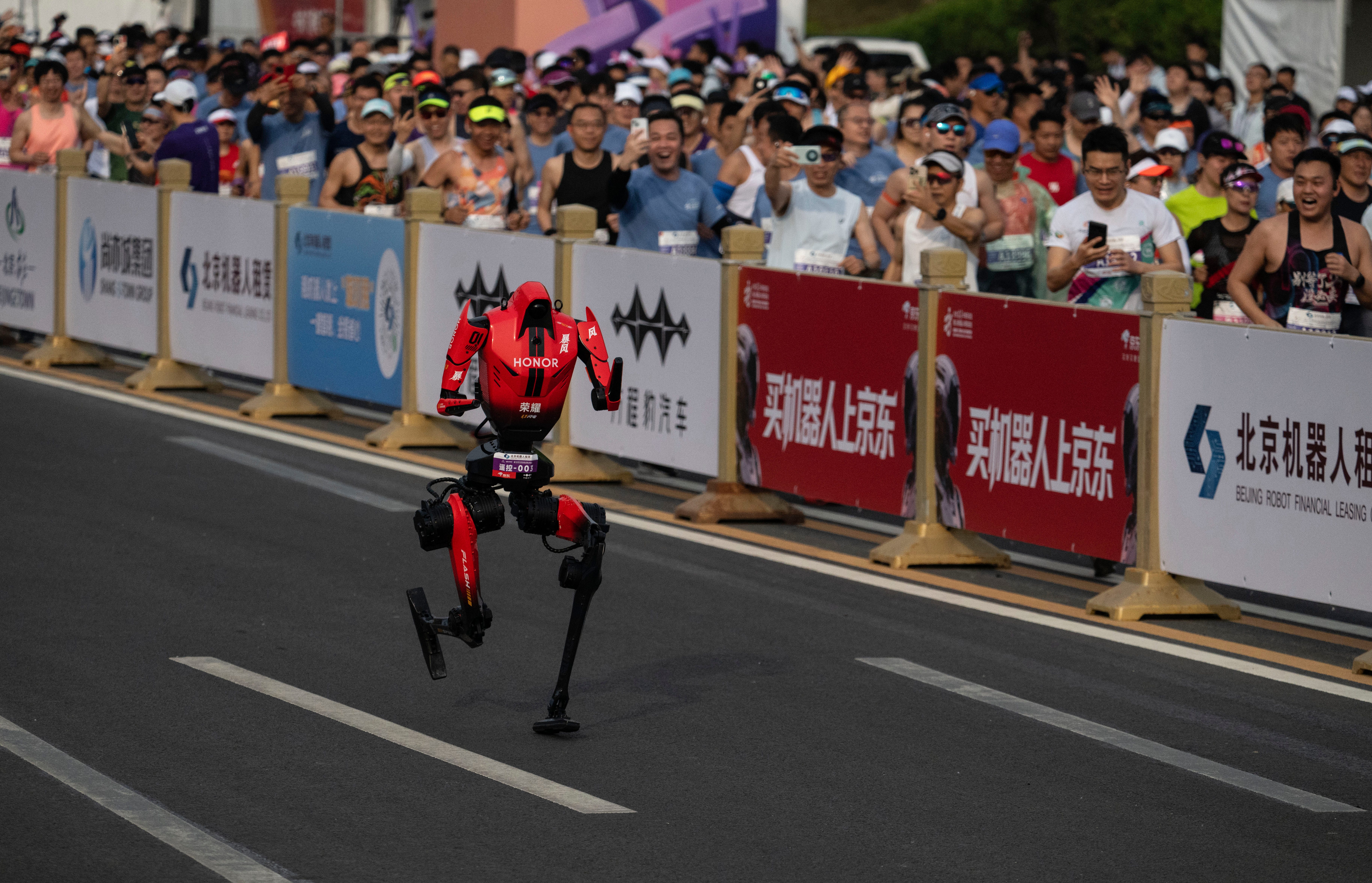
1. China’s Humanoid Robots Break Men’s World Record in Beijing Half-Marathon
What Happened: On April 19, Honor’s humanoid robot “Lightning” won the Beijing E-Town Half Marathon in 50 minutes and 26 seconds, surpassing the men’s world record and outpacing all 12,000 human competitors. The event drew over 300 robots from more than 100 teams.
Why It Matters: The race is as much industrial policy as it is spectacle. Humanoid robot development is a stated priority in China’s 15th Five-Year Plan, and investment in embodied AI reached 73.5 billion yuan in 2025. Chinese firms AGIBOT, Unitree, and UBTech lead global vendors by humanoid shipment volume. But doubts remain: only 40% of robots ran autonomously, and ultimately, humanoid robots may struggle to translate into real-world applications, such as in elder-care settings. Beijing’s playbook of high-visibility demonstrations to accelerate commercialization has worked before with EVs and AI, but whether humanoids follow the same trajectory remains an open question.
By Shengyu Wang, Research Assistant, Center for China Analysis
Learn More: Watch "DeepSeek Moment, One Year Later: The State of U.S.-China AI Competition," moderated by CCA Fellow Lizzi C. Lee with CCA Honorary Senior Fellows Alvin Wang Graylin and Paul Triolo.
2. Central Inspection Teams Target China’s Security and Stability Sectors
What Happened: China’s central discipline inspection teams launched a new round of inspections across 36 central institutions in the security and social stability sectors, including the Central Political and Legal Affairs Commission, the Ministry of Public Security, and the National Public Complaints and Proposals Administration. According to the announcement, the inspections aim to reinforce loyalty to Xi Jinping while ensuring that the central leadership’s major decisions are fully implemented. During this period, dedicated hotlines and mailboxes have been established to receive complaints, particularly those involving disciplinary violations by senior officials.
Why It Matters: The previous round of inspections in regions such as Xinjiang helped drive high-level purges, including Politburo member Ma Xingrui. Reports indicate that more than 60% of major corruption cases stem from public tip-offs submitted during inspection periods. As a result, the coming months could see further investigations or purges targeting senior officials in the political-legal affairs, social stability, and public welfare systems. Amid intensified political scrutiny, the 36 institutions under inspection are likely to exercise greater caution when handling major issues.
By Lobsang Tsering, Senior Research Associate on Chinese Politics, Center for China Analysis
Learn More: Read “What Will Xi Jinping’s Priorities Be in 2026?” by CCA Fellow Neil Thomas and Lobsang in China 2026: What to Watch.
3. China Warns Travelers Off Seattle Airport
What Happened: China warned its citizens to avoid Seattle-Tacoma International Airport after reports that roughly 20 Chinese scholars were denied entry to the United States despite holding valid visas. Chinese officials accused U.S. border authorities of “malicious interrogation,” framing the episode as a consular and treatment issue rather than an isolated immigration case.
Why It Matters: The incident reflects a broader shift in how both governments are managing cross-border academic exchange. The United States has increased scrutiny of Chinese researchers on national security grounds, while China has become more willing to respond publicly through travel advisories and diplomatic signaling. These actions are raising the uncertainty and cost of routine mobility. Over time, unpredictable entry conditions may discourage early-career scholars and weaken one of the few remaining channels of stable U.S.–China engagement. The dynamic also risks becoming self-reinforcing: heightened screening invites reciprocal warnings, which in turn strengthen the case for further restrictions, narrowing the space for scientific collaboration, especially in sensitive or strategic fields.
By Emma Zang (@DrEmmaZang), Fellow on Chinese Society, Center for China Analysis
Learn More: Watch “What is the Cost to Global Science? U.S.-China Relations and the Future of Innovation” featuring Yasheng Huang, CCA Honorary Senior Fellow, Susan Shirk, Director Emeritus of the 21st Century China Center, and others.
4. PLA Warships Transit Near Southwest Japan Following Taiwan Strait Passage
What Happened: China and Japan conducted closely timed naval activities, with each side transiting through sensitive waterways. On April 22, two PLA Navy vessels returned from the western Pacific via the Yonaguni–Iriomote Waterway following what Beijing described as a routine exercise, days after the same formation transited through the Yokoate Waterway in the first publicly recorded PLA transit of that channel. Both passages are strategically significant as they run along Japan’s southwest island chain near military facilities and potential intervention corridors tied to Taiwan and the East China Sea.
Why It Matters: This episode reflects a pattern of reciprocal deterrence signaling through operational activity between China and Japan. The PLA transit followed Japan’s April 17 Taiwan Strait passage — which Beijing criticized — and served as a deterrent signal directed at Tokyo over Taiwan-related activity. Days earlier, Japan fully participated for the first time in the annual U.S.–Philippines Balikatan exercise, highlighting its expanding role in regional contingency planning. This dynamic is likely to lead to a more entrenched rivalry in which Beijing frames Japan’s naval moves through the lens of remilitarization and historical revisionism, complicating near-term diplomatic engagement.
By Jie Gao, Research Associate on Foreign Policy and National Security, Center for China Analysis
Learn More: “A Stress Test for Resilience: Risks & Opportunities for the U.S.-Japan Alliance,” by Emma Chanlett-Avery, Director of Political-Security Affairs and Deputy Director at Asia Society Policy Institute.
5. China’s Clean Tech Exports Surge amid Middle East Energy Crisis
What Happened: China’s exports of solar panels and batteries jumped sharply in March, both month-on-month and year-on-year, offering early evidence that global demand for Chinese clean-tech products is being buoyed by volatility stemming from the conflict in Iran and the broader Middle East crisis. According to data released by China’s General Administration of Customs on April 18, exports of lithium-ion batteries, electric vehicles, and solar cells grew by 34%, 53%, and 80%, respectively, on an annual basis.
Why it matters: This surge builds on a wave of overseas sales already driven by China’s cost competitiveness, rising global energy demand, and accelerating fuel switching. The war in Iran is likely to intensify that trend. With its domestic economy relatively insulated from oil and gas price shocks and its clean-tech industries primed for export, China is emerging as one of the long-term energy winners of this crisis.
By Li Shuo, Director of China Climate Hub, and Senior Fellow, Center for China Analysis
Learn More: Read “The Evolving Politics of Climate Change in China” by CCA Fellow Neil Thomas and Senior Fellow Guoguang Wu.