


1. China Signals Trade De-Escalation and Economic Reassurance at Davos
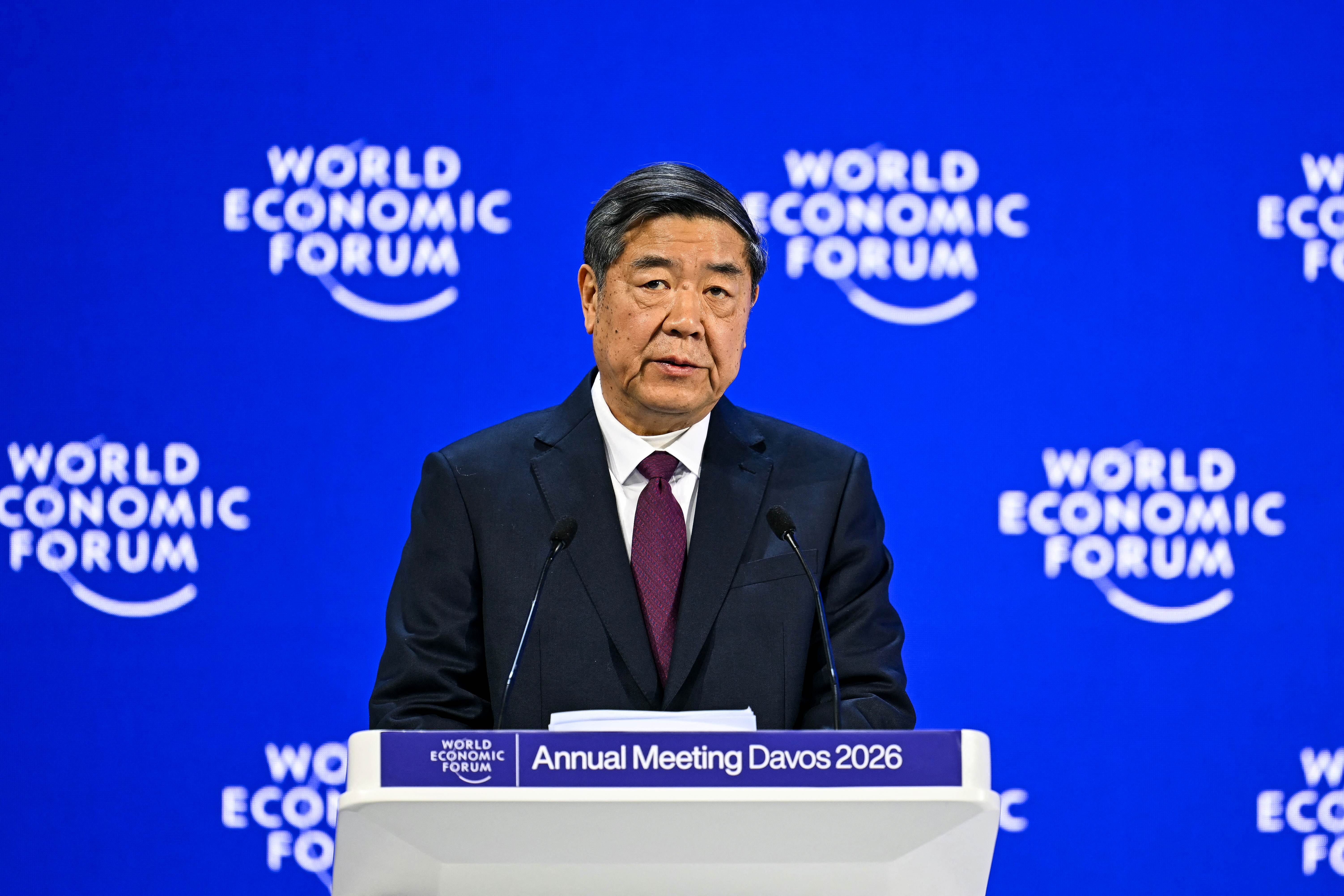
What Happened: Chinese Vice Premier He Lifeng attended the 2026 annual meeting of the World Economic Forum in Davos, where he delivered a keynote speech and held bilateral meetings on the sidelines. His trip included exchanges with Swiss leaders, meetings with business leaders, as well as talks with U.S. Treasury Secretary Scott Bessent under existing economic dialogue mechanisms.
Why It Matters: Following his meeting with He Lifeng, Bessent confirmed that Chinese purchases of U.S. soybeans and rare-earth magnet shipments are proceeding largely as agreed, signaling that the U.S.-China trade de-escalation is holding. In his Davos speech, the Vice Premier pledged to boost China’s domestic consumption, improve its business environment, and “safeguard global supply chain stability” amid Western efforts to reconfigure industrial networks. He’s focus on domestic demand and supply-chain stability aims to rebut Western claims of Chinese overcapacity and systemic risk. In doing so, he frames Beijing as a vital anchor for global growth during a period of sluggish demand, heightened geopolitical uncertainty, and trade volatility. He also reinforced China’s objection to the “over-securitization” of economic issues.
By Jie Gao, Research Associate on Foreign Policy and National Security, Center for China Analysis
Learn More: Read “Can the United States and China Find a New Equilibrium on Trade and Technology?” by Brendan Kelly and Michael Hirson in CCA’sChina2026: What to Watch.
2. London Greenlights China’s New “Super Embassy” Despite Political Backlash
What Happened: The UK government gave the go ahead for China to build a new “super embassy” — a sprawling, 20,000 square meter site hosting over 200 staff in central London — despite intense criticism from lawmakers from all sides, including those in the ruling Labour Party. The embassy has long been controversial since Beijing purchased the site in 2018, and opponents worry the site, which sits on top of fiber-optic cables carrying sensitive financial and personal data, can be used as a base for Chinese espionage activities. Despite domestic pushback, the embassy’s approval would ease strained bilateral ties, in part due to the yearslong delays over the embassy’s opening. The opening is also expected to pave a clear path for Prime Minister Keir Starmer to visit Beijing, making Starmer the first Prime Minister to visit Beijing since 2018. Some suggest that Starmer hopes to revive the “golden era” of Sino-British relations, a high point of bilateral relations during the mid-2010s.
Why It Matters: Strained relations with the United States has given the UK a reason to rebalance towards China. Trump’s aggressive rhetoric around Greenland, however, elicited a tepid response from Starmer — notably weaker compared to other European leaders. The UK’s deep reliance on the United States over economic and security matters constrains its ability to pushback against American pressure, and the embassy move is an attempt to try to rebalance toward China, in a similar fashion to recent moves by Canada. However, since leaving the EU, the UK has less economic incentives to offer China in return.
By Barclay Bram, Fellow on Chinese Society, Center for China Analysis
Learn More: Explore China’s global image on CCA’s Global Public Opinion on China, an interactive website that aggregates worldwide polling on public opinion toward China.
3. China’s Demographic Crisis Deepens as Births Hit Modern-Era Low
What Happened: On Monday, the National Bureau of Statistics revealed that China’s population contracted by 3.39 million in 2025, marking the fourth consecutive year of decline and a significant acceleration from the previous year. Births plummeted to 7.92 million — a modern-era low — dropping sharply from 9.54 million in 2024, as the temporary boost from the “Year of the Dragon” faded. The data indicates a total fertility rate estimated at just 0.96, far below the replacement level of 2.1. Simultaneously, the aging crisis is intensifying, with the population aged 60 and above reaching 23% of the total, firmly categorizing China as a “moderately aged” society on a fast track to becoming “heavily aged.”
Why It Matters: The accelerating decline suggests China is approaching a “low-fertility trap” where standard policy interventions prove ineffective. This rapid contraction seriously threatens Beijing’s economic strategy, as a shrinking workforce and weakening consumer demand undermines China’s strategy of increasingly relying on domestic consumption. The data confirms the long-held fear that China is “getting old before it gets rich,” with the dependency ratio worsening faster than the social safety net can adapt. For policymakers, the failure of current incentives implies that incremental adjustments are no longer sufficient; the situation may force Beijing to consider more drastic fiscal measures — such as issuing long-term bonds to fund massive fertility subsidies or other structural shifts, as the deepening labor shortage will severely constrain China’s long-term economic potential and global competitiveness.
By Jennifer Choo, Director of Research and Strategy, Center for China Analysis
Learn More: Read “Can Beijing Preserve Growth and Stability amid Rapid Demographic Change?” by Emma Zang, Fellow on Chinese Society, in CCA’s flagship report China 2026: What to Watch.