


1. Beijing Defines “Constructive Strategic Stability” After Trump-Xi Summit
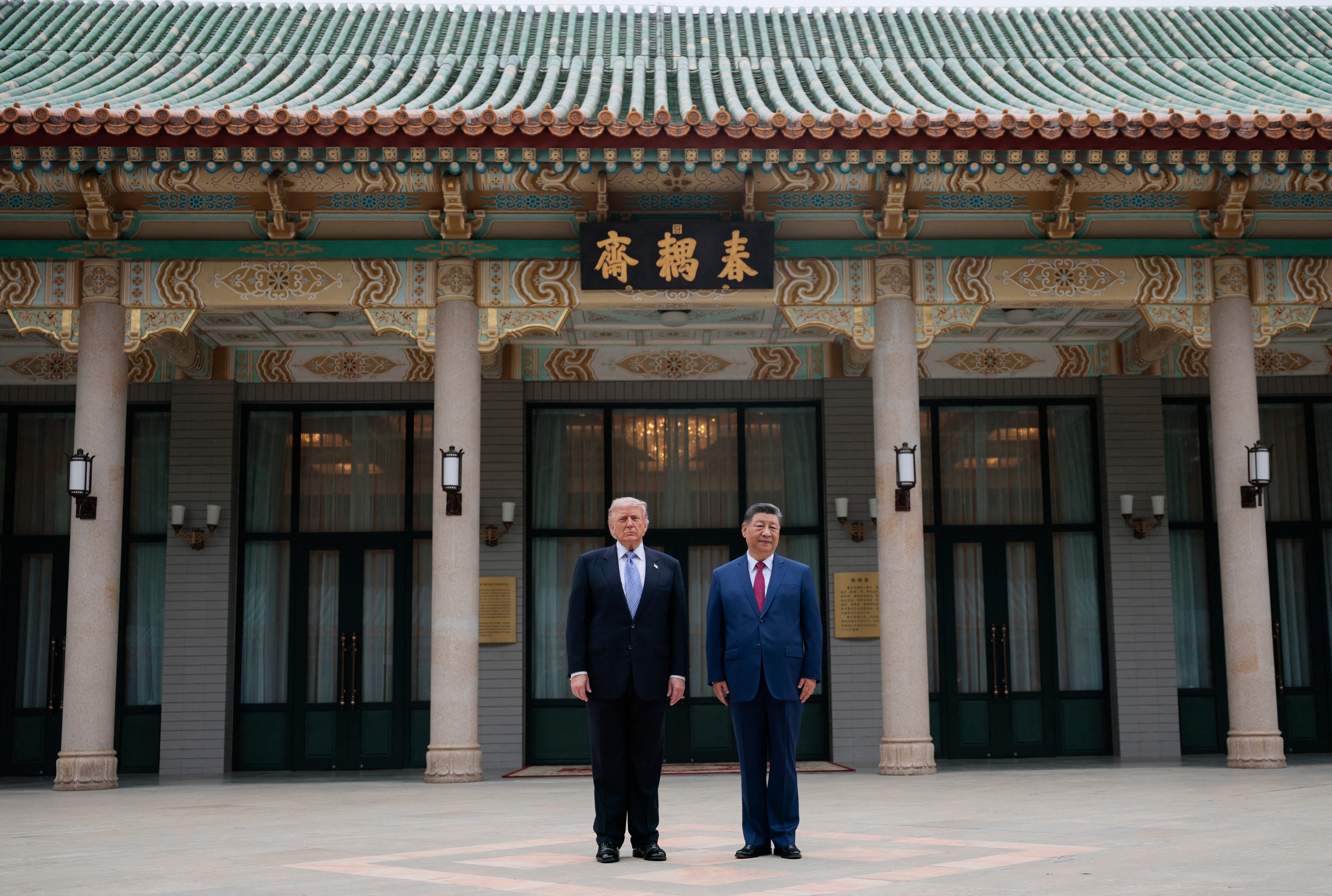
What Happened: The most important new framing to emerge from the Trump-Xi summit was the idea of “a constructive China-U.S. relationship of strategic stability.” Beijing has elevated this as the summit’s defining outcome, with similar language echoed by the White House. Chinese officials and state media are presenting it as guidance for the next three years and beyond, even elevating it as a major Xi-era innovation in great-power relations. The concept moves beyond Cold War-style strategic stability rooted in rivalry and mutually assured destruction. Instead, Beijing’s official interpretation stresses expanding shared interests, avoiding zero-sum competition, preventing sharp swings in ties, and steering clear of conflict, confrontation, or war.
Why It Matters: Beijing’s motivation behind “constructive strategic stability” reflects both confidence and anxiety. On one hand, China wants this framework to reduce external volatility amid China’s domestic economic weaknesses, elevate Xi as the central architect of leader-level diplomacy, and position China as a historic power shaping a new paradigm with the United States. On the other hand, the push also reflects mounting pressure stemming from China’s economic slowdown, geopolitical headwinds, uncertainty surrounding the Iran crisis and resulting global turmoil, and fears that unmanaged competition with Washington could harden into confrontation, or worse. The appeal of this concept is that it allows China to seek guardrails while positioning itself as an equal to the United States, while preserving room for cooperation in critical areas such as public health and AI safety, even as strategic competitive fundamentals intensify.
By Lizzi C. Lee, Fellow on Chinese Economy, Center for China Analysis (@wstv_lizzi)
Learn More: Explore “The Avoidable War: An Alternative Future for U.S.-China Relations,” an ASPI initiative on alternative futures for U.S.-China relations, and read “U.S.-China 21: The Future of U.S.-China Relations Under Xi Jinping,” Kevin Rudd’s framework for managing strategic divergence and cooperation within a stable long-term relationship.
2. April Data Shows China’s Uneven Recovery
What Happened: April data revealed the fragility of China’s domestic recovery. Retail sales slowed to just 0.2 percent year-on-year, fixed-asset investment fell back into contraction, private investment weakened, and the property slump showed few signs of easing. Exports remained a key cushion, but their strength was increasingly concentrated in tech and high-end manufacturing—sectors that boost output and headline growth but do not generate enough broad-based employment or income support to revive household confidence.
Why It Matters: The Trump-Xi summit may have temporarily eased tensions, as reflected in MOFCOM’s readout on bilateral trade, but China’s deeper challenge lies at home. Households are borrowing less, spending cautiously, and deleveraging amid a weak labor market and prolonged property downturn. Private firms, especially smaller firms in traditional sectors, are being squeezed from both sides: weak domestic demand limits pricing power, while higher energy prices linked to the conflict in Iran are raising input and supply chain costs. China’s tech engine is buoying sentiment, but it is not pulling the wider economy or the labor market along with it.
By Shengyu Wang, Research Assistant, and Lizzi C. Lee, Fellow on Chinese Economy, Center for China Analysis (@wstv_lizzi)
Learn More: Read “China’s Property Rebalancing: The Long Road to a New Development Model,” by CCA Fellow Lizzi C. Lee and David Zhang, Analyst at Trivium.
3. Xi Hosts Putin Five Days after Trump in a Bid for Reassurance
What Happened: Five days after President Xi held a high-stakes summit with President Trump, Beijing welcomed President Putin with comparable grandeur. Commemorating the 30th anniversary of the “China-Russia strategic partnership of coordination,” Xi praised their strategic cooperation as reaching a “historic high,” while Putin hailed the two as a stabilizing force in the world. The leaders signed around 40 agreements focused on the economy, trade, education, science, and technology.
Why It Matters: Putin’s 25th visit to China, coming on the heels of Xi’s historic meeting with Trump, is meant to reassure Moscow of its continued importance to Beijing while projecting a united front amid lingering tensions with the United States after the Trump-Xi summit. In an indirect jab at Washington, the two leaders warned of the unprecedented damage caused by unilateralism and hegemony. They criticized the war in Iran as a violation of international law, called the United States “irresponsible” for allowing the New START nuclear treaty to expire, and condemned Trump’s proposed Golden Dome missile defense system as a threat to global stability. At the same time, the visit revealed limits in the bilateral relationship. The two sides failed to reach a breakthrough on the Power of Siberia 2 pipeline, which would have doubled Russia’s natural gas exports to China, underscoring Beijing’s reluctance to deepen long-term dependence on Russian gas despite mounting concerns over energy security. The Chinese foreign ministry also refuted reports that Xi had told Trump that Putin might regret his 2022 invasion of Ukraine, raising questions about the extent of China’s support for Russia in the war.
By Kristina Lozinskaya, Schwarzman Fellow and Junior Fellow on China-Russia Relations, Center for China Analysis
Learn More: Watch “China’s Role in and Perception of a Post-Ukraine Conflict Scenario,” with CCA Non-Resident Senior Fellow Ambassador Pierre Andrieu and CCA Senior Fellow Lyle Morris.
4. Record EV Exports Sustain China’s Cleantech Momentum
What Happened: Analysis of monthly data from China’s General Administration of Customs indicates that China’s cleantech exports in April 2026 remained close to record highs, despite changes to tax rebate policies that were expected to reduce solar and battery exports. Although solar and battery exports declined, they remained considerably above pre-Strait of Hormuz crisis levels. At the same time, a surge in electric vehicle (EV) exports drove monthly export volumes to a record USD 9.4 billion, more than offsetting the decline in solar and battery exports.
Why It Matters: Against the backdrop of ongoing geopolitical tensions and instability in global energy markets, the April data provides the clearest evidence yet that disruption to the Strait of Hormuz is accelerating demand for Chinese clean technology products. This is especially visible in the EV sector, where electrification offers an alternative to dependence on traditional internal combustion engines. Continued strength in overall cleantech exports also suggests that demand has remained resilient despite policy adjustments aimed at reducing solar and battery export volumes.
By Taylah Bland, Fellow on Climate and the Environment, Center for China Analysis (@Taylahbland)
Learn More: Read “The Evolving Politics of Climate Change in China“ by CCA Senior Fellow Guoguang Wu and CCA Fellow Neil Thomas.
5. Xi Calls for Accelerating China’s Independent Discourse and Knowledge System
What Happened: On May 17, Xi Jinping issued instructions on promoting the development of China’s philosophy and social sciences at a symposium. He called for deeper systematic and academic study and interpretation of the Chinese Communist Party’s innovative theories, while accelerating the construction of an independent Chinese knowledge system in philosophy and social sciences. Separately, more than 200 representatives from China’s social science community gathered in Beijing for a two-day symposium to study and implement Xi Jinping Thought on Culture.
Why It Matters: In order to promote its own discourse system and value standards, the CCP has historically sought to create new governing concepts, propositions, and theoretical frameworks, such as the concept of “One Country, Two Systems.” Since Xi came to power, Beijing has accelerated these efforts. In politics, Xi introduced the concept of “whole-process people’s democracy” while in economics, he promoted the idea of “new quality productive forces.” More recently, during his meeting with Trump, Xi proposed a “constructive relationship of strategic stability” between China and the United States, extending the same impulse to shape how China’s role is described in the international arena. Through these formulations, Beijing seeks not only to shape international narratives, but also define the terms on which China is understood.
By Lobsang Tsering, Senior Research Associate on Chinese Politics, Center for China Analysis
Learn More: Read “Guided Autonomy: America Watching in Xi’s China” by CCA Senior Fellow Guoguang Wu.