


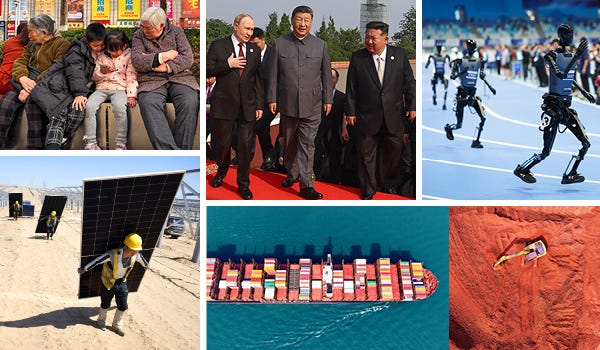
Five Strategic Questions for China in 2026
The year 2026 poses a hinge point for China. It marks the launch of its 15th Five-Year Plan, the policy blueprint that will guide economic and political priorities through the end of the decade, and the runway to the 21st Party Congress in 2027, when Xi Jinping will seek to further entrench his leadership and legacy. China boasts global leadership in advanced technologies, including in green tech, EVs, power batteries, and robotics, as well as in multiple AI subfields. At the same time, China enters the year facing slower growth, fragile confidence, mounting fiscal strains, and a tense but temporarily stabilized relationship with the United States. The world is also entering an era of turbulence that few could have anticipated a year ago.
These pressures are forcing hard choices upon Beijing. Can China sustain tight political control while restoring economic vitality? Can it rebalance toward consumption without undermining its state-led model? Can competition with the United States be managed without tipping into destabilizing escalation? And can Beijing advance its long-term goals — on innovation, security, and Taiwan — without compounding the risks it already faces?
This special New Year’s edition of China 5 draws on the Center for China Analysis’s flagship report, China 2026: What to Watch, and identifies five strategic questions that will shape China’s trajectory in the year ahead. Rather than predict outcomes, these essays focus on the constraints, contradictions, and signals that will determine what is possible — and what is not — in 2026. Together, they offer a framework for understanding where China is headed, what could alter its course, and why the answers matter well beyond China’s borders.
1. What Will Xi Jinping’s Priorities Be in 2026?
Bottom Line: Xi Jinping will prioritize Party control, national security, and technological self-reliance in 2026 — while tolerating limited pragmatism when growth or stability is threatened.
What’s Driving This: 2026 launches the 15th Five-Year Plan and serves as a lead-up to the 21st Party Congress in 2027, when Xi will seek to further consolidate his leadership and legacy. Slowing growth, a fragile property sector, local government debt, and U.S.-China competition have narrowed Xi’s room for maneuver. His response has been continued centralization, an expansive national security regime, strategic guidance of China’s private economy, and channeling of state resources into strategic industries. Yet these same tools have dampened bureaucratic initiative, private-sector confidence, and household sentiment — deepening the tension between control and dynamism.
What to Watch in 2026: The 15th Five-Year Plan’s resource allocation will provide critical clues. Continued emphasis on advanced manufacturing and self-reliance, paired with modest support for households, would confirm that control remains paramount. Personnel moves favoring political reliability over technocratic competence would reinforce this trajectory. Selective easing — targeted stimulus or quiet regulatory restraint — would signal tactical flexibility, but not substantial reforms.
Why It Matters Beyond China: Xi’s priorities will shape not only China’s growth trajectory but also its external behavior. A leadership focused on security and control is less likely to pursue bold economic reforms or compromise in trade and technology disputes. For foreign governments, investors, and companies, 2026 will clarify whether China is settling into a model of managed stagnation with pockets of strength — or whether Xi is prepared to accept limited adjustment to maintain social stability and sustain the system he has built.
Learn more: Read the full essay, “What Will Xi Jinping’s Priorities Be in 2026?” by Neil Thomas and Lobsang Tsering in China 2026: What to Watch.
2. Can Beijing Truly Pivot Toward a Consumption-Led Economy?
Bottom Line: Beijing now treats consumption-led growth as strategically necessary for long-term economic resilience and national security — but remains unlikely to accept the tradeoffs required to deliver it.
What’s Driving This: China’s growth model has reached diminishing returns, while debt, overcapacity, and trade tensions have intensified external pressure. By 2025, Beijing elevated consumption from an economic aspiration to a pillar of national security and social stability. Yet genuine rebalancing would require 2-3 percent annual GDP growth, redistribution away from local governments and state firms, an end to household financial repression, and greater autonomy for households — steps that conflict with Xi’s control-first governance model.
What to Watch in 2026: The 15th Five-Year Plan will reveal whether consumption is institutionalized through durable reforms — higher transfers, stronger welfare, financial market reforms, and reduced reliance on investment targets — or handled through incremental subsidies and rhetorical support. The key test will come when growth falls below politically acceptable levels: whether Beijing stays the course or reverts to investment-led stimulus.
Why It Matters Beyond China: China’s growth model shapes global demand and trade tensions. Failure to rebalance will entrench overcapacity and volatility; success would support more sustainable global growth and ease frictions.
Learn More: Read “Can Beijing Truly Pivot Toward a Consumption-Led Economy?” by Diana Choyleva in China 2026: What to Watch.
3. Can the United States and China Find a New Equilibrium on Trade and Technology?
Bottom Line: A fragile U.S.-China truce is likely to hold in 2026 — but it rests on mutual vulnerability, not trust, and remains inherently unstable.
What’s Driving This: By late 2025, Washington and Beijing had settled into an uneasy equilibrium shaped by their capacity to harm one another economically. Escalating tariffs, export controls, and China’s use of rare earths as leverage demonstrated the risks of uncontrolled decoupling. The result was a temporary stabilization: not rapprochement, but recognition that escalation carries real costs on both sides.
Yet this equilibrium is inherently unstable. Both governments are racing to reduce dependence on the other’s chokepoints — semiconductors for China, critical minerals and manufacturing inputs for the United States. Each step toward de-risking erodes the very interdependence that underpins restraint.
What to Watch in 2026: Leader-level engagement and senior communication channels will help manage flare-ups, particularly as domestic politics in the United States and in China constrain escalation. More consequential will be whether either side closes key vulnerabilities faster than expected — through semiconductor breakthroughs or supply-chain diversification — which would weaken incentives for stability.
Why It Matters Beyond China: A managed truce reduces near-term risk but perpetuates uncertainty for allies, investors, and multinational firms caught between competing systems. For third countries, 2026 will reinforce the reality that strategic hedging — not alignment with a stable order — is becoming the default.
Learn More: Read “Can the United States and China Find a New Equilibrium on Trade and Technology?” by Brendan Kelly and Michael Hirson in China 2026: What to Watch.
4. Can China Reconcile Private-Sector Vitality with State-Led Innovation?
Bottom Line: Beijing will continue courting entrepreneurs rhetorically in 2026 — but systemic uncertainty will prevent a full revival of private-sector dynamism.
What’s Driving This: China’s leadership increasingly recognizes that private firms are indispensable to innovation, particularly as U.S.-China competition shifts toward advanced technologies. Symbolic gestures — the rehabilitation of prominent entrepreneurs, new legal frameworks, and official praise for the private economy — signal a desire to restore confidence after years of regulatory crackdowns.
Yet the underlying dilemma remains unresolved. The Party wants innovation without independence, entrepreneurial creativity without autonomy, and global competitiveness without exposure. Entrepreneurs are encouraged to take risks — but only within politically defined boundaries that remain opaque and unevenly enforced. This model is well suited to scaling known technologies but far less effective at generating breakthrough innovation.
What to Watch in 2026: The credibility of Beijing’s recalibration will hinge on execution, not signaling. Consistent enforcement of new private-sector protections, restraint in security-related investigations, and reliable dispute resolution would suggest real progress. Conversely, continued discretionary enforcement — often driven by fiscally stressed local governments — would reinforce caution and capital flight.
Why It Matters Beyond China: China’s innovation trajectory affects global competition in everything from artificial intelligence to clean energy. Partial revival will produce impressive advances in select areas, but persistent uncertainty limits China’s ability to sustain broad-based growth. For global partners, this hybrid model complicates engagement — offering opportunity but without predictability.
Learn More: Read “Can China Reconcile Private-Sector Vitality with State-Led Innovation?” by Lizzi C. Lee in China 2026: What to Watch.
5. Will Beijing Recalibrate Its Approach to Taiwan?
Bottom Line: In 2026, Beijing is likely to intensify pressure on Taiwan without crossing the threshold into war — incrementally reshaping the status quo rather than overturning it.
What’s Driving This: With new leaders in Washington and Taipei and Xi Jinping entering a politically sensitive phase ahead of the 2027 Party Congress, cross-Strait dynamics are becoming more brittle. Beijing remains committed to “peaceful reunification,” but patience with nonmilitary approaches is thinning as Taiwan’s political trajectory diverges further from Beijing’s narrative of inevitability. Rather than choosing between peace and force, China is refining a third path: sustained gray-zone pressure that blurs the line between peacetime coercion and military conflict. Expanded military exercises and civilian-military measures are designed to normalize Chinese presence around Taiwan and gradually erode deterrence without triggering outright war.
What to Watch in 2026: The baseline remains continuity with caveats. Watch for cumulative shifts — expanded PLA exercises, law enforcement actions, and pressure on Taiwan’s international space — rather than singular dramatic moves.
Why It Matters Beyond China: Taiwan remains the most dangerous flashpoint in U.S.-China relations. Even without conflict, sustained coercion raises risks of miscalculation and forces regional actors to adapt militarily and diplomatically. For global markets and supply chains, the absence of war does not mean the absence of instability.
Learn More: Read “Will Beijing Recalibrate Its Approach to Taiwan?” by Lyle Morris in China 2026: What to Watch.