


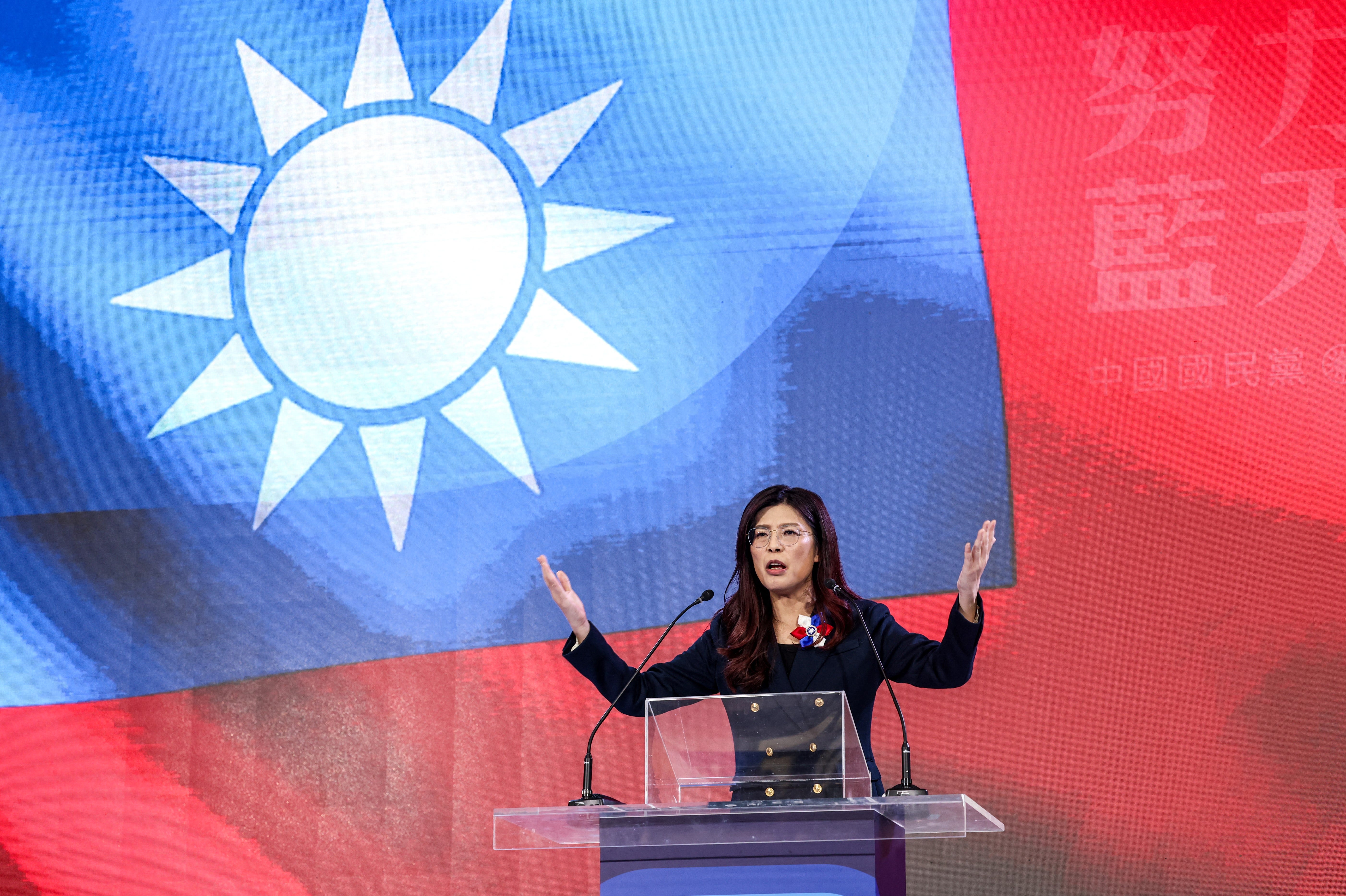
1. Taiwan’s KMT Chair Cheng Li-wun to Beijing
What Happened: On March 30, Beijing announced that Xi Jinping had extended an invitation to Kuomintang (KMT) Chair Cheng Li-wun to visit the mainland. Cheng accepted and will lead a KMT delegation to Jiangsu, Shanghai, and Beijing from April 7–12, which is the first visit by a sitting KMT chair to the mainland since 2016. However, whether a direct meeting between Cheng and Xi will take place has not been confirmed.
Why It Matters: The timing is significant on multiple fronts. Domestically, a meeting with Xi could reinforce Cheng’s leadership within the KMT and validate her strong pro-China stance. Cheng currently is facing internal pressure, notably from Taichung Mayor Lu Shiow-yen, whose recent visit to Washington and initial support for a defense budget exceeding the KMT caucus position — later moderated — are seen as a challenge to Cheng’s approach ahead of the 2028 presidential cycle. Internationally, Cheng’s visit gives Beijing the opportunity to show Washington that cross-strait dialogue can be managed bilaterally by Taiwan and the mainland, strengthening Xi’s hand in the run-up to the Trump-Xi summit in mid-May.
By Sheng-Wen Cheng, Research Intern, Center for China Analysis, and Lyle Morris, Senior Fellow on Foreign Policy and National Security (@LyleJMorris).
Learn More: Read “PLA Watch,” a monthly newsletter centered on delivering insights into China’s military affairs on the Center for China Analysis’s Substack.
2. Three Chinese Ships Transit the Strait of Hormuz
What Happened: On March 31, Mao Ning, spokesperson for China’s Ministry of Foreign Affairs, confirmed that three Chinese ships had recently transited through the Strait of Hormuz. Mao underscored that “the Strait of Hormuz and waters nearby are an important route for international goods and energy trade” while restating that “China calls for an immediate end to hostilities to restore peace and stability in the Gulf.” In response to the ongoing instability, China is reportedly considering extending its fuel export ban into April.
Why It Matters: The Strait of Hormuz remains a volatile bottleneck for global energy flows. While China has a diversified energy mix, network of importers, and stockpile of oil and gas, that doesn’t insulate it from potential disruptions. Roughly 45-50% of China’s crude oil imports transit the Strait of Hormuz, which represents around 6.6% of China’s overall energy consumption. China maintains its stance that the conflict should be de-escalated through diplomacy and appears to have a dual priority: safeguarding domestic energy security while preserving critical trade routes.
By Taylah Bland, Fellow on Climate and the Environment, Center for China Analysis (@Taylahbland)
Learn More: Listen to “Jeffrey Feltman on the Israel-Hezbollah Conflict” with non-resident Distinguished Fellow Jeffrey Feltman and Asia Society Policy Institute’s former Managing Director Rorry Daniels on Asia Inside Out, a podcast by ASPI.
3. Boao Forum at 25 Reaffirms China’s Regional Message of Openness and Stability
What Happened: The Boao Forum for Asia held its 2026 annual conference in Hainan from March 24–27, marking its 25th anniversary under the theme, “Shaping a Shared Future: New Dynamics, New Opportunities, New Cooperation.” Coming at the start of China’s 15th Five-Year Plan, the forum offered an early read on Beijing’s economic direction: green growth, digital upgrading, and sustained regional integration amid complex protectionist headwinds. The broader message was that Asia must remain a driver of growth and cooperation under conditions of rising uncertainty. Hainan’s Free Trade Port featured prominently as the practical expression of that agenda, positioned as a gateway for high-standard opening and stronger regional links.
Why It Matters: Boao was a timely exercise in reassurance. Under a confluence of tariff, supply-chain, and geopolitical pressure, Beijing used the forum to reaffirm that China still sees its future, at least in Asia, in openness, integration, and growth, with Hainan serving as a working model of high-standard opening. In that sense, Hainan will function as proof of concept: a demonstration of how China intends to deepen trade, services, and connectivity across the region, especially with its southern neighbors. The prominence of sustainability and “new productive forces” further suggested that Beijing wants the next phase of regional integration to center on resilience, green growth and clean energy, and economic upgrading. That reading was reinforced by regional voices at the forum, including Singapore Prime Minister Lawrence Wong’s emphasis on China’s role in Asia’s stability and prosperity.
By Kevin Zongzhe Li, former Affiliated Researcher, Center for China Analysis
Learn More: Read “Another Continent, Another Planet: The Curious Case of the Missing China Conversation at Davos” by CCA Fellow Neil Thomas.
4. China Launches World’s First International Data Governance Body
What Happened: China launched the World Data Organization (WDO) in Beijing on March 30, positioning it as the first global NGO focused on data governance. With more than 200 members across more than 40 countries, the WDO aims to harmonize cross-border data rules, cut compliance costs, and help Global South countries build data capacity.
Why It Matters: Beyond signaling China’s ambitions in global data governance, the WDO is a bid to ease investor concerns over “over-securitization.” As data becomes the backbone of AI development, Beijing is seeking a greater role in shaping global standards, and the WDO is an important step in that direction. However, despite recent institutional milestones like the establishment of the National Data Administration, China’s domestic data ecosystem remains fragmented. Recurring, large-scale data leaks expose severe gaps in privacy protection and cybersecurity, revealing a reality in which the overarching legal and regulatory framework has yet to catch up with Beijing’s data ambitions.
By Shengyu Wang, Research Assistant, and Lizzi C. Lee, Fellow on Chinese Economy, Center for China Analysis (@wstv_lizzi)
Learn More: Read “Assetizing, Trading, Franchising: China’s Strategy for Building a National Data Economy,” by CCA Affiliated Researcher Ran Guo.
5. Beijing Tightens Grip on Local Party Committees Ahead of Key Political Milestones
What Happened: Xi Jinping recently chaired the CCP Politburo’s March meeting, which reviewed the Regulations on the Work of Local Party Committees. The meeting emphasized that local Party committees must safeguard the authority of Xi and the central leadership and strictly implement their decisions. First introduced on a trial basis in 1996 and formalized in 2016, the regulations are now under renewed review — signaling a fresh push to reinforce central control over local governance in support of Xi’s national development agenda, most recently set forth in the 15th Five-Year Plan.
Why It Matters: The CCP now counts over 100 million members, with 5.25 million grassroots organizations and 3,199 local Party committees, making it the second-largest political party in history after India’s Bharatiya Janata Party. Xi has long warned of weak central oversight and remains wary of local autonomy and policy drift. Despite decades of institutional tightening, enforcement has been uneven. As the 21st Party Congress in 2027 approaches, strengthening local governance is likely to be a central priority at the upcoming Fifth Plenum. More robust oversight will be critical not only for implementing the 109 major projects outlined in the 15th Five-Year Plan, but also for enabling foreign firms to expand beyond China’s top-tier cities — both of which are key to shaping Xi’s economic legacy as he nears the end of his unprecedented third term.
By Lobsang Tsering, Senior Research Associate on Chinese Politics, Center for China Analysis
Learn More: Read Xi Gets His Way at Last, by CCA Senior Fellow Christopher K. Johnson.