


1. At Shangri-La, China Saves Its Fire for Japan
What Happened: From May 29 to 31, world leaders and defense officials from about 45 countries gathered in Singapore for the Shangri-La Dialogue, Asia’s premier security summit. The forum has historically given Beijing a platform to articulate its regional security positions, but this year’s dialogue was shaped less by direct U.S.-China confrontation than by broader concerns over strategic mistrust, rising defense spending, military modernization, and lessons from Ukraine.
Why it Matters: For the second year in a row, Chinese Defense Minister Dong Jun skipped the forum, signaling Beijing’s reduced interest in a venue where it is often scrutinized over its regional behavior. While China’s delegation criticized “certain countries” for “hegemonism” and “bloc confrontation,” the overall U.S.-China exchange was tame. U.S. Defense Secretary Pete Hegseth said bilateral ties were “better than they’ve been in many years” and avoided direct mention of Taiwan in his prepared remarks. The sharper exchange came instead between Beijing and Tokyo: China accused Japan of reviving militarism and questioned whether it could “win the trust of the international community,” while Japan criticized China’s military expansion and warned against changing the status quo by force. The contrast suggests that, even as Beijing manages optics with Washington after the recent Trump-Xi summit, it remains willing to pressure U.S. allies — especially Japan — over regional security issues.
By Kristina Lozinskaya, Schwarzman Fellow and Junior Fellow on China-Russia Relations at the Center for China Analysis
Learn More: Read “PLA Watch,” a monthly newsletter centered on delivering insights into China’s military affairs on the Center for China Analysis Substack.
View this email in your browser.


The latest on what’s happening in China from Asia Society Policy Institute’s Center for China Analysis.
THIS WEEK:
China targets Japan at Shangri-La, Beijing tightens overseas investment rules, Xi touts youth exchanges, policymakers advance urban renewal, and Xi spotlights future industries.
Read back issues in the China 5 Archive.
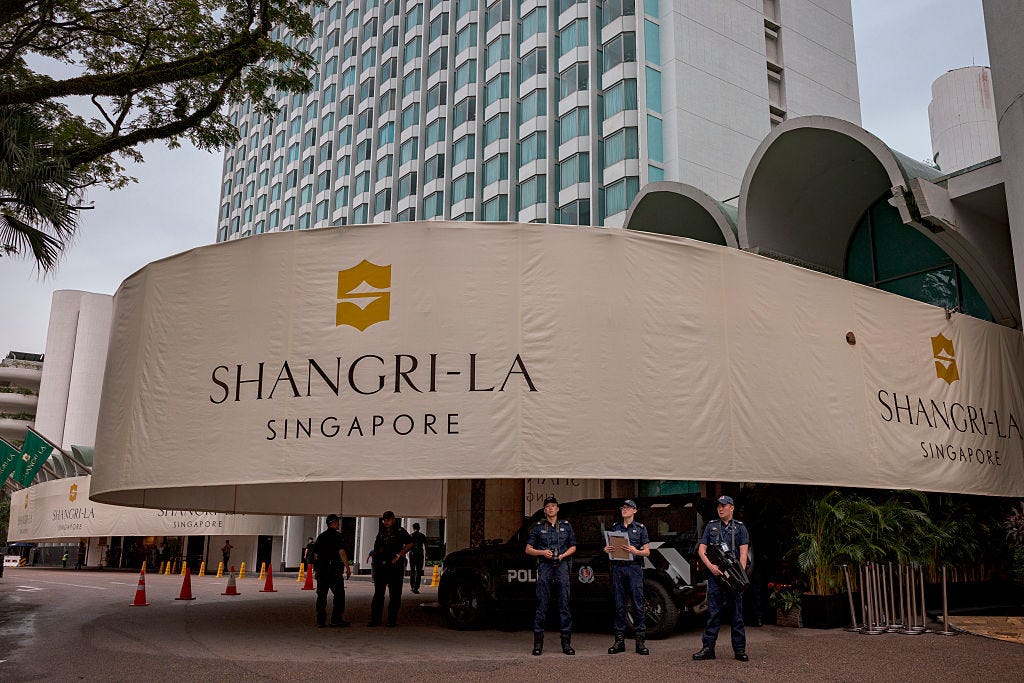
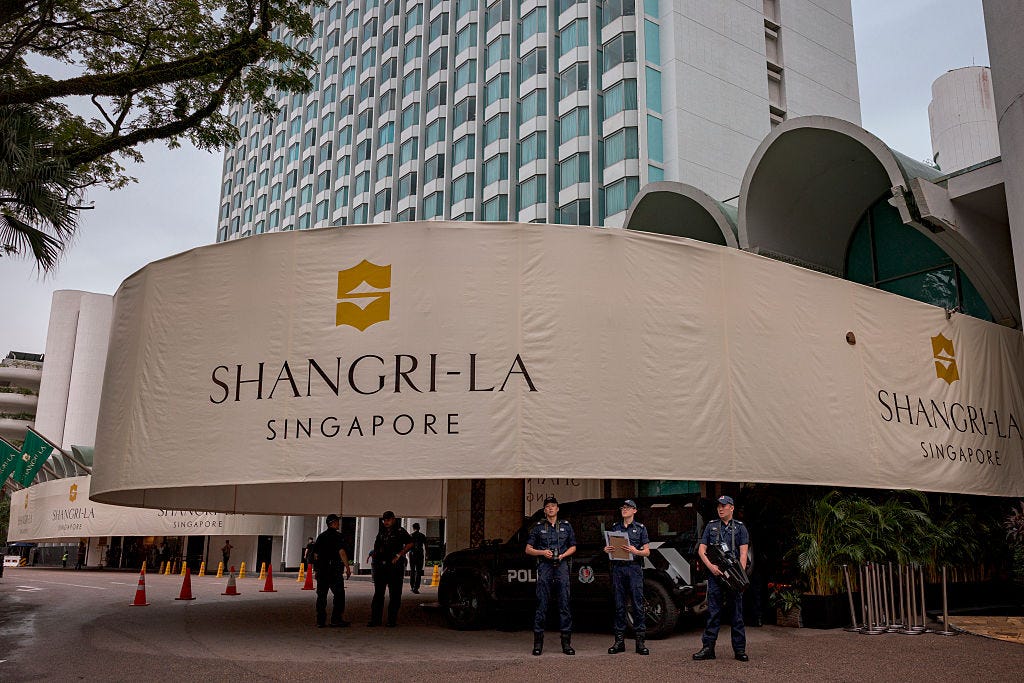
Police officers stand on patrol during the 23rd IISS Shangri-La Dialogue at the Shangri-La Hotel on May 29, 2026 in Singapore. (Photo by Ezra Acayan/Getty Images)
1. At Shangri-La, China Saves Its Fire for Japan
What Happened: From May 29 to 31, world leaders and defense officials from about 45 countries gathered in Singapore for the Shangri-La Dialogue, Asia’s premier security summit. The forum has historically given Beijing a platform to articulate its regional security positions, but this year’s dialogue was shaped less by direct U.S.-China confrontation than by broader concerns over strategic mistrust, rising defense spending, military modernization, and lessons from Ukraine.
Why it Matters: For the second year in a row, Chinese Defense Minister Dong Jun skipped the forum, signaling Beijing’s reduced interest in a venue where it is often scrutinized over its regional behavior. While China’s delegation criticized “certain countries” for “hegemonism” and “bloc confrontation,” the overall U.S.-China exchange was tame. U.S. Defense Secretary Pete Hegseth said bilateral ties were “better than they’ve been in many years” and avoided direct mention of Taiwan in his prepared remarks. The sharper exchange came instead between Beijing and Tokyo: China accused Japan of reviving militarism and questioned whether it could “win the trust of the international community,” while Japan criticized China’s military expansion and warned against changing the status quo by force. The contrast suggests that, even as Beijing manages optics with Washington after the recent Trump-Xi summit, it remains willing to pressure U.S. allies — especially Japan — over regional security issues.
By Kristina Lozinskaya, Schwarzman Fellow and Junior Fellow on China-Russia Relations at the Center for China Analysis
Learn More: Read “PLA Watch,” a monthly newsletter centered on delivering insights into China’s military affairs on the Center for China Analysis Substack.
2. China Expands Oversight of Overseas Investment
What Happened: Beijing issued sweeping new rules on June 1 that expand regulators’ authority over overseas investment involving Chinese investors, technology, data, and national security. The State Council regulation requires approval for overseas transfers of export-controlled goods, technologies, services, and related data, and bars indirect transfers through cross-border personnel deployment, consulting, and training arrangements. Building on the National Development and Reform Commission’s 2017 outbound investment rules, the new framework extends oversight to a broader range of overseas interests acquired directly or indirectly by firms, organizations, and individuals.
Why It Matters: The changes signal a shift from traditional outbound investment controls toward a more integrated national security regime. While earlier frameworks primarily targeted corporate outbound investments, the new rules also extend explicit regulatory reach to individual investors and non-traditional channels, especially with respect to sensitive technologies and data. This arrives as Beijing has already launched a crackdown on offshore trading platforms accused of helping retail investors bypass capital controls, while regulators have also moved against brokerages like Tiger and Futu over illegal cross-border securities operations.
By Shengyu Wang, Research Assistant, Center for China Analysis
Learn More: Watch “Are Export Controls Working? Field Notes from China’s AI Frontlines,” with Scott Kennedy, Trustee Chair in Chinese Business and Economics at the Center for Strategic & International Studies, and Paul Triolo, CCA Honorary Senior Fellow on Technology, moderated by CCA Fellow Lizzi C. Lee.
3. China Sets National Framework for Urban Renewal
What Happened: The 15th Five-Year Plan for Urban Renewal was released on May 28, turning a patchwork of local policy experiments into a national framework for long-term urban redevelopment. The plan reflects Beijing’s effort to move beyond the era of rapid outward city expansion and toward upgrading existing urban stock: improving older housing, pursuing adaptive reuse of old districts and factories, strengthening public services, and balancing development with cultural-heritage protection. It also explicitly warns against “large-scale demolition and construction” and “fake reconstruction,” marking a shift away from earlier redevelopment models that frequently relied on tearing down low-value areas for higher-density commercial projects. The key financing change is that eligible urban-renewal projects can now use local-government special-purpose bonds as project capital.
Why It Matters: Beijing is trying to redirect developers, construction demand, and local-government investment away from the land-financing model that contributed to China’s property crisis. The plan’s financing architecture also shows how difficult that shift will be. It combines special bonds, policy-bank lending, REITs, public-private partnerships, and utility-pricing reforms to make projects viable while avoiding new hidden local debt. If it works, urban renewal could become a more disciplined model for upgrading aging cities and infrastructure without fully reviving land-finance dependence. If returns on new projects disappoint, however, Beijing risks creating another channel for local debt.
By Jeremiah May, Research Assistant, Center for China Analysis
Learn More: Read “China’s Property Rebalancing: The Long Road to a New Development Model,” by CCA Fellow Lizzi C. Lee and David Zhang, Analyst at Trivium.
4. Xi Jinping on Developing China’s Future Industries
What Happened: In the June 1 issue of Qiushi, Xi Jinping published “Looking Ahead to the Future and Developing Industries,” an article based on his January 30 speech during the 24th collective study session of the 20th CPC Central Committee Political Bureau. The article calls for developing future industries through innovation and strategic planning, with a focus on sectors such as quantum technology and biomanufacturing. It also highlights the importance of enterprises, supportive policies, governance, and international cooperation in advancing China’s long-term development goals.
Why It Matters: Xi’s speech and Qiushi article signal China’s strategic priorities for achieving technological self-reliance and economic competitiveness in emerging industries. By emphasizing frontier sectors alongside stronger enterprise participation and policy support, Beijing is positioning future industries as key drivers of innovation, industrial upgrading, and long-term national development.
By Taylah Bland, Fellow on Climate and the Environment, Center for China Analysis (@Taylahbland)
Learn More: Follow China’s DeepSeek Moment, CCA’s webinar series examining key moments in China’s technological rise and their implications for global competition.
5. Xi Highlights Early Success of U.S.-China Youth Exchange Initiative
What Happened: Xi Jinping responded to a letter from students participating in a U.S.-China youth exchange program, highlighting that since he launched the initiative in November 2023 to “invite 50,000 American youth to China for exchanges and study over five years,” they have exceeded this goal and achieved the target two and a half years early. Xi noted that these exchanges have deepened mutual understanding, fostered lasting friendships, and opened a new chapter in people-to-people ties between China and the United States.
Why It Matters: The “50,000 in Five Years” initiative was announced during Xi’s 2023 visit to California for his meeting with then-President Biden, marking his first trip to the United States since the pandemic. Supported largely through programs such as the Young Envoys Scholarship (YES) initiative, the effort was initially met with skepticism regarding both its feasibility and strategic intent. Its completion well ahead of schedule nevertheless demonstrates that when top leaders on both sides actively support engagement—and neither side erects significant political obstacles—certain areas of U.S.–China cooperation can transcend partisan divisions and outperform expectations. Going forward, it will be important to watch whether Beijing and Washington continue to prioritize youth exchanges as a means of sustaining long-term people-to-people ties and cultivating a new generation of bridge-builders across the Pacific.
By Lobsang Tsering, Senior Research Associate on Chinese Politics, Center for China Analysis
Learn More: Read “Global Perceptions of China: Insights from the Next Generation,” featuring four winning essays from emerging young scholars around the world on how China is viewed from their corners of the globe.