


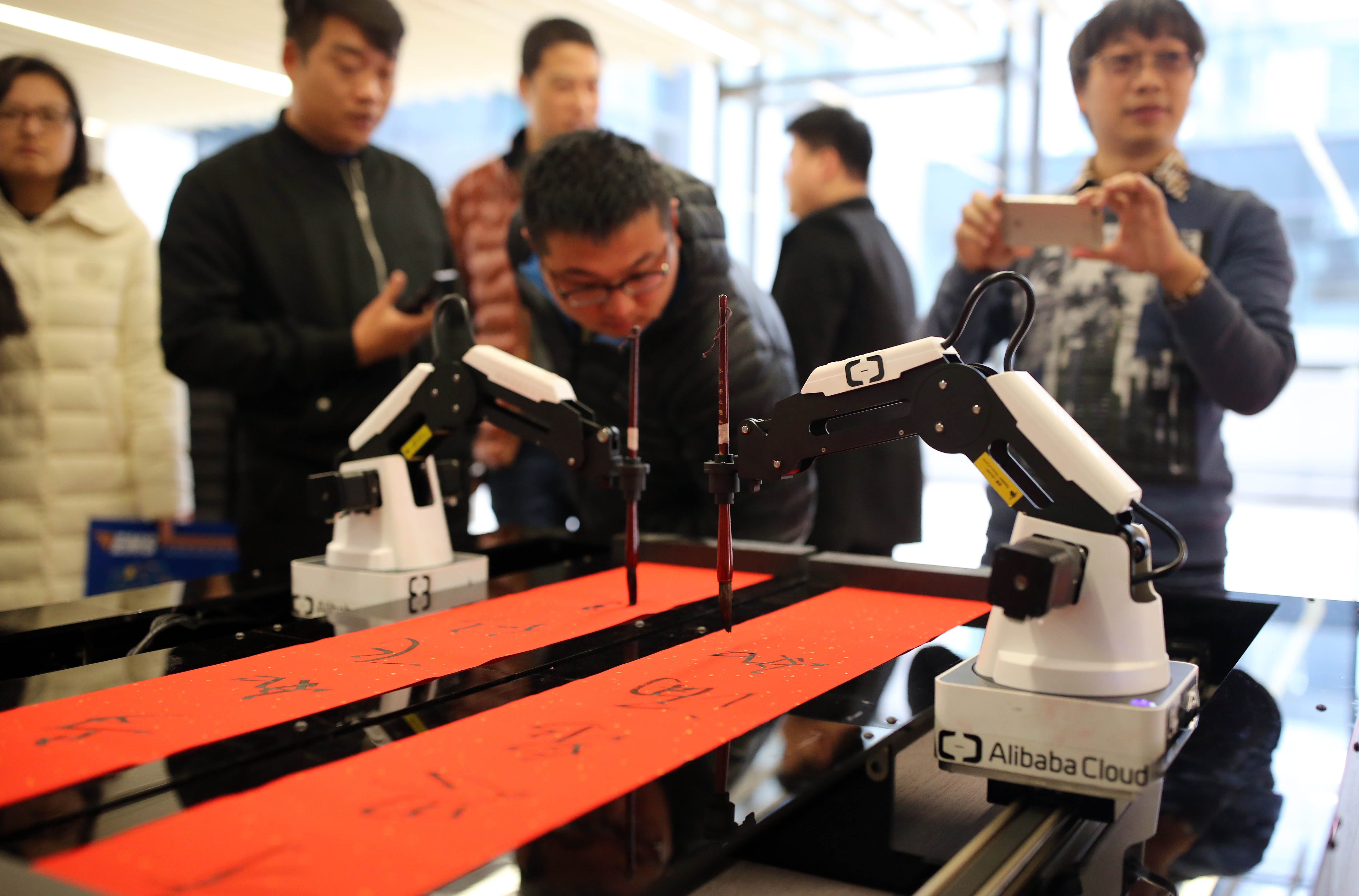
1. AI Competition Accelerates Ahead of Spring Festival
What Happened: Ahead of China’s Spring Festival celebration, competition among tech firms is intensifying across robotics, agent-style AI apps, and major model launches. Robotics firms Galbot, MagicLab, Unitree Robotics, and Noetix Robotics have landed official Spring Festival Gala partnerships, turning the holiday spotlight into a showcase for embodied AI. Big tech is also treating the holiday week as a fight for AI “entry points,” driven by a growing red-packet spending war: Tencent, Baidu, and Alibaba have all rolled out massive campaigns totaling billions of yuan. New frontier model releases are expected around the same period, including from ByteDance and Alibaba, with the biggest anticipation around DeepSeek’s next-generation V4.
Why It Matters: Spring Festival is China’s largest moment of mass travel, consumption, and digital engagement, when hundreds of millions spend long hours on their phones socializing, paying, and using apps. That makes it the most valuable window for China’s tech firms to lock in default AI entry points and maximize the visibility of new launches. Last year, DeepSeek’s surprise holiday breakout jolted Silicon Valley and reset the pace of China’s AI race. This year, the spotlight is far more contested: the field has widened from upstream model competition to downstream agent ecosystems and even embodied robotics. The holiday has become a live stress test and a microscope of China’s accelerating AI landscape.
By Lizzi C. Lee, Fellow on Chinese Economy, Center for China Analysis (@wstv_lizzi)
Learn More: Read “Why China Has So Many Robot IPOs,” by Lizzi.
2. ByteDance’s Seedance 2.0 challenges AI video generation models
What Happened: On February 7, ByteDance released its new Seedance 2.0 AI video model, which quickly went viral on Chinese and global social media platforms for its hyper-realistic visuals. ByteDance described its main use to be autonomous “multi-shot storytelling” — an end-to-end video system that turns text, images, video, and audio prompts into coherent, tightly synchronized scenes while maintaining consistent faces, clothing, sound, and scenery. Chinese AI stocks rallied up to 20% upon the release. ByteDance ran into some controversy, however, and suspended uploads of real faces after the model replicated a person’s voice from a photo alone — raising the issue of deepfake risks that accompany AI video models.
Why It Matters: Seedance 2.0 is the most advanced video generation model to date, and industry analysts ranked the model as easily surpassing both OpenAI’s Sora 2 and Google’s Veo 3.1 video models in benchmark testing. When it comes to real-world use cases, Seedance 2.0 fundamentally shifts production economics: One user produced a two-minute sci-fi short-film for just RMB 330.6 (~US$45). Feng Ji, CEO of GameScience, declared it the end of “Artificial Intelligence-Generated Content’s childhood”. The geopolitical implications are equally stark: one U.S. developer observed that Chinese AI video models now appear “two full generations ahead” of publicly available American alternatives. For the global video production industry — including America’s Hollywood and other entertainment and video-production hubs like Georgia — the question is no longer whether AI will reshape workflows: it’s whether Western AI companies can keep pace with China.
By Jeremiah May, Research Assistant, Center for China Analysis
Learn More: Watch “The Smartphone That Acts on Your Behalf: Is China’s ByteDance–ZTE Agentic AI Phone a Game Changer or a Cautionary Tale?” from China’s DeepSeek Moment webinar series.
3. Xi Reasserts Political Control Over PLA Veterans
What Happened: On February 6, Xi Jinping attended a PLA cultural performance honoring the veterans ahead of China’s Spring Festival celebrations. At the event, retired PLA officers pledged to uphold Xi’s core leadership position and Xi Jinping Thought. During the group photo session, Xi was flanked by two retired former Central Military Commission (CMC) vice chairmen and three former CMC members, along with other senior military elders. Two days after the event, the PLA Daily published a commentary quoting Xi as stating that “political character is the essential attribute of the military, and military development must first be viewed from a political perspective.” Most importantly, the commentary warned that entrenched corruption within the armed forces has not yet been fully eradicated, signaling that further purges are likely.
Why It Matters: Amid ongoing military reforms and anti-corruption purges, Xi Jinping appears intent on reinforcing absolute political loyalty within both the retired and active ranks of the PLA. Public reaffirmations of loyalty, coupled with continued warnings about unresolved corruption, function as both consolidation and deterrence — reinforcing unity while creating uncertainty for those who may be politically ambivalent. The symbolism of the event is notable: Li Jinai, an 84-year-old general and former Director of the PLA General Armaments Department and Director of the General Political Department, was seated prominently next to Xi during the group photo. Yet Li’s son, Li Lei, former assistant governor of Yunnan Province, has reportedly been under investigation since 2020, with no official updates released.
By Lobsang Tsering, Senior Research Associate on Chinese Politics, Center for China Analysis
Learn More: Check out “Unsettling Implications of Xi’s Military Purge” by CCA Senior Fellow on Chinese Politics, Christopher Johnson.
4. Hong Kong Security White Paper Reasserts the Primary of Beijing’s “One Country” Policy
What Happened: On February 10,Chinaissued a white paper outlining its account of Hong Kong’s national security developments. It frames years of political unrest, especially the 2019 protests, as evidence of legal gaps and external interference, and defends Beijing’s actions, including the 2020 National Security Law, electoral changes, and Hong Kong’s 2024 local security legislation, as necessary to restore order, strengthen governance, and stabilize the business environment.
Why It Matters: The paper was released one day after Jimmy Lai, founder of the shuttered pro-democracy newspaper Apple Daily, was sentenced to 20 years in prison under national security charges. By timing the white paper’s release with this high-profile ruling, Beijing appears to present the case as part of a broader legal framework rather than an isolated political decision, seeking to counter foreign criticism by emphasizing rule of law and stability in Hong Kong. The document also makes clear that authorities plan to continue strict enforcement of national security measures, including closer scrutiny of overseas advocacy, foreign ties, and public dissent concerning Hong Kong, while reassuring investors that stronger security will underpin long-term economic confidence.
By Jie Gao, Research Associate on Foreign Policy and National Security, Center for China Analysis
Learn More: Read “Hong Kong’s Financial Evolution: China’s Bid to Shape Global Capital Flows”, by CCA Senior Fellow on Chinese Economy Diana Choyleva.
5. BYD Sues the U.S. Government Over Tariffs
What Happened: Four U.S.-based subsidiaries of Chinese electric vehicle company BYD filed a lawsuit against the U.S. government in the U.S. Court of International Trade. The suit argues that the U.S. government’s implementation of tariffs is a misuse of the powers granted to the U.S. President under the International Emergency Economic Powers Act (IEEPA) because the “IEEPA does not employ the word ‘tariff’ or any term of equivalent meaning.” While BYD doesn’t currently sell passenger vehicles in the United States, it does produce electric buses for municipal transit agencies. BYD is seeking reimbursements for tariffs it has already paid, plus court orders to invalidate future tariffs.
Why It Matters: BYD’s suit poses a legal challenge to the existing trade restrictions placed on Chinese products. The suit should not be viewed in isolation, but rather within the broader context of mounting restrictions on Chinese clean-technology products. Despite these constraints, recent media reports point to continued commercial interest between Chinese and American companies. Ford and BYD, for example, have reportedly discussed using BYD batteries in some of Ford’s hybrid models for markets outside the United States — an illustration of how engagement with China remains important for maintaining competitiveness.
By Taylah Bland, Fellow on Climate and the Environment, Center for China Analysis (@Taylahbland)
For More: Read “The China Model’s Fatal Flaw” by CCA Fellow, Lizzi C. Lee.