


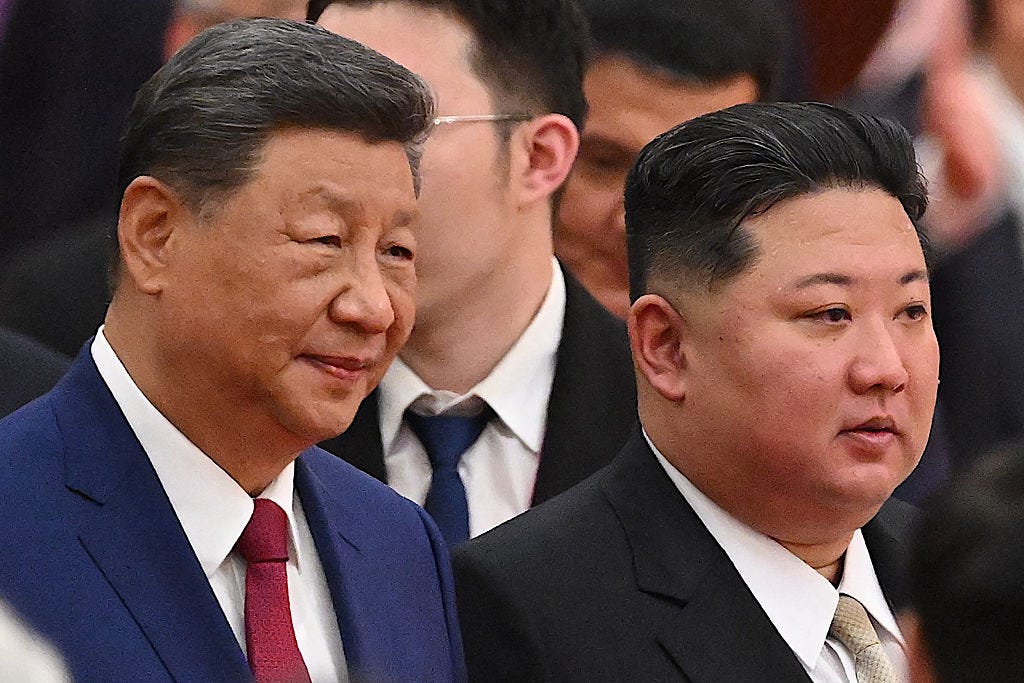
1. Xi Reportedly Planning North Korea Trip
What Happened: A possible visit by Xi Jinping to North Korea is being actively discussed by regional governments and media outlets. According to a May 20 Reuters report citing South Korea’s Yonhap News Agency, Xi could travel to Pyongyang in late May or early June. Reuters also reported that Chinese security and protocol teams had recently visited Pyongyang, often a sign of preparations for a high-level state visit. The Chinese government has not officially confirmed the trip, however.
Why it Matters: The proposed trip would be highly significant for China–DPRK relations. It would be Xi’s first visit to North Korea since 2019, following Xi’s recent summits in Beijing with Donald Trump and Vladimir Putin. The visit could also signal a shift in China’s approach toward “denuclearization” of the Korean Peninsula. China continues to publicly endorse “denuclearization” in principle, but recent statements suggest a growing emphasis toward “stability,” “dialogue,” and opposition to “deterrence and pressure.” Finally, the trip could help Beijing shore up its influence over Pyongyang. Beijing has arguably lost leverage since Vladimir Putin and Kim Jong Un signed a strategic partnership treaty in June 2024 that includes a mutual defense provision widely interpreted as a de facto mutual defense pact.
By Lyle Morris, Senior Fellow on Foreign Policy and National Security, Center for China Analysis (@LyleJMorris)
Learn More: Read the roundtable report from “The China–Russia–North Korea Nexus,” a closed-door discussion convened by the Sungkyun Institute of China Studies (SICS) and the Asia Society Policy Institute’s Center for China Analysis.
2. Beijing Tightens Expectations for Advisors Through Revised Responsibility Guidelines
What Happened: Wang Huning, a Politburo Standing Committee member and chairman of the Chinese People’s Political Consultative Conference (CPPCC), recently chaired a meeting calling on CPPCC members to strengthen research and consultation around key tasks set by the CCP Central Committee. Wang urged members of the Party’s political advisory body to offer policy recommendations that are forward-looking, targeted, and practical. The meeting also approved revised guidelines on “Strengthening the Responsibility and Commitment of CPPCC Members.”
Why It Matters: The specific revisions have not yet been disclosed. But when the guidelines were first introduced in 2020, their core message was that CPPCC members—who serve as part of the Party-state’s advisory and policy consultation apparatus—should “be neither magpies nor crows, but only woodpeckers.” In practice, this means they are expected neither to exaggerate positive news nor amplify pessimistic narratives, but instead to identify concrete problems and propose workable solutions. This principle has become an important guideline for Chinese scholars and policy experts, many of whom are CPPCC members, when engaging with overseas think tanks and foreign interlocutors.
By Lobsang Tsering, Senior Research Associate on Chinese Politics, Center for China Analysis
Learn More: Read “Guided Autonomy: America Watching in Xi’s China” by CCA Senior Fellow Guoguang Wu.
3. China Expands Social Insurance Access for Migrant Workers
What Happened: On May 22, China’s State Council announced new measures to encourage migrant workers to enroll in social insurance programs where they work, regardless of their hukou—China’s household registration system. The move affects China’s 357 million migrant workers, including gig economy workers on ride-hailing and food delivery platforms. The reforms aim to simplify cross-regional insurance transfers, with officials framing the changes as a way to help narrow the rural-urban gap, accelerate urbanization, and boost consumption.
Why It Matters: The move is part of China’s broader effort to dismantle the hukou system. To boost domestic consumption, Beijing recognizes the need to equalize access to public services, including education and healthcare, that remain tied to residents’ place of household registration. The reform also addresses mounting pressure on China’s social insurance system, which faces rapid population aging, sluggish contribution growth, and uneven participation among migrant and informal workers under the existing pay-as-you-go framework. Extending access to these workers could expand the social insurance system’s contribution base and improve its long-term fiscal sustainability.
By Shengyu Wang, Research Assistant, Center for China Analysis
Learn More: Read “Who Will Till the Land? Conflicting Narratives About Rural China’s Demographic Future,” by Vivianne Zhang Wei, founder of Chinese Farm Chronicles, and CCA Fellow Lizzi C. Lee.
4. Li Qiang Highlights Energy and Food Security in Zhejiang Visit
What Happened: Chinese Premier Li Qiang visited several strategic storage and logistics facilities in Zhejiang province, including the Zhoushan National Petroleum Reserve Base, a bulk agricultural product storage and transportation base, and the Ningbo Daxie commercial petroleum reserve project. During the tour, Li emphasized the need to maintain adequate reserves of “bulk commodities and important materials” amid growing uncertainty in the external environment. He also called for expanding reserve capacity, accelerating storage infrastructure construction, improving technological and digital management systems, and strengthening coordination between strategic and commercial reserves.
Why It Matters: While China’s reserve expansion is not new, the political signaling behind Li’s visit is significant. Senior Chinese leaders do not choose inspection stops randomly, and the focus on petroleum and grain reserves underscores Beijing’s growing emphasis on economic security and resilience in a more unstable geopolitical environment. The call to better coordinate strategic and commercial reserves also suggests China is building a more comprehensive resilience system to withstand supply disruptions and political shocks. More broadly, the visit reflects how Beijing increasingly views energy and food security as core components of national security.
By Li Shuo, Director of China Climate Hub, and Senior Fellow, Center for China Analysis
Learn More: Read “Why Food Security is a Top Priority for China” by former Research Associate Genevieve Donnellon-May.
5. Deadly Shanxi Mine Explosion Exposes Safety Failures
What Happened: On May 22, a gas explosion occurred at the Liushenyu mine in Qinyuan County, Changzhi, Shanxi. After initial uncertainty over the death toll, authorities now say 82 people are dead, two are missing, and more than 120 have been hospitalized. Xi Jinping and Li Qiang have framed the disaster, now under State Council investigation, as a warning for the country amid broader efforts to improve workplace safety.
Why It Matters: Reporting by Chinese state media has pointed to poor business practices and systematic rule evasion by the mining company, Shanxi Tongzhou Group. These include the company’s failure to maintain an accurate count of workers underground, as well as its outsourcing of labor to contractors under arrangements that weakened accountability and prioritized production over safety. Some reports also point to unregulated mining areas omitted from official maps, including the use of so-called “yin-yang drawings,” in which one set of drawings was submitted for regulatory filings while another guided actual mining operations. Following the incident, public commentary on Chinese social media has emphasized how catastrophic industrial accidents reflect long-term failures in enforcement and organizational cultures that normalize risk. There is also concern that local authorities initially minimized the death toll, reporting only eight deaths.
By Michael Cerny, Affiliated Researcher, Center for China Analysis
Learn More: Read “China’s New Climate Targets Decoded: Cautious Progress or Missed Opportunity?” by CCA Senior Program Officer Taylah Bland.