



On September 3, China hosted its largest-ever military parade to commemorate the 80th anniversary of Japan’s surrender in World War II, or, as China calls it, the “Chinese People’s War of Resistance Against Japanese Aggression.” The parade showcased the People’s Liberation Army’s (PLA’s) latest military hardware, with tens of thousands of troops marching in formation and Xi Jinping proudly presiding over the festivities. Foreign heads of state convened in Beijing to bask in the grandeur of China’s accomplishments. In many ways, the event was a litmus test for Xi’s “circle of friends,” with Russian President Putin and North Korean leader Kim Jong Un taking center stage as VIP guests.
Why did China hold the event, and what did it accomplish? This special issue of PLA Watch will examine the diplomatic, historical, and military significance of the parade and what it means for China’s domestic and international image and military ambitions.
Not a “Thing of the Past”
Goose-stepping troops and grandiose displays of tanks, missiles, and fighter jets lumbering through the streets are sights typically associated with the Soviet Union at the height of the Cold War or the totalitarian regime of North Korea. The West might ridicule such an ostentatious display as wasteful, but for China under Xi Jinping, it holds particular purpose and value. For one, it offers Xi a chance to unveil, in no uncertain terms, the arrival of China as a confident military power on the world stage. It also offers him a chance to showcase, with meticulous choreography, how far the PLA has come in its modernization efforts. Perhaps most importantly, it provides an opportunity for Xi to invite his closest allies and partners to Beijing to celebrate China’s accomplishments.
Of course, none of these were the parade’s official purpose. Officially, it signified China’s dedication to peace in Asia and commemorated the sacrifices made by the Chinese military and people fighting Imperial Japan. Unofficially, the international community saw a display of formidable military muscle, one that stoked nationalistic fervor and showcased the PLA’s “unstoppable rise.” Not incidentally, the parade also doubled as a large advertisement for Chinese arms, particularly to buyers who no longer desire Russian systems or can purchase Western offerings. Regardless of interpretation, the message was delivered loud and clear.
Who Attended the Party?
In total, 26 foreign leaders attended the parade. Headlines focused on the rare international appearance of North Korean leader Kim Jong Un as well as Russian President Vladimir Putin, but other heads of state from Iran, Belarus, Cuba, Indonesia, and more also convened. To that end, the absence of Western leaders was notable and underscored the parade’s role as a stage for nations skeptical of or defiant toward Western influence. In fact, only one EU and NATO head of state attended: Slovakian Prime Minister Robert Fico. The only other European head of state to attend was Serbian President Aleksandar Vucic. Neither attendance was surprising—Fico has pushed for closer ties with Russia, and Vucic has been critical of sanctions against Russia over its war in Ukraine. Both leaders have recently visited Moscow.
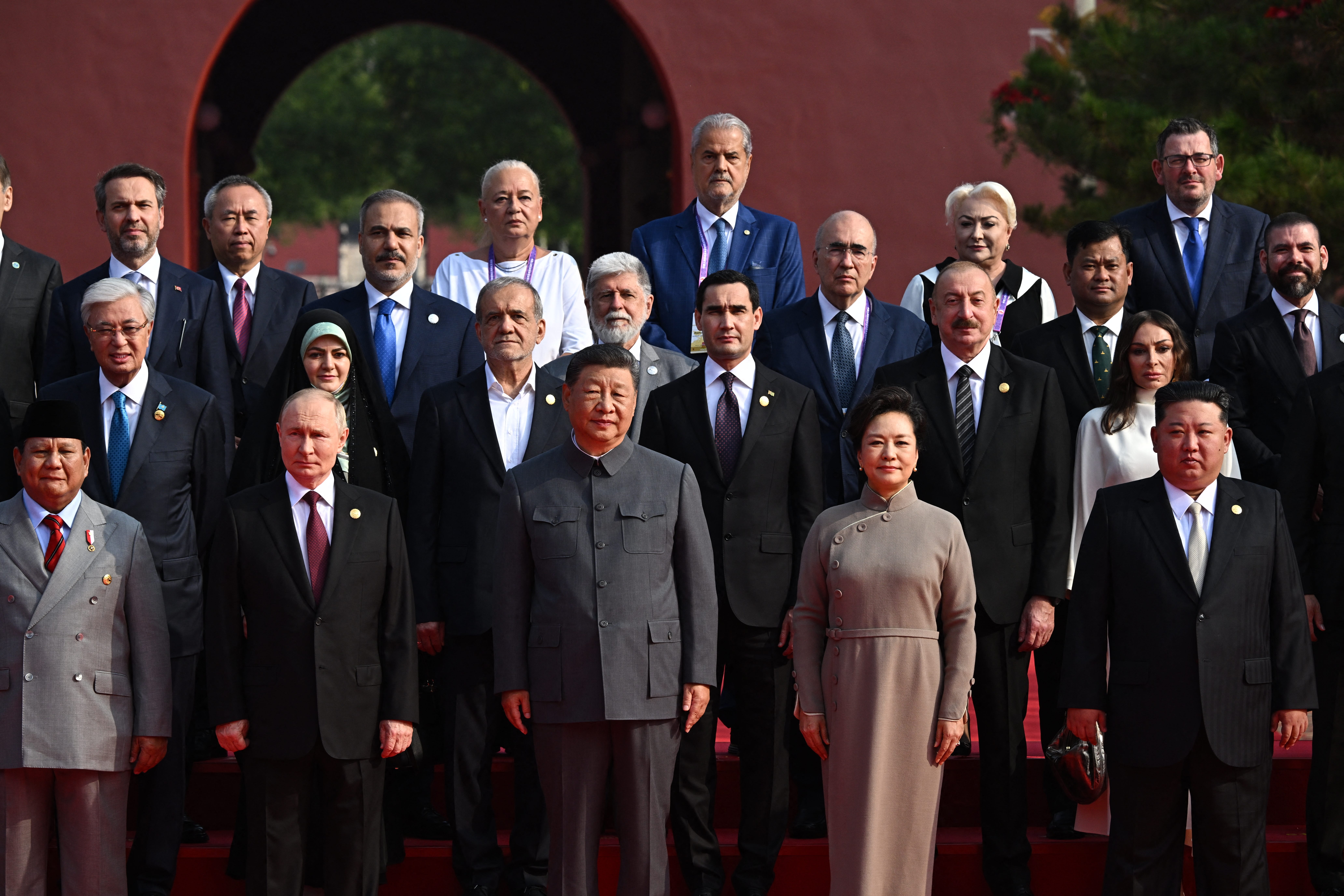
In other words, this was not a showing of nations who fought in World War II standing in solidarity with China. Instead, it manifested, in very clear terms, who China’s “friends” are, with strong representation from Central Asia, Africa, and Southeast Asia. A better term might be the “coalition of the willing, with Chinese characteristics.”
As the headlines noted, Kim Jong Un’s attendance was particularly significant. It marked his first trip to China since January 2019 and the first time a North Korean leader had attended a Chinese military parade since 1959. It was also Kim’s first engagement with multiple world leaders in one setting since assuming power in 2011. Xi, Kim, and Putin stood side by side for most of the ceremony in a purposeful signal to Washington. The picturesque moment of the three leaders sharing smiles as they walked through Tiananmen Square underscored their burgeoning alignment against U.S. influence. This alignment is undoubtedly troubling for Washington, Seoul, and Brussels, given North Korea’s expanding nuclear arsenal and its military support for Russia’s war in Ukraine.
Shiny Objects and New Hardware
If the foreign dignitaries seated beside Xi Jinping symbolized Beijing’s diplomatic reach, the military hardware rolling through Tiananmen Square showcased the other half of the message: China’s demonstration of the material tools to “fight and win” in any potential armed conflict. Assuredly, Beijing also chose to hide some of its cutting-edge platforms for technical and strategic reasons.
The parade marked the first time China publicly unveiled a complete nuclear triad. On land, the PLA unveiled the DongFeng (DF)-61 intercontinental ballistic missile, mounted on a launcher resembling the DF-41, as its newest road-mobile platform. The DF-31BJ, likely linked to silo-loading at China’s new missile fields, also made an appearance, alongside the DF-5C, a liquid-fueled silo-based missile believed to carry a multi-megaton warhead. At sea, the JuLang (JL)-3 submarine-launched ballistic missile signaled longer-range deterrence from Type-094A submarines. In the air, China revealed the JL-1 air-launched ballistic missile, which can be loaded on the H-6N bomber.
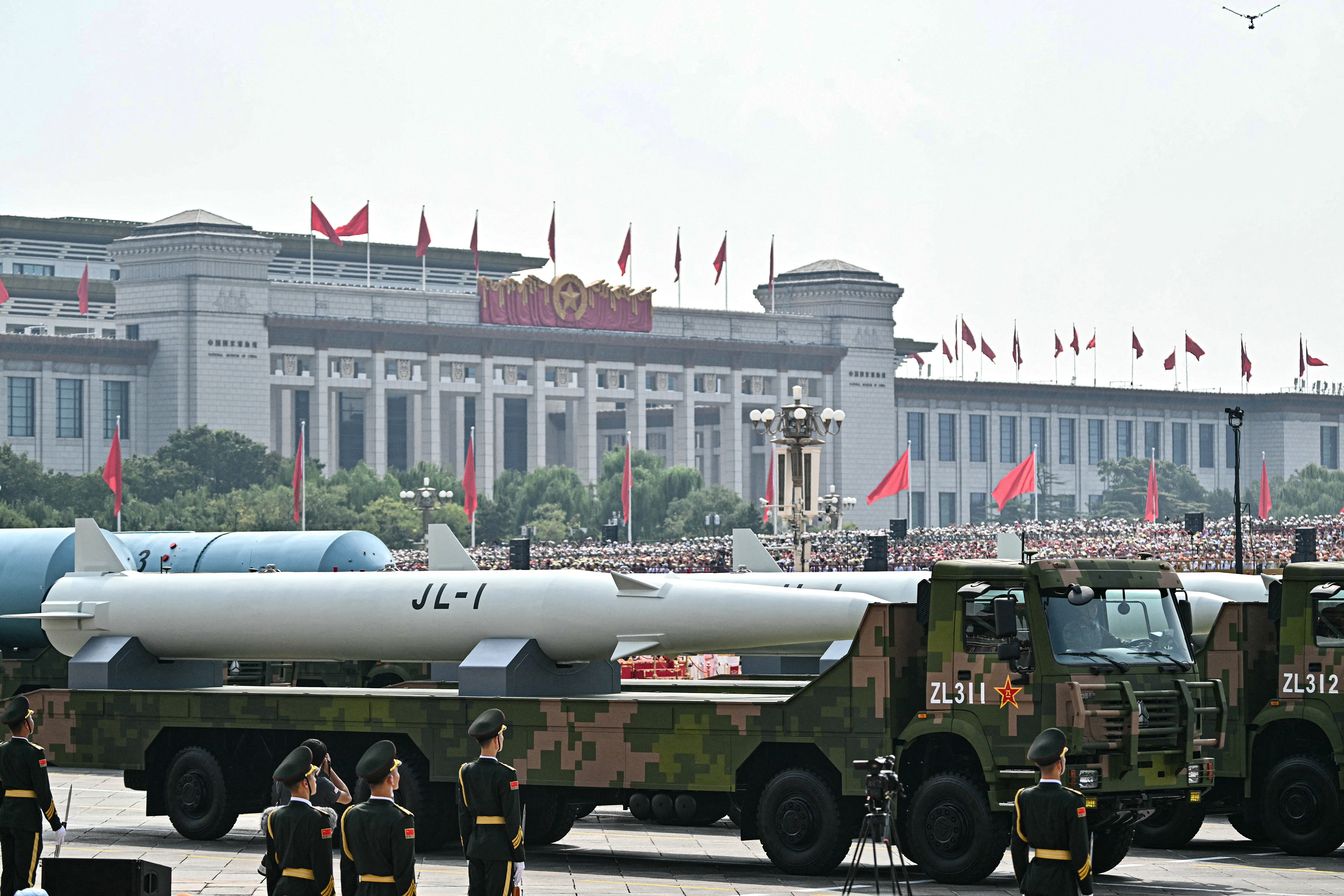
By showing its nuclear triad, Beijing highlighted improved survivability, second-strike capability, and sophistication in nuclear deterrence. CCTV coverage proudly phrased the reveal as “a strategic ace for safeguarding national sovereignty and defending national dignity.” However, as China flexes, it must also calibrate how this display is framed to remain consistent with its declared no-first-use policy.
Alongside nuclear missiles, the PLA highlighted a new suite of hypersonic anti-ship weapons. Four variants of the YingJi(YJ)-series—YJ-15, YJ-17, YJ-19, and YJ-20—rolled through, three of them hypersonic. Chinese experts boasted of “diverse technological paths”: the YJ-17 and YJ-20 use boost-glide configurations, while the YJ-19 is believed to employ a scramjet engine for air-breathing hypersonic flight. Western analysts noted that if deployed in large numbers, such missiles could overwhelm U.S. naval defenses by arriving at unpredictable angles and speeds, adding credibility to China’s capabilities.
The PLA gave equal prominence to unmanned warfare. Two extra-large unmanned underwater vehicles, the HSU-100 and the mine-laying AJX-002, were revealed. Large truck-mounted drones resembling “loyal wingmen” for jet fighters indicated the PLA’s integration of manned and unmanned aviation. Ground forces showed remote-controlled vehicles capable of mine-clearing and casualty evacuation, while robotic dogs equipped with AI features appeared as part of electronic warfare units.
Near the end of the parade, the J-35 stealth carrier-borne fighter, flanked by upgraded J-15 variants, flew across the sky. The J-35 marks China’s official entry into the fifth-generation era for carrier aviation, with enhanced stealth, range, and payload. Its appearance was paired with carrier-based early-warning and electronic warfare aircraft, showing a more comprehensive naval aviation ecosystem.
Equally telling were the absences. Prototypes of sixth-generation stealth fighters such as the J-36 and the J-50, reportedly tested since 2024, were absent, likely because they are still in an early stage of development and too sensitive to reveal. Although the HongQi-29 missile was displayed at the parade with anti-satellite (ASAT) capabilities, counterspace systems such as the SC-19 direct-ascent ASAT missile and the DongNeng series were withheld. Their omission could imply Beijing’s desire to avoid international backlash against its stated commitment to the peaceful use of outer space while maintaining deterrent ambiguity.
Conclusion
To summarize, the parade delivered four symbolic messages. First, Xi reinforced the Chinese Communist Party’s narrative that China has emerged from its “century of humiliation” as a strong and powerful nation. Second, it sent a strong message of conventional and nuclear deterrence to the United States and other regional actors that China has the means and intent to militarily intervene in any conflict along its periphery, including over Taiwan. Third, to quell any doubts of Xi’s command of and trust in the PLA, it underscored that he remains in firm control as chairman of the Central Military Commission and leader of the Chinese armed forces. And finally, it drove the narrative that China, Russia, and North Korea are forming an even tighter alliance than previously recognized.
Regarding capabilities, the PLA unveiled several new platforms that were previously unknown to the international community. Most of the capabilities displayed clearly target U.S. military assets and posture, especially in the nuclear domain. However, the scale of deployment and integration of these capabilities into active duty remains uncertain. Ultimately, the parade was more performative than an actual showcase of battlefield capabilities. How effectively China can integrate them into the PLA remains to be seen.