


By Daniel Fu, Stonex PhD Scholar in International Relations at the London School of Economics and Political Science (LSE)
Key Takeaways
“Effective compute” is something firms can create rather than acquire. Across the “Six Tigers,” algorithmic innovation, memory optimization, and whole software rewrites have increased how much AI capability can be extracted from fixed amounts of compute.
Export controls are pushing much earlier model-chip co-design. Rather than adapting after models are built, firms like StepFun and Z.ai are increasingly developing models alongside domestic hardware manufacturers, while Huawei, Biren, Moore Threads, and Cambricon, among others, are optimizing their hardware according to the needs of model developers.
China’s dependence on Nvidia’s GPUs is becoming increasingly concentrated on frontier model training as domestic hardware proves increasingly capable of supporting a widening range of inference and deployment workloads.
Export controls on frontier AI hardware have created durable path dependence in China’s AI ecosystem. As firms optimize models for Huawei Ascend, integrate with MindSpore, and participate in domestic chip alliances, switching back to American technology will prove costly even if controls are loosened.
Introduction
Anthropic’s recent report alleging large-scale distillation by Chinese labs has raised widespread questions about how Chinese firms are achieving advanced capabilities.[1] Specifically, it accused Moonshot AI of routing user requests through Claude while attributing outputs to its new flagship model, Kimi K3. In this process, Moonshot potentially exposed sensitive, government-linked information, raising challenges about security practices at one of China’s premier frontier labs as it prepares for its IPO. Moreover, it shows how access to frontier U.S. models can provide Chinese firms with alternative pathways to advanced capabilities, even as Washington restricts the hardware traditionally necessary to develop those capabilities independently.
While Anthropic is correct to highlight distillation techniques, distillation is only one part of a wider pattern of adaptation. China’s most prominent AI start-ups – collectively known as the “Six Tigers” – Z.ai, Moonshot AI, StepFun, Baichuan AI, MiniMax, and 01.AI, have progressively reduced their reliance on the American technology stack through adapting models to domestic processors and developing more compute-efficient model architectures, often in combination. Taken together, their responses show how the technological bottlenecks constraining Chinese advances are not static. As Washington restricts one part of the AI technology stack, Chinese firms have successfully substituted, economized on, or circumvented that constraint, shifting the once binding bottleneck elsewhere.
In this context, the primary challenge for policymakers is a classic moving-target problem. Access to frontier compute is important, but it is more substitutable than conventionally assumed. Algorithmic efficiencies have reduced the amount of compute required, domestic processors have substituted – albeit imperfectly – for Nvidia hardware, and access to cloud infrastructure provides alternate means to achieve frontier capabilities. Export controls will therefore only be effective when they evolve in tandem with the changing sources of Chinese AI capability, rather than remain fixed on a single technological constraint.
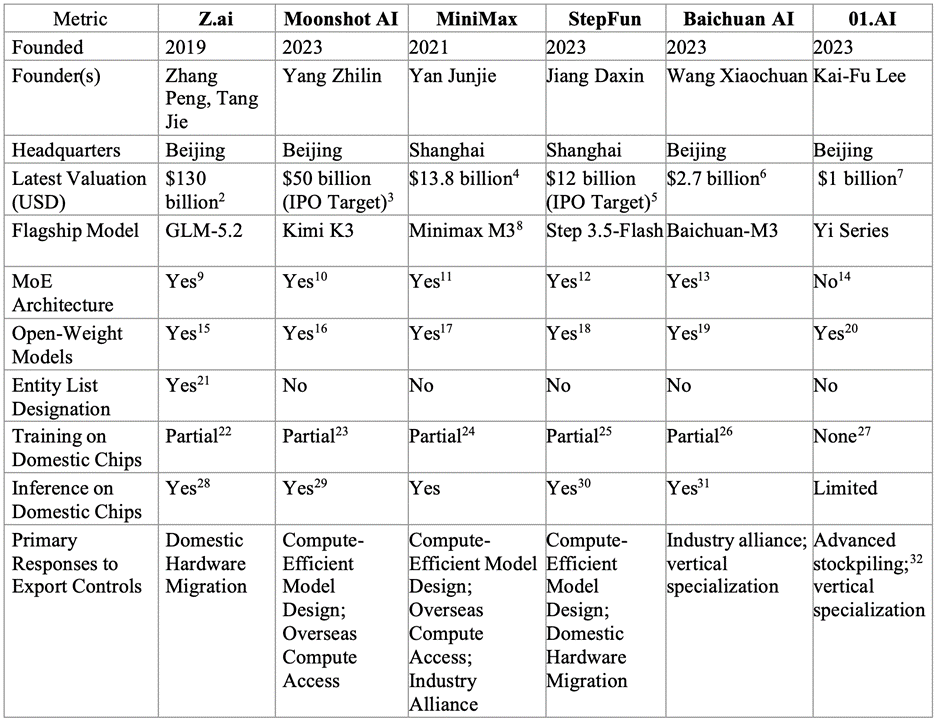
The table below examines the six individual AI tigers and evaluates their performance across several metrics, including adoption of mixture of experts (MoE) architectures – which activate only a subset of a model’s specialized components, reducing the compute needed to run large models – utilization of domestic chip technologies, and responses to export controls.
Algorithmic and Scaling Efficiencies
Restricted access to advanced Nvidia processors has compelled Chinese labs to make the most of limited compute. Several of the “Six Tigers” have developed novel model architectures with this explicit purpose. StepFun’s Step-3, for example, leveraged a new method known as Matrix Factorized Attention (MFA) to reduce the amount of temporary memory required while a model is generating responses, making it significantly more efficient on hardware with limited memory bandwidth.[33] Compared with DeepSeek’s earlier Multi-Head Latent Attention (MLA) approach, StepFun reports that MFA reduces memory requirements by nearly 94 percent.[34] As a result, Step-3 reportedly achieves higher inference efficiency on Huawei’s Ascend 910B than even Huawei’s own Pangu Pro MoE model.[35] Likewise, MiniMax developed a proprietary “MiniMax” Sparse Attention (MSA) architecture embedded in its M3 model.[36] Rather than processing every word equally, MSA first identified the parts of the input that were most relevant and focused computing power on those sections. By avoiding unnecessary computation, it could process context windows of up to one million tokens while using up twenty times less compute per token than conventional approaches.[37] Z.ai similarly incorporated a new sparse attention technique named IndexShare into GLM 5.2, reducing the computing power needed to process each token by nearly two-thirds at a one-million token context length.[38]
Meanwhile, Moonshot incorporated Kimi Delta Attention and a highly-sparse mixture-of-experts architecture into Kimi K3 that activates only 16 of its 896 experts per token.[39] Kimi’s hybrid attention architecture reduced the memory required by long outputs by as much as 75 percent and increased processing throughput by six times at a one million token context compared to conventional architecture.[40] Moreover, Moonshot developed a new training technique called MoonClip (also called MuonClip), which the company says can achieve comparable training performance using approximately half as much data and computing power by preventing instability from exploding attention scores.[41] These innovations were complemented by lower-precision model weights that reduced memory and computational requirements.[42] Altogether, the company claimed that Kimi K3 had achieved 2.5 times the overall scaling efficiency of Kimi K2.[43] Even 01.AI, prior to its shift away from building large foundational models, successfully replaced the dense architecture used in Yi-Large with a mixture-of-experts architecture for Yi-Lighting. As a result, Yi-Lighting’s time to first token was reportedly half that of Yi-Large, while its maximum generation speed increased by nearly 40 percent.[44]
These developments reflect a wider skepticism among Chinese AI executives about continuing to rely on brute-force scaling alone to achieve frontier capabilities. Z.ai CEO Zhang Peng has argued that scaling laws describe the empirical relationship between compute and model architecture without adequately detailing why intelligence emerges. Since the causal relationship is not better understood, allocating increasing amounts of compute to train larger models was nothing but “expensive guesswork.”[45] Reflecting on the success of DeepSeek-R1, Zhang stated that its significance lay in moving away from the “brute-force” logic of piling on parameters or data and demonstrating that algorithmic optimization could concurrently reduce costs and improve performance.[46]
Other Chinese executives more explicitly attributed algorithmic innovations to compute constraints. MiniMax CEO Yan Junjie argued that “China has a significant gap with the United States in computing resources. Therefore, we have to rely on more innovative methods if we are to achieve comparable results.”[47] Indeed, he suggested that “because of compute constraints, Chinese talent may be actually forced to produce more innovation.”[48] Kai-Fu Lee similarly argued that engineering improvements had “to some extent offset” challenges posed by U.S. export controls after training Yi-Lighting with only 2,000 GPUs at just USD $3 million.[49]
These adaptations do not show that export controls were ineffective. Access to frontier processors remains an important advantage, particularly for large-scale training. Instead, these innovations show how constraints on compute do not translate proportionally into constraints on capability, as Chinese labs have often successfully compensated for hardware scarcity through greater algorithmic efficiencies.
Hardware Substitution
Another response has been efforts to substitute restricted American hardware with an increasingly integrated domestic computing stack. While Chinese processors remain inferior to Nvidia’s high-end GPUs, model developers are increasingly optimizing their models around those limitations instead of waiting for domestic hardware to achieve technological parity.
StepFun, for example, emphasized the importance of tailoring AI models to the strengths of different chips. Company researchers asserted that DeepSeek-V3 is best suited for Nvidia’s H800, Alibaba’s Qwen 3 aligns naturally with the H20, while Step-3 is particularly well optimized for Huawei’s Ascend 910B.[50] It also established a “Model-Chip Ecosystem Innovation Alliance” with Huawei, Cambricon, Biren, Moore Threads, and other domestic chipmakers. Instead of getting companies to optimize software for a single processor, the alliance sought to ensure that models developed by StepFun were compatible with AI chips manufactured by different hardware companies.[51] Zhu Yibo, StepFun’s CEO, described one benefit of the alliance in clear terms, stating that “before the next generation of chips launches, we will already have early access to aspects of their design.”[52] Others subscribed to similar industry alliances. Before Baichuan withdrew from the large foundation model race, it joined an industry consortium in Beijing named the “Large Model Application Industry Consortium.” Organized around Huawei’s technology stack, including Ascend processors, the Kunpeng computing platform, MindSpore, and ModelArts, the alliance enabled Baichuan to optimize its models for other domestic processors as well, including Cambricon accelerators.
Z.ai went further. It was the first among the “Six Tigers” to train a model on domestic hardware. In January 2026, the company announced that GLM-Image, its open-source image generation model, was trained on Huawei’s Ascend Atlas Servers and its MindSpore framework.[53] Company representatives described the project as a “comprehensive exploration and validation of China’s domestic computing ecosystem,” noting that every stage of development, from preparing training data to model training, had been completed on Huawei’s hardware.[54] Z.ai scientists successfully rewrote key parts of its training software so that different training stages could occur concurrently and processors could communicate more efficiently.[55] By mid-2026, Z.ai was so confident in Chinese computing infrastructure that it announced a one-gigawatt AI data center it intended to stock with only Chinese-made processors.[56] Huawei almost certainly does not have enough chips to supply the facility. The investment, however, emphasizes the company’s expectation that domestic hardware will form a new foundation for its model development. In the same month, Z.ai reportedly engaged in discussions with domestic chip design houses about building a custom processor for its GLM family.[57]
The speed of domestic adoption has also increased significantly. When Moonshot released K3, Huawei, Alibaba, and Hygon provided inference support on “day one.”[58] One Chinese researcher argued that the ability of all of these companies to adapt in such a short period demonstrates that “the industry’s coordination cycle has compressed the scale of quarters to the scale of days.”[59] These developments do not suggest that Chinese hardware manufacturers have caught up with Nvidia. Rather, they demonstrate that substitution does not require technological parity. As model developers and chipmakers enter industry alliances and optimize their products around each other, inferior processors can still become sufficient substitutes for a wide range of workloads.
Adaptation Is Not Circumvention
Both forms of adoption should be distinguished from circumvention, which entails bypassing controls rather than adapting to them. Chinese AI firms have acquired computing resources through several circumvention channels. Before controls tightened, for example, 01.AI accumulated a large inventory of high-end chips. Lee stated in November 2023 that the company had bought enough high-end Nvidia GPUs to sustain its operations for fourteen months, declaring bluntly that “we have stockpiled a lot of Nvidia chips.”[60]
Meanwhile, MiniMax avoided constructing its own GPU infrastructure altogether, opting instead to lease access to GPU clusters from cloud providers across China and Singapore, including at least three providers in Beijing and another in Zhejiang.[61] Moonshot did the same, reportedly training Kimi K3 using a cluster of 20,000 chips accessed through Alibaba Cloud.[62] K3’s training infrastructure was dispersed across several locales. Since no supplier could provide sufficient compute alone, Moonshot relied on at least two Chinese cloud providers that provided access to Nvidia’s Blackwell chips and linked computing resources located in different data centers.[63] Its engineers successfully optimized networking between different centers so that partial supplies of advanced compute could function as part of a larger training system.[64] In this sense, compute restrictions did not only encourage Moonshot to seek alternative hardware, but also incentivized it to come up with new systems to source compute across diverse providers and locations.
Following the Bottleneck
The experience of China’s “Six Tigers” demonstrates that the effectiveness of export controls cannot be measured by the amount or sophistication of computing hardware they restrict. What matters more is how much those restrictions increase the cost and time required for Chinese labs to realize frontier capabilities, and how long those effects last as firms adapt. Several policy implications can be identified here.
First, it would be remiss to treat compute requirements as fixed. Across the “Six Tigers,” algorithmic innovations, memory optimization, and software rewrites have allowed more AI capability to be derived from a fixed amount of compute. Firms can therefore increase their computational capabilities without acquiring additional or more sophisticated hardware. This process is not limited to models alone. StepFun and Z.ai are optimizing models around domestic processors while hardware manufacturers like Huawei, Moore Threads, and Cambricon tailor their products to the demands of model developers. Policymakers must therefore emphasize “effective compute,” focusing not simply on the quantity and sophistication of chips available to Chinese firms, but how effectively fixed amounts of compute can be converted into frontier AI capabilities.
Second, policymakers must continuously reassess where the binding technological bottleneck lies. China’s reliance on foreign chips is increasingly workload-specific as domestic hardware enables a widening range of inference and deployment workloads. Firms like Moonshot that are stitching together compute across different providers and data centers to support a single model make factors like large-cluster integration, inference infrastructure, and high-speed networking increasingly important constraints. The Bureau of Industry and Security (BIS) must institutionalize a periodic review of these constraints rather than relying on static assumptions about which parts of the AI stack provide Washington with the most leverage.
Third, the temporal dimensions of export controls must be readily distinguished. Export controls constrain Chinese capabilities in the short term while simultaneously accelerating algorithmic efficiencies and the consolidation of a domestic, end-to-end technology stack in the long term. As firms increasingly optimize around domestic hardware, integrate with MindSpore, partake in industry alliances, and build data centers around Chinese processors, reverting to an American technology stack will prove increasingly costly even if controls are loosened. This path dependence means that the consequences of export controls may outlast the restrictions themselves.
Endnotes
[1] Tolomia, Cris. “Anthropic says Chinese AI labs secretly used hundreds of millions of Claude exchanges to train their models.” Quartz, September 11, 2026. https://qz.com/anthropic-chinese-ai-labs-distillation-alibaba-deepseek-moonshot-091126; “Detecting and countering misuse of AI: September 2026.” Anthropic, September 10, 2026. https://www-cdn.anthropic.com/e50be2e51e7695dc4b1366a37a245a597377d3b5/Anthropic-Detecting-and-countering-091026.pdf.
[2] James, Luke. “Chinese Z.ai’s latest model tops AI ranking charts amid Anthropic Fable 5 ban- blacklisted China’s firm’s popular open-weight GLM 5.2 AI model powered by Huawei silicon.” Tom’s Hardware, June 30, 2026. https://www.tomshardware.com/tech-industry/artificial-intelligence/z-ai-free-glm-5-2-tops-the-open-weight-ai-rankings-on-all-huawei-silicon; Russell, Jon. “Zhipu, China’s breakout AI star, is raising billions despite best being known for open-source software.” Asia Tech Review, June 25, 2026.; Venkat, P.P. “Z.AI Plans $5.0 Billion Fundraising to Fuel AI Expansion.” Wall Street Journal, September 13, 2026. https://www.wsj.com/tech/ai/z-ai-plans-5-0-billion-fundraising-to-fuel-ai-expansion-56da16dc.
[3] “Moonshot AI Surpasses Funding Goal to Hit $35 Billion Value.” Bloomberg, July 29, 2026. https://www.bloomberg.com/news/articles/2026-07-29/china-s-moonshot-ai-passes-funding-goal-to-hit-35-billion-value; “In Depth: Inside the $50 Billion Rise of Moonshot AI.” Caixin, September 11, 2026. https://www.caixinglobal.com/2026-09-11/in-depth-inside-the-50-billion-rise-of-moonshot-ai-102484028.html.
[4] Ngui, Yantoultra, Kane Wu, and Liam Mo. “MiniMax, China’s second ‘AI tiger’ to go public, doubles value in Hong Kong output.” Reuters, January 8, 2026. https://finance.yahoo.com/news/china-ai-firm-minimax-set-012942121.html.
[5] Chen, Elaine. “Chinese AI startup StepFun seeks $12 billion valuation in Hong Kong IPO.” Digitimes, June 10, 2026. https://www.digitimes.com/news/a20260609VL212/china-ai-startup-ipo-financing-deepseek-technology.html.
[6] “Baichuan- Company Profile.” Tracxn, June 14, 2026. https://tracxn.com/d/companies/baichuan/__nyczwSZaD75dOWgygmpH3BzBn75Ah90GXmE0_DAuBAM; Berman, Noah. “Baichuan’s Big Pivot.” The Wire China, March 30, 2025. https://www.thewirechina.com/2025/03/30/baichuans-big-pivot-baichuan-ai-china/.
[7] Rai, Saritha and Peter Elstrom. “AI Pioneer Kai-Fu Lee Builds $1 Billion Startup in Eight Months.” Bloomberg, November 5, 2023. https://www.bloomberg.com/news/articles/2023-11-05/kai-fu-lee-s-open-source-01-ai-bests-llama-2-according-to-hugging-face; “01. AI- Company Profile.” Tracxn, June 7, 2026. https://tracxn.com/d/companies/01ai/__-gDw3QA2cxhEHCuampmbLXvEk9cBAO1Opo3mdn774Kg.
[8] “China’s MiniMax plans to launch 2.7 trillion parameter model.” Reuters, July 8, 2026.
[9] “GLM 4.5,” https://z.ai/blog/glm-4.5.
[10] Chan, Kyle. “Competing AI strategies for the US and China.” Brookings Institution, April 16, 2026. https://www.brookings.edu/articles/competing-ai-strategies-for-the-us-and-china/.
[11] https://developer.nvidia.com/blog/minimax-m2-7-advances-scalable-agentic-workflows-on-nvidia-platforms-for-complex-ai-applications/
[12] “Step 3.7 Flash”
https://platform.stepfun.ai/docs/en/guides/models/step-3.7-flash; https://static.stepfun.com/blog/step-3.5-flash/
[13] https://pandaily.com/baichuan-ai-launches-low-hallucination-medical-model-m3-plus-announces-free-access-program; https://arxiv.org/html/2309.10305v4
[14] Young, Alex, Bei Chen, Chao Li, Chengen Huang, Ge Zhang, Guanwei Zhang, Guoyin Wang et al. “Yi: Open foundation models by 01. ai.” arXiv preprint arXiv:2403.04652 (2024). https://arxiv.org/html/2403.04652v1.
[15] Shen, Xinmei. “China weighs open-weight AI’s security risks against national tech innovation strategy: researchers.” South China Morning Post, July 8, 2026. https://www.scmp.com/tech/policy/article/3359791/china-weighs-open-weight-ais-security-risks-against-national-tech-innovation-strategy-researchers.
[16] “Kimi 2.5.” Moonshot AI, https://github.com/MoonshotAI/Kimi-K2.5.
[17] “MiniMax is building China’s biggest AI model yet, and plans to open-source it.” The Next Web, July 8, 2026. https://thenextweb.com/news/minimax-2-7-trillion-parameter-open-source-model.
[18] “Stepfun-ai/Step-3.5-Flash,” Nvidia NIM, https://build.nvidia.com/stepfun-ai/step-3.5-flash.
[19] “StepFun: Models Intelligence, Performance, and Price.” Artificial Analysis, https://artificialanalysis.ai/providers/stepfun.
[20] Young, Alex, Bei Chen, Chao Li, Chengen Huang, Ge Zhang, Guanwei Zhang, Guoyin Wang et al. “Yi: Open foundation models by 01. ai.” arXiv preprint arXiv:2403.04652 (2024). https://arxiv.org/html/2403.04652v1.
[21] U.S. Department of Commerce, Bureau of Industry and Security, “Addition of Entities to and Revision of Entry on the Entity List,” Federal Register 90, no. 10 (January 16, 2025): 4617–21. Federal Register.
[22] Chow, Vincent. “Zhipu AI Breaks US Chip Reliance With First Major Model Trained on Huawei Stack.” South China Morning Post, January 14, 2026. https://www.scmp.com/tech/tech-war/article/3339869/zhipu-ai-breaks-us-chip-reliance-first-major-model-trained-huawei-stack; “GLM-5 vs QWen 3.5: China’s Two AI Giants Go Head-to-Heard (2026),” Morph, March 2, 2026. https://www.morphllm.com/comparisons/glm-5-vs-qwen-3-5; “GLM-5: China’s First Public AI Company Ships a Frontier Model,” Hugging Face, February 17, 2026. https://huggingface.co/blog/mlabonne/glm-5.
[23] “AI Daily: Kimi K3 to be launched in the third quarter; Nvidia releases a multimodal all-round model; Claude integrates deeply with Adobe and Blender. AI Base, April 29, 2026. https://news.aibase.com/daily/27605.
[24] “Huawei Cloud Adapts MiniMax’s Latest M3 Model, Accelerating Synergy in China’s Domestic AI Ecosystem and Benefiting Chips and Computing Infrastructure” (“华为云适配MiniMax最新模型M3,国产AI生态协同加速,芯片与算力基础设施受益”), Sina Finance (新浪财经), June 15, 2026, https://finance.sina.com.cn/stock/t/2026-06-15/doc-inicnckx8282541.shtml; Cheng, Evelyn, “CNBC’s The China Connection newsletter: China learns to build without Nvidia.” CNBC, June 1, 2026. https://www.cnbc.com/2026/06/01/china-learns-to-build-without-nvidia.html.
[25] “Chinese AI chipmakers join forces with StepFun to counter Nvidia’s return to China.” TechNode, July 31, 2025. https://technode.com/2025/07/30/chinese-ai-chipmakers-join-forces-with-stepfun-to-counter-nvidias-return-to-china/.
[26] Lin Zhijia (林志佳), “Model Inference Costs Drop by as Much as 99%! Baichuan Intelligence Launches One-Stop Large-Model Commercialization Solution” (“模型推理成本下降最高99%!百川智能发布一站式大模型商业化解决方案”), TMTPost (钛媒体), October 31, 2024, https://www.tmtpost.com/7316880.html.
[27] Rai, Saritha and Yoolim Lee. “China AI Startup Stockpiled 18 Months of Nvidia Chips Before Ban.” Bloomberg, November 9, 2023. https://www.bloomberg.com/news/articles/2023-11-10/china-ai-startup-stockpiled-18-months-of-nvidia-chips-before-ban.
[28] Chen, Laurie. “After Anthropic shutdown, China’s Z.ai closes frontier gap as it plans dual listing.” Reuters, June 25, 2026. https://www.reuters.com/world/asia-pacific/after-anthropic-shutdown-chinas-zai-closes-frontier-gap-it-plans-dual-listing-2026-06-25/.
[29] Tobin, Meaghan. “China Seeks A.I. Independence Weakening Trump’s Leverage.” New York Times, May 12, 2026. https://www.nytimes.com/2026/05/12/business/china-semiconductor-ai-deepseek.html.
[30] “StepFun’s AI Infrastructure Strategy 2026: Building China’s Sovereign Compute Ecosystem.” Enki AI, https://enkiai.com/ai-market-intelligence/step-fun-ai-strategy-2026-inside-chinas-ai-ecosystem/.
[31] Ding, Jeffrey. “ChinAI #305: Computing Power Shifts in the Inference Era.” ChinAI Newsletter, March 24, 2025.
[32] Lee, Yoolim and Saritha Rai. “China AI Startup Stockpiled 18 Nvidia Chips Before Ban.” Bloomberg, November 9, 2023. https://www.bloomberg.com/news/articles/2023-11-10/china-ai-startup-stockpiled-18-months-of-nvidia-chips-before-ban.
[33] Ibid.
[34] Ibid.
[35] Ibid.
[36] “MiniMax M3.” Minimax, https://www.minimax.io/models/text/m3.
[37] “MiniMax M3: Frontier Coding, 1M Context, Native Multimodality – All in One Model.” Minimax, June 1, 2026. https://www.minimax.io/blog/minimax-m3; Lai, Xunhao, Weiqi Xu, Yufeng Yang, Qiaorui Chen, Yang Xu, Lunbin Zeng, Xiaolong Li et al. “Minimax sparse attention.” arXiv preprint arXiv:2606.13392 (2026). https://arxiv.org/html/2606.13392v1.
[38] “GLM 5.2: Built for Long-Horizon Tasks.” Z.ai, June 16, 2026. https://z.ai/blog/glm-5.2.
[39] “Kimi K3 Goes Open Source as Domestic Computing Platforms Race to Support It, but Only for Inference, Not Training” (Kimi K3开源,国产算力争相跑通,但仅在推理,未达训练). Caiwen (财闻), July 28, 2026. https://www.caiwennews.com/article/1533362.shtml; “Kimi K3 Goes Open Source: Heated Discussion Overseas as Huawei, Alibaba, and Other Domestic Computing Platforms Complete Adaptation” (Kimi K3开源:海外热议,华为阿里等国产算力已适配). Guancha (观察者网), July 28, 2026. https://www.guancha.cn/economy/2026_07_28_825302.shtml.
[40] “Leading the Nation: AI Companies’ Deep Cultivation and Perseverance” [领跑全国,AI企业的深耕与坚守]. Science and Technology Daily [科技日报], March 4, 2026. https://www.tsinghua.edu.cn/info/1182/124486.htm.
[41] “Kimi K3 Officially Open-Sourced, with Alibaba, Huawei, and Other Vendors Providing Day-One Support” (Kimi K3正式开源,阿里、华为等厂商首日适配). 21st Century Business Herald (21世纪经济报道), July 28, 2026. https://m.21jingji.com/article/20260728/herald/122ffcb35b01b2c72392ceb63c42d68d.html.
[42] “Kimi K3 Goes Open Source as Domestic Computing Platforms Race to Support It, but Only for Inference, Not Training” (Kimi K3开源,国产算力争相跑通,但仅在推理,未达训练). Caiwen (财闻), July 28, 2026. https://www.caiwennews.com/article/1533362.shtml; “Kimi K3 Goes Open Source: Heated Discussion Overseas as Huawei, Alibaba, and Other Domestic Computing Platforms Complete Adaptation” (Kimi K3开源:海外热议,华为阿里等国产算力已适配). Guancha (观察者网), July 28, 2026. https://www.guancha.cn/economy/2026_07_28_825302.shtml.
[43] “Kimi K3 Officially Open-Sourced, with Alibaba, Huawei, and Other Vendors Providing Day-One Support” (Kimi K3正式开源,阿里、华为等厂商首日适配). 21st Century Business Herald (21世纪经济报道), July 28, 2026. https://m.21jingji.com/article/20260728/herald/122ffcb35b01b2c72392ceb63c42d68d.html.
[44] “01.AI Releases Flagship Pretrained Model; Kai-Fu Lee Responds to Rumors About the ‘Six AI Tigers’ Facing Difficulties” [“零一万物发布旗舰预训练模型,李开复回应AI六小虎困境传言”], China Information Technology (中国信息化), October 16, 2024. https://www.citnews.com.cn/news/202410/187166.html.
[45] Jiang, Mable. “The Trailblazer: How a Tsinghua Lab Spawned the World’s 1st LLM IPO.” X (Twitter), March 22, 2026. https://x.com/Mable_Jiang/article/2035714797426413639.
[46] Fang Sanwen (方三文), “ Fang Sanwen in Conversation with Zhipu CEO Zhang Peng: There Won’t Be Just One Large Model; Diversity Is the Driving Force of Technological Innovation.” (方略| 方三文对话智谱CEO张鹏:大模型不会只剩一家,多样性是技术革新的源动力”), Sina Finance (新浪财经), March 9, 2026. https://finance.sina.com.cn/wm/2026-03-09/doc-inhqksxk9830404.shtml.
[47] Li Chaofan (李超凡), “MiniMax Yan Junjie and Luo Yonghao’s Four-Hour Interview: Finding a Third Path for Chinese AI, Mountains Are Not Impossible to Cross” (“MiniMax 闫俊杰和罗永浩四小时访谈:走出中国AI的第三条路,大山并非不可翻越”], 36Kr (36氪), December 11, 2025. https://eu.36kr.com/zh/p/3590840490688517.
[48] Li Dan (李丹), “Reviewing Luo Yonghao’s Conversation with MiniMax’s Yan Junjie: How an AI-Native Company Grew” (“复盘罗永浩对谈MiniMax闫俊杰:一个AI原生的公司是怎么长出来的”), The Paper (澎湃新闻), December 11, 2025. https://m.thepaper.cn/newsDetail_forward_32148957.
[49] Kong Yuexin (孔月昕), “Kai-Fu Lee Personally Takes to the To-B Battlefield: ‘I Myself Am the Biggest Salesperson’” (“李开复亲征To B战场:我自己就是最大的销售”), China Entrepreneur Magazine (中国企业家杂志), August 6, 2025. https://mp.weixin.qq.com/s/zODMSPMwTsV0QjiKZbxgQQ.
[50] Ibid.
[51] Shilov, Anton. “China forms AI alliances to cut U.S. tech reliance- Huawei https://www.tomshardware.com/tech-industry/artificial-intelligence/china-forms-ai-alliances-to-cut-u-s-tech-reliance-huawei-among-companies-seeking-to-create-unified-tech-stack-with-domestic-powered-standardization
[52] “How Significant Is the Alliance Between Domestic Large Models and AI Chips?” (“国产大模型与AI芯片联盟,意义有多重大?”), Guancha (观察者网), July 30, 2025, https://www.guancha.cn/haoping/2025_07_30_784916.shtml.
[53] Ding, Luz. “China’s Zhipu Unveils New AI Model Trained on Huawei’s Chips.” Bloomberg, January 13, 2026.
https://www.bloomberg.com/news/articles/2026-01-14/china-s-zhipu-unveils-new-ai-model-trained-on-huawei-s-chips; Cui Shuang (崔爽), “Chinese AI Tops Global Rankings! Zhipu and Huawei Join Forces” (“国产AI登顶全球!智谱+华为联手”), Science and Technology Daily (科技日报), January 16, 2026, https://www.stdaily.com/web/gdxw/2026-01/16/content_462870.html.
[54] Cui Shuang (崔爽), “Chinese AI Tops Global Rankings! Zhipu and Huawei Join Forces” (“国产AI登顶全球!智谱+华为联手”), Science and Technology Daily (科技日报), January 16, 2026, https://www.stdaily.com/web/gdxw/2026-01/16/content_462870.html.
[55] “Zhipu Launches and Open-Sources GLM-5.2, Adapting It to Domestic Computing Platforms Including Huawei Ascend, Moore Threads, MetaX, and Others” (“智谱上线并开源GLM-5.2,适配华为昇腾、摩尔线程、沐曦等国产算力平台”), China Securities Journal (中国证券报), June 17, 2026, https://jnzstatic.cs.com.cn/zzb/htmlInfo/125336.html.
[56] “Z.ai to Use Only Chinese AI Chips at New Giant Data Center.” Bloomberg, July 20, 2026.
[57] Liu, Qianer and Juro Osawa. “China’s AI Lab Zhipu Weighs Custom Chip As Demand for its GLM Model Soars.” The Information, July 7, 2026. https://www.theinformation.com/articles/chinas-ai-lab-ziphu-weighs-custom-chip-demand-glm-model-soars.
[58] “Kimi K3 Goes Open Source as Domestic Computing Platforms Race to Support It, but Only for Inference, Not Training” (Kimi K3开源,国产算力争相跑通,但仅在推理,未达训练). Caiwen (财闻), July 28, 2026. https://www.caiwennews.com/article/1533362.shtml.
[59] Ibid.
[60] Rai, Saritha and Yoolim Lee. “China AI Startup Stockpiled 18 Months of Nvidia Chips Before Ban.” Bloomberg, November 9, 2023. https://www.bloomberg.com/news/articles/2023-11-10/china-ai-startup-stockpiled-18-months-of-nvidia-chips-before-ban.
[61] Zhang, Irene. “Zhipu and MiniMax IPO.” ChinaTalk, January 19, 2026.
[62] Hawkins, Mackenzie and Haze Fan. “Moonshot’s Kimi Uses 20,000 Nvidia Chip Cluster from Alibaba.” Bloomberg, July 31, 2026. https://www.bloomberg.com/news/articles/2026-07-31/moonshot-s-kimi-built-on-20-000-nvidia-chip-cluster-from-alibaba.
[63] “Chinese AI Startup Moonshot Seeks More Nvidia Blackwell Chips for Next Model.” The Information, July 28, 2026. https://www.theinformation.com/articles/chinese-ai-startup-moonshot-seeks-nvidia-blackwell-chips-next-model.
[64] Ibid.