


Welcome to the November edition of PLA Watch, a monthly newsletter from the Center for China Analysis that provides insights into the latest developments in Chinese military affairs and writings using primary sources.
This has been an eventful month for PLA watchers. We start out with news of PLA activity around Taiwan following remarks by Prime Minister Sanae Takaichi about a Taiwan contingency; the barring of four Chinese universities from PLA procurement activities; the official unveiling of China’s third aircraft carrier, the Fujian; and the completion of the first sea trial of the amphibious assault ship Sichuan. On PLA Strategy, we unpack a recent commentary in People’s Daily by CMC Vice Chair Zhang Youxia, where he lays out PLA strategy following the 4th Plenum in Beijing. Finally, for PLA Modernization, we dissect a new film by the PLA Air Force featuring how the service is integrating unmanned systems into the fleet.
To help us improve, we’d love to hear your feedback. If you have two minutes, please take a moment to fill out this short survey. Thank you!
Written by:
Lyle Morris, Senior Fellow, Center for China Analysis
Jie Gao, Research Associate, Center for China Analysis
Sheng-Wen Cheng, Intern, Center for China Analysis
Section I: PLA News
China–Japan Tensions Escalate Following Taiwan-Related Remarks and Regional Military Activity
Bilateral tensions between China and Japan rose sharply in November after Japanese Prime Minister Sanae Takaichi stated that a contingency involving the use of force against Taiwan could constitute a situation threatening Japan’s survival. Her remarks, delivered during Diet deliberations, indicated that Japan could consider deploying Self-Defense Forces under its security legislation. Beijing issued formal protests in response, summoning Japan’s ambassador and urging Tokyo to retract the comments.
Chinese state media and official outlets criticized Japan for what they characterized as interference in China’s internal affairs, with the PLA’s official newspaper warning of serious consequences should Japan intervene militarily in a Taiwan scenario. The diplomatic dispute coincided with increased Chinese Coast Guard activity near the Senkaku/Diaoyu Islands and a PLA unmanned aircraft flight that prompted Japan to scramble fighters. Japan, in turn, expressed concern about Chinese rhetoric and protested statements made by PRC officials that Tokyo deemed inappropriate.
In parallel, debate intensified around Japan’s evolving defense posture, including its first delivery of domestically produced Patriot interceptor missiles to the United States under existing licensing arrangements. Chinese officials used the episode to argue that Japan was abandoning longstanding self-imposed restrictions and accelerating its rearmament trajectory.
CCA Analysis: The November exchanges underscore how closely developments around Taiwan are now linked to the broader trajectory of China–Japan relations. Prime Minister Takaichi’s remarks reflected growing Japanese concern that a crisis in the Taiwan Strait would directly affect Japan’s security environment. However, Beijing interpreted the remarks as a serious security provocation and a signal of Japan tilting toward the U.S.-aligned regional posture, triggering diplomatic retaliation. China’s combination of diplomatic pressure, media messaging, and maritime presence near disputed areas appears aimed at deterring Tokyo from adopting a more active security role. At the same time, Beijing’s sharp responses may reinforce Japan’s already strong domestic momentum toward expanding its defense capabilities and deepening coordination with Washington. The episode illustrates the narrowing space for crisis-management diplomacy between the two countries and highlights the risk that future cross-strait tensions could rapidly spill over into China–Japan relations. For the United States, this dynamic increases the importance of alliance coordination to prevent miscalculation and maintain regional stability.
PLA Bars Four Universities from Procurement Activities Following Bid-Rigging Investigation
On November 9th, the PLA suspended four major Chinese universities—Beijing Institute of Technology (BIT), Beijing Jiaotong University (BJTU), Harbin Institute of Technology (HIT), and Harbin Engineering University (HEU)—from participating in military procurement activities within the Central Theater Command. According to procurement notices briefly posted on the PLA’s official bidding platform, the four universities were cited for coordinated bidding on two R&D projects involving engineering-condition simulation analysis and the development of an intelligent data-correlation algorithm model.
The notices stated that the institutions submitted mutually synchronized bids for identical project requirements. BIT was also cited for transferring benefits during the bidding process. Based on the violations, BIT received an indefinite procurement ban, while BJTU, HIT, and HEU were suspended for two to three years. The Chinese Academy of Sciences Institute of Mechanics was also listed as disqualified from bidding on related projects. The penalties drew attention because three of the sanctioned institutions—BIT, HIT, and HEU—are core members of China’s “seven sons of national defence,” a group of universities closely tied to defense research and equipment development. Due to the sensitivity of the case and its potential implications for the PLA’s procurement governance, the notices were taken down shortly after publication.
CCA Analysis: This is not the first time that the PLA banned universities from procurement due to unfair practices. In fact, the BIS was also suspended from PLA procurement last September. It reflects a tightening of oversight at a time when Beijing is emphasizing clean governance in military modernization. By publicly identifying coordinated bidding and benefit transfers, even on technically complex projects, the PLA is signaling that academic institutions embedded in its research ecosystem will be held to the same compliance standards as defense enterprises.
In the near term, the suspensions will likely affect the continuity of several research programs. The sanctioned universities serve as primary partners for modeling, simulation, and algorithm-development work central to advanced weapons research. Their temporary exclusion may delay project timelines, require reallocation of specialized tasks, and impose additional compliance demands on alternative institutions stepping in to fill the gap.
Over the longer horizon, the episode highlights a shift in China’s defense science & technology governance. Innovation is increasingly expected to coexist with transparency and procedural discipline. As Beijing pushes forward with military–civil fusion and technological self-reliance, universities may need to strengthen internal oversight, adjust bidding practices, and improve auditing mechanisms to remain competitive in the defense procurement arena.
Aircraft Carrier Fujian Officially Commissioned into PLA Navy Service
On November 5th, China commissioned its third aircraft carrier, the Fujian, during a ceremony at the Sanya naval. Senior political and military leaders attended the event, where the vessel’s commanding officers formally received the service flag from president Xi Jinping. However, aside from Zhang Shengmin, the newly promoted Vice Chairman of the Central Military Commission (CMC), there was not a single four-star general or admiral at the ceremony. Many military leaders who would normally attend such a celebration were absent, including Xu Xueqiang, Director of the CMC Equipment Development Department; Wu Yanan, Commander of the PLA Southern Theater Commander; Wang Wenquan, Political Commissar of the PLA Southern Theater Command; and Hu Zhongming, Commander of the PLA Navy. All are assumed to be under disciplinary investigation.
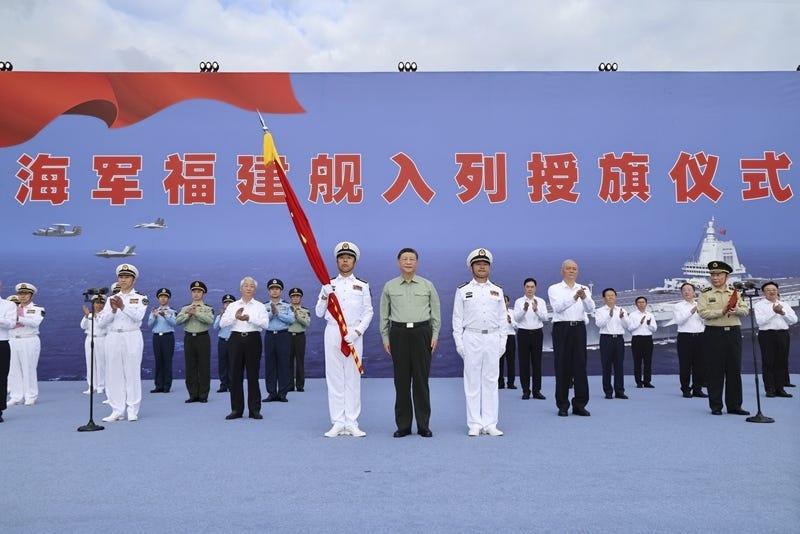
The ceremony showcased the carrier’s indigenous electromagnetic catapult system and presented several new carrier-based aircraft on deck, including advanced fighter and airborne early-warning platforms. The Fujian is China’s first CATOBAR (Catapult-Assisted Take-Off But Arrested Recovery) carrier and its largest domestically built warship. State media described the commission as marking China’s entry into a new stage of carrier aviation development. Following the ceremony, the carrier and its strike group launched into a series of live-fire exercises on November 18th, testing operations with multiple aircraft types.
The ship had already completed multiple sea trials verifying electromagnetic launch and recovery for the J-35 stealth fighter, J-15T, and KJ-600 early-warning aircraft. According to the Chinese media, the Fujian will be home-ported in the PLA Southern Theater Command to operate in the South China Sea.
CCA Analysis: The Fujian’s commissioning represents a notable leap in China’s carrier program. The adoption of electromagnetic catapults, previously fielded only by the U.S. Navy, significantly expands the range of aircraft the PLAN can operate from its decks and increases sortie-generation potential. Early test footage suggests that carrier integration of newer fixed-wing platforms is progressing faster than anticipated. However, the transition to a true CATOBAR concept will require substantial investments in pilot training, deck-handling procedures, and sustainment infrastructure. While the Fujian is unlikely to achieve full operational readiness in the near term, its induction signals Beijing’s intent to field a carrier force capable of extended operations beyond the Western Pacific and highlights the PLAN’s ambition to reduce its technological gap with established carrier powers, and the pace of PLA’s modernization won’t be slowed down by the purge of military leadership.
Type 076 Amphibious Assault Ship Sichuan Completes First Sea Trials
In mid-November, China’s first Type 076 amphibious assault ship, the Sichuan, departed from Shanghai’s Hudong–Zhonghua Shipyard to conduct its initial sea trial. According to official and state-linked reporting, the ship spent several days at sea testing propulsion, navigation control, power distribution, and integrated platform management systems. The sea trials also included evaluations of the ship’s electromagnetic launch and recovery components, although no aircraft operations were conducted during this phase. State media described the tests as meeting expected objectives.
The Type 076 represents a new class of large-deck amphibious vessels within the PLA Navy and is believed to displace between 40,000 and 50,000 tons, making it significantly larger than the existing Type 075 landing helicopter docks. Unlike earlier platforms, the Sichuan is designed with an electromagnetic-assisted launch system intended to support fixed-wing unmanned aircraft, in addition to helicopters and landing craft. Satellite imagery and prior construction photos indicate a straight-deck configuration similar to a light carrier, with a full-length flight deck and catapult tracks installed.
CCA Analysis: The Sichuan marks a notable evolution in China’s amphibious warfare capabilities by pairing traditional landing functions with fixed-wing unmanned aviation. If the UAV integration proves successful, the Type 076 could provide persistent reconnaissance, wide-area surveillance, and potential stand-off strike coordination in contested littoral environments. The platform also indicates how the PLA envisions future joint-force operations in a Taiwan contingency. A ship capable of simultaneously serving as an aviation node, amphibious staging platform, and command-and-control hub would allow the PLA Navy and Marine Corps to operate more flexibly across multiple axes. It could support early-phase shaping operations, ISR coverage over the strait, and support helicopter-borne or surface landing elements with improved real-time situational awareness. However, the PLAN will need to further invest in layered escorts, air-defense coverage, and electronic-warfare protection if it intends to deploy the Type 076 in high-threat waters.
Section II: PLA Strategy
Zhang Youxia Commentary Features Achievements and Problems in the PLA
On November 12, Zhang Youxia published a commentary in People’s Daily, called “Advancing the Modernization of National Defense and the Armed Forces with High Quality (Studying and implementing the spirit of the Fourth Plenary Session of the 20th CPC Central Committee) [高质量推进国防和军队现代化(学习贯彻党的二十届四中全会精神)],” laying out the main tasks and requirements of the PLA coming out the 4th Plenum and 15th Five Year Plan. Jargon and propaganda aside, it’s a very illuminating treatise on the various problems plaguing the PLA and the challenges ahead. A thread highlighting the key passages, and my initial takeaways.
Here are eight key takeaways from the essay:
1) Political reliability, loyalty, and anti-corruption remain THE key priority for the PLA, given Zhang devotes the first passage to the issue. It is noteworthy that Zhang includes the phrase 两面人 (two-faced people) who “violate Party principles.” Such an emphasis suggests corruption is still the biggest problem facing the PLA, and it’s not getting any better.
2) Zhang called for the PLA to “leverage the inherent Marxist socialism values” to modernize the PLA. Zhang believes the CCP governance system is advantageous over other governance systems to build a modern army and innovate.
3) Xi is strategically planning a “three-step” process for achieving military modernization, starting with 2027, 2035 and then towards the 2049 goal of achieving a “world class military,” but bottlenecks remain. The interpretation here is that much work is needed to meet these benchmarks, which include weaknesses in the Chinese system preventing such goals (note this directly contradicts Zhang’s earlier point about the governance “advantages” that China enjoys.)
4) The PLA needs to adapt the “rapidly changing evolution of warfare,” focusing on “informatization, joint operations, and network-centric warfare.” The translation here is that the PLA is aware of military-industrial trendlines, but how much “change” and “innovation” the PLA can achieve to “be at the forefront” remains to be seen.
5) Tackle the “contradictions” restricting high-quality development. This includes network information systems, unmanned systems, new talent pools, and national R&D systems, to include “killer” weapons (i.e. assassins mace), likely targeting the U.S.
6) Utilize China’s “inherent systemic strengths” through reform, political correctness, ideology, and work style. It is notewrorthy that the means to achieve this – “rectification;” “perfecting military governance;” “reforming” the military budget system management; “strengthening” guidance, evaluation and consultation mechanisms; and “deepening” rule of law and “closing” loopholes – are key words to imply that the PLA has a lot of work to do in all these regards, and has not yet achieved a system that succeeds in military governance.
7) Strengthen civilian-military cooperation. Note that Zhang proposals for “strengthening” the system is a laundry list of all the issues preventing an efficient system that can innovate and industrialize.
8) Finally, Zhang calls for “improving quality and efficiency” of military procurement by “strengthening Party Committee leadership;” “improving cost reduction and sustainability;” and “improving asset management.” This includes “correcting tendencies such as being detached from actual combat, duplication and dispersion, and extensive and inefficient practices.” This includes “the unsatisfactory progress of some planning tasks in the past is partly related to the insufficient matching and improvement of policies and systems.” This is especially noteworthy given the focus of recent PLA purges targeting the equipment and development bureaucracy of the PLA. It’s clear that the current procurement system is deeply flawed and corrupt, and it is striking how much Zhang admits the flaws in the system, which will not be resolved quickly.
CCA Analysis: While Zhang’s essay underscored the PLA’s personnel and governance constraints in adapting to the rapidly changing evolution of warfare, what was most striking was the admission of the myriad systematic constraints within the PLA in achieving these goals. The PLA desires to “be at the forefront” of warfare, but Zhang offered a frank assessment of the bottlenecks in military governance issues facing the PLA. His essay is a sober assessment of the fundamental flaws in Party-army relations, under-performing civ-mil architectures, mismanagement of funds, and incompatibilities in the defense needs of the PLA with its governance structures.
Section III: PLA Modernization
PLAAF Unveils Progress in Integration of Unmanned Systems
The PLAAF released a new film featuring the first public formation flight of a GJ-11 stealth drone, a J-20 stealth fighter, and a J-16D electronic warfare aircraft. The clip shows the GJ-11 emerging from a hangar, taking off, and joining the manned aircraft in a coordinated sequence that highlights the maturing integration of unmanned systems. The GJ-11 features a flying wing configuration, an internal weapons bay, radar absorbing materials, and a shielded exhaust outlet that reduces its radar and infrared signatures. These traits position it for deep penetration, reconnaissance, and precision strike missions in contested environments. Meanwhile, the J-20 contributes to long range sensing and air superiority, along with electronic attack provided by the J-16D through jamming and suppressing hostile radars.
(clip of the original film from 81.cn)
The film implies that the GJ-11 now operates at a stage of practical readiness. Observed testing at major Chinese ranges has included formation control and mission sequencing trials, which reinforce the message that the drone can work as a wingman or forward sensor. The footage also reflects the broader trend within the PLAAF to build a family of stealth oriented unmanned aircraft. China has introduced several flying wing designs since 2019, and recent parades revealed additional wingman drones that support reconnaissance, jamming, and decoy roles. The appearance of the GJ-11 with frontline fighters demonstrates a shift from platform-based development to an integrated manned-unmanned system that supports distributed and persistent operations. The clip also includes a J-20 air-to-air missile launch and an HQ-20 interceptor launch, which underscores PLA’s modernization progress toward a complete air defense and strike network.
CCA Analysis: The manned-unmanned combination gives the PLAAF critical advantages. The GJ-11 can scout ahead of manned aircraft and absorb risk in high-threat zones. At the same time, the J-16D can weaken defensive sensors and create openings for the J-20 and the GJ-11. This structure allows China to plan strike packages that would penetrate air defense systems while preserving manned assets. The teaming model resembles the United States Collaborative Combat Aircraft effort, yet China’s industrial scale may support larger deployment numbers.
These advances could raise concerns in the Indo-Pacific region. In a conflict scenario, such an aerial combination would support saturation tactics against critical sites in Taiwan and against naval forces in the South China Sea – two of the power kegs in China’s periphery. Thus, by demonstrating its new capabilities, Beijing aims to strengthen deterrence by presenting a flexible and resilient strike network that can continue operating under electronic pressure. Nevertheless, this system is not impeccable: reliance on data links and satellite support could introduce vulnerabilities to cyber intrusion and signal disruption. Ultimately, the success of this model will depend on the PLAAF’s ability to secure communications and maintain autonomy under contested conditions in real-life battlefields.
Section IV: PLA Research Highlights
Title: Modeling and Design of Aviation Platform Reconnaissance System Based on Advanced Simulation Framework [基于先进仿真框架的航空平台侦察系统建模与设计]
Authors: Zhao Zhen [赵震]1,2, Zhao Xiaolin [赵晓林]1, Li Zongzhe [李宗哲]1, Li Yunfei [李云飞]1, Liu Dong [刘东]1, Zhang Chao [张超]2
Affiliation: 1. Air Force Engineering University, Shaanxi; 2. Unit 93057 of PLA, Jilin
Publisher: Aviation Ordnance [航空兵器]
Date: 2025-11-10
Abstract: A simulation modeling design method for an aviation platform reconnaissance system based on the advanced simulation framework is proposed. The overall architecture design, platform modeling design approach, and behavioral modeling approach of the platform are discussed. Through complete reconnaissance process modeling and multi-sensor fusion simulation, the application development and testing of the aviation platform reconnaissance system are completed. Practical experience shows that the advanced simulation framework can effectively simulate the operational processes of aviation platform reconnaissance systems, supporting the simulation work at various stages of aviation platform reconnaissance equipment, thereby enhancing the research, argumentation, and design capabilities of aviation platform reconnaissance equipment in complex battlefield environments.
Link: https://link.cnki.net/urlid/41.1228.TJ.20251107.1440.001
Title: Research on the Development of Intelligence in the Field of US Navy Situation Awareness [美海军态势感知领域智能化发展研究]
Authors: Niu Yalei [牛亚雷]1, Li Xun [李迅]1, Ding Peng [丁鹏]2
Affiliation: 1. 91977 Unit of PLA, Beijing; 2. the 28th Research Institute of China Electronics Technology Group Corporation, Jiangsu
Publisher: Command Control & Simulation [指挥控制与仿真]
Date: 2025-11-28
Abstract: As one of the core elements of the naval battlefield, situational awareness plays a vital role in supporting commanders to grasp battlefield information in an all-round way and ensuring the efficient execution of command decisions. Starting from the situation of future wars, this article studies and analyzes the key intelligent projects in the field of situational awareness of the US Navy under the guidance of the new combat concepts of the US Navy, the development strategy of artificial intelligence of the US military, and combat concepts. It also summarizes its key technologies and suggestions for the application of artificial intelligence technology in the field of situational awareness by the navy.
Section V: PLA Observers
James Palmer, “What Are China’s Nuclear Ambitions?” Foreign Policy, November 4, 2025, https://foreignpolicy.com/2025/11/04/china-trump-nuclear-weapons-testing-arsenal/.
Jennifer Hlad, “China is already dominating the data war in the Pacific, experts say,” Defense One, November 4, 2025, https://www.defenseone.com/threats/2025/11/china-already-dominating-data-war-pacific-experts-say/409310/.
Rupert Schulenburg and Erik Green, “The PLA’s expanding joint-exercise profile and modernisation,” International Institute for Strategic Studies (IISS), November 6, 2025, https://www.iiss.org/online-analysis/charting-china/2025/11/the-plas-expanding-joint-exercise-profile-and-modernisation/.
China Power Team, “How Advanced Is China’s Third Aircraft Carrier?” Center for Strategic and International Studies (CSIS) - ChinaPower, November 7, 2025, https://chinapower.csis.org/china-type-003-fujian-aircraft-carrier/.
Gerui Zhang and Brandon Tran, “Political Purification and Strategic Realignment in the PLA,” The Jamestown Foundation, November 14, 2025, https://jamestown.org/political-purification-and-strategic-realignment-in-the-pla/.
Nick Childs and Douglas Barrie, “China’s Carrier Capabilities – Fujian Adds a New Boost,” International Institute for Strategic Studies (IISS), November 14, 2025, https://www.iiss.org/online-analysis/military-balance/2025/11/chinas-carrier-capabilities--fujian-adds-a-new-boost/.
“The Warcast: China’s Newest Aircraft Carrier”, War on the Rocks, November 18, 2025, https://warontherocks.com/episode/warcast/42118/chinas-newest-aircraft-carrier/.
Andrew Orchard, “How China’s Expanded Operations in the Sea of Japan Are Troubling Tokyo,” Center for International Maritime Security (CIMSEC), November 20, 2025, https://cimsec.org/how-chinas-expanded-operations-in-the-sea-of-japan-are-troubling-tokyo/.
Allison Martell, David Lague, Clare Farley, and Minami Funakoshi, “Visual Investigation: China’s Shadow Navy Trains to Take Taiwan,” Center for a New American Security (CNAS), November 20, 2025, https://www.cnas.org/press/in-the-news/chinas-shadow-navy-trains-to-take-taiwan.
Raymond Wang and Lachlan MacKenzie, “Golden Dome for America: Assessing Chinese and Russian Reactions,” Center for Strategic and International Studies (CSIS), November 20, 2025, https://www.csis.org/analysis/golden-dome-america-assessing-chinese-and-russian-reactions.
Tye Graham and Peter W. Singer, “To China’s war planners, AI is just another thing to deceive,” Defense One, November 24, 2025, https://www.defenseone.com/threats/2025/11/chinas-emerging-counter-ai-warfare-playbook/409757/.
Suyash Desai, “A ‘Cold Start’ Military Posture with Chinese Characteristics,” Center for Strategic and International Studies (CSIS) - ChinaPower, November 24, 2025, https://chinapower.csis.org/analysis/pla-cold-start/.