


This issue of PLA Watch takes a closer look at how the People’s Liberation Army is moving ahead on several interconnected fronts at the start of 2026, from military diplomacy to operational concepts and force modernization. Alongside sustained high-level engagement with Russia amid a more volatile international environment, we highlight clearer PLA signaling on unmanned systems, counter-swarm, and attrition concepts. We also look at fifth-generation fighter programs that are increasingly defined by scale, integration, and routine employment rather than experimentation.
Written by:
Lyle Morris, Senior Fellow
Jie Gao, Research Associate
Sheng-wen Cheng, Intern
Chinese and Russian Defense Ministers Held Video Conference
Chinese Defense Minister Dong Jun and Russian Defense Minister Andrei Belousov held a video conference on Jan 26. The call focused on the state of China–Russia military relations and the implementation of agreements reached by the two countries’ leaders. Both defense ministers emphasized strategic communication, practical cooperation, and coordination on international and regional security issues, without disclosing specific agenda items or outcomes.
The Chinese readout highlighted the importance of maintaining close defense ties under the guidance of leader-level consensus, reiterating Beijing’s support for deepening military exchanges and cooperation. While Belousov brought up Venezuela and Iran during the opening remarks in a video published online, the official press release did not disclose specific language from their discussions on these two hot topics.
CCA Analysis: The Dong–Belousov video conference occurred amid a volatile international environment. The meeting marked one of the first senior China–Russia military exchanges following heightened tensions involving Venezuela and Iran. Public messaging from both sides continued to emphasize shared opposition to what they describe as U.S. intervention in other countries’ internal affairs. At the same time, the broader context suggests that the discussions may have extended beyond rhetorical alignment to include practical assessments of regional risks and partner capabilities.
Recent developments in Venezuela underscore potential challenges for both Moscow and Beijing as defense partners. Despite Caracas’ adoption of Russian air defense systems and Chinese radar technologies, U.S. military operations appeared to negate Venezuela’s ability to detect or deter U.S. aircraft. Some analysts attribute this outcome largely to issues of system integration, readiness, and operational execution rather than equipment performance alone. Nonetheless, the episode may prompt reflection in both capitals on the effectiveness of exported systems and the broader implications on bilateral coordination in addressing capability and integration gaps.
Iran’s security environment adds another layer of complexity. Although China, Russia, and Iran do not maintain a formal alliance, their regular trilateral and multilateral military exercises suggest ongoing efforts to build coordination mechanisms and shared operational familiarity. With Iran facing sustained U.S. military pressure, Beijing and Moscow may see value in aligning assessments of escalation risks and potential responses, even if such coordination remains informal and discreet.
The timing of the call also coincides with renewed diplomatic activity surrounding the war in Ukraine, including recent trilateral engagements involving Russia, Ukraine, and the United States. While no details were disclosed, developments on the Ukrainian front and the trajectory of negotiations will likely impact China–Russia defense consultations, particularly as Moscow manages multiple strategic challenges and Beijing continues to emphasize stability and risk management in its external security environment.
PLA Trains for Saturation Swarms and Sustainable Intercepts
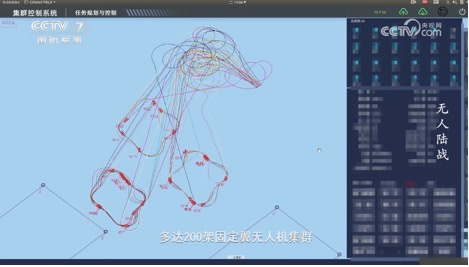
In recent weeks, the PLA has publicized training activities and operational messaging related to unmanned aerial systems and counter-drone capabilities. On January 4, China Central Television (CCTV) footage showed a PLA Navy unit, at the start of its 2026 training cycle, employing “blue force” opposition force training. The “blue force” used multiple attack drones to simulate ultra-low-altitude penetration strikes against maritime targets, while the “red force” responded with shipborne missiles and interception systems. The report said the unit recreated a battlefield environment featuring multi-wave suicide-drone attacks to test countermeasure equipment. Days later, on January 20, CCTV disclosed details of an AI-enabled drone-swarm test by the National University of Defense Technology (NUDT, 中国人民解放军国防科技大学). It stated that a single soldier could control a swarm of more than 200 drones, relying on artificial intelligence and data links to launch them in large numbers within a short period. The system allocates tasks through autonomous algorithms and shifts between reconnaissance, diversion, and strike roles.
In parallel, China North Industries Group Corporation (NORINCO, 中国北方工业集团有限公司) released partial specifications for its truck-mounted Hurricane 3000 (飓风3000) high-power microwave counter-drone system, which was displayed during the military parade in Beijing last September. NORINCO claims the Hurricane 3000 has an effective interception range of 3 km against small UAVs and drone swarms, and describes employment as a standalone asset or as part of a networked “iron triangle” with laser weapons and conventional artillery. On the external-operational front, the PLA Southern Theatre Command said it conducted “completely legitimate and lawful” routine flight training in airspace around what it calls Dongsha (Pratas) Island, while Taiwan’s Ministry of National Defense reported that a PLA reconnaissance drone briefly entered the island’s airspace and said it issued warnings over international radio channels.
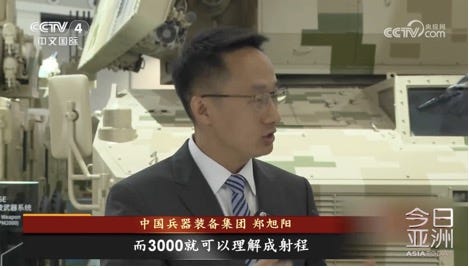
CCA Analysis: The PLA views drone operations at a key feature of future combat. What is most noteworthy is that the PLA has regularized drone warfare into annual PLA training requirements, as opposed to one-off exercises. The PLA Daily describes the current equipment shift in terms of “unmanned (无人化), intelligent (智能化), and clustered (集群化)” capabilities, and argued that warfare is moving from “platform-centric warfare (平台中心战)” toward “system-versus-system confrontation (体系对抗).” Recent training coverage focuses on the employment of multiple suicide drones flying at low altitudes to generate saturation pressure, then rehearsing shipborne interception against multi-wave attacks. Furthermore, NUDT’s swarm tests appear to be focusing on the integration of AI into data-enabled battlefield concepts, emphasizing single-soldier control, rapid mass launch, autonomous task allocation, and role switching. On the defensive side, NORINCO’s high-power microwave system points to a more sustainable counter-swarm approach, emphasizing longer-range interception and networked employment with lasers and conventional fires. Operationally, unmanned platforms support real-world operational training, as reflected in the PLA’s recent flights near Dongsha/Pratas Islands and Taiwan’s reporting of a brief drone entry.
PLA Aviation Progress in Stealth Mass Production and Kill Chain Integration
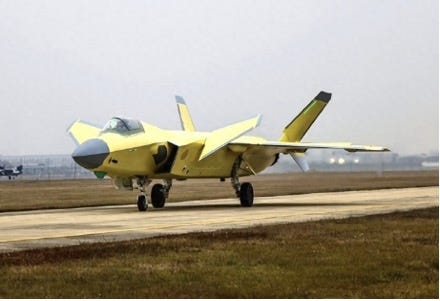
Recent flight tests of China’s fifth generation stealth fighter — the J-20A — indicate that the aircraft is approaching operational effectiveness. The Chengdu Aircraft Corporation (CAC) showcased multiple “yellow-coat” J-20As, prompting speculation about improvements in engine technology, dorsal avionics, and AI integration. Simultaneously, the Shenyang Aircraft Corporation (SAC) has operationalized a new assembly facility to support another fifth-gen fighter – the J-35 – suggesting an ability to deliver large batches of the aircraft.
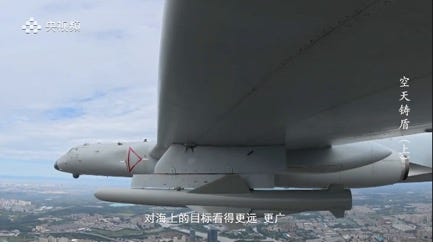
Beyond fighter platforms, recent official coverage has reframed the role of the H-6J bomber, highlighting its evolution into an integrated sensor node. Specifically, a recent showcase of the bomber revealed for the first time specialized reconnaissance pods on its outer wing pylons. Reconnaissance pods turn bombers into high-end intelligence, surveillance, and reconnaissance (ISR) platforms without permanently modifying the aircraft, which enhance ISR sharing between bombers, fighter jets, and drones.
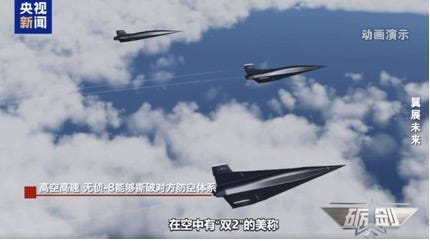
Finally, recent state media reports provide clarity on how the PLA is integrating the WZ-8 UAV into a broader array of high-altitude, high-speed ISR capabilities. Utilizing a rocket-powered design, the WZ-8’s “Double 2” capability - which can reach 20,000-meters at Mach 2 speeds – provides the PLA added capability to penetrate carrier strike group air defenses. In particular, the WZ-8’s will have an important role in providing terminal targeting data required for long-range anti-ship systems, closing the kill chain against high-value targets.
CCA Analysis: Accelerated production of the J-20A and J-35 signifies that the PLA’s stealth fighter development has entered an industrialized mass delivery phase. External estimates from RUSI suggest the PLA Air Force has deployed over 300 J-20s across 13 regimental units, with J-20A annual production projected to reach 120 units by late 2025. If true, such scale will erode U.S. and allied stealth combat advantages within the First Island Chain. The completion of SAC’s new assembly facilities moves the J-35/A from a Low-Rate Initial Production (LRIP) phase into industrialized production at scale.
Concurrently, the PLA is “nodalizing” legacy platforms to optimize long-range strike chains. Recent disclosures regarding the H-6J highlight its evolution from a pure missile bomber into an aerial sensor node for ISR, bridging a critical gap in over-the-horizon (OTH) maritime strikes. This shift, supported by regularized South China Sea deployments, allows the PLA to utilize the H-6J for additional roles, such as for extending kill-chain strikes over contested waters. When paired with the WZ-8 UAV, the PLA is formalizing an ISR architecture designed to bypass existing air defense grids and provide terminal guidance for standoff anti-ship assets.
Strategically, the combination of industrial capacity and distributed nodes significantly bolsters the resilience of the PLA’s Anti-Access/Area Denial (A2/AD) framework. As stealth platforms become ubiquitous, secondary assets like the H-6J and WZ-8 provide additional sensing capabilities. As a result, potential adversaries like the United States face a more lethal strike network that is increasingly difficult to counter.