



Dear PLA Watch readers,
We wanted to share some exciting news about PLA Watch. The Center for China Analysis (CCA) is launching a new Substack page featuring timely insights and analysis from CCA fellows and staff on broader China questions. As a result, PLA Watch will be folded into a broader array of CCA content.
What does that mean for you? PLA Watch isn’t going anywhere. It will continue to provide fresh and timely analysis on all things PLA. If you’re happy to receive the broader CCA Substack content, you don’t need to do anything — you’ll continue to receive PLA Watch as usual, along with other analysis from our team. If you prefer to receive only PLA Watch-related emails, you’ll be able to adjust your subscription preferences on your desktop following the instructions below:
Navigate to your Home page (https://substack.com/home) and log into your account
Select “☰ More” at the bottom left and go to “Settings”
Scroll down to “Subscriptions” and select Center for China Analysis
Under “Notifications,” choose which sections you would like to receive
And of course, you can unsubscribe at any time through the standard links at the bottom of any email.
We are grateful for your continued readership and support of PLA Watch, and are excited to be joining the new CCA Substack page providing new, timely content on Chinese foreign policy, domestic politics, economic and technology issues, among other items. Thank you for being part of this community, and we look forward to sharing what’s next!
Regards,
Lyle and Jie
This issue of PLA Watch examines Chinese arms exhibitions at the 2026 World Defense Show (WDS) and the Singapore Airshow; new unveilings of long-range unmanned aerial systems; and the expulsions of senior defense industry officials from China’s National People’s Congress.
Written by:
Lyle Morris, Senior Fellow
Jie Gao, Research Associate
Sheng-wen Cheng, Intern
Dual Showcases: China’s Defense Export Signaling at WDS 2026 and the Singapore Airshow
Over the past two weeks, Chinese defense state-owned enterprises (SOEs) unveiled cutting-edge weapons and equipment at the 2026 World Defense Show (WDS) and the Singapore Airshow.
The WDS, which kicked off on February 8 in Riyadh, is a biennial international defense exhibition held in Saudi Arabia. Compared to 2024, China’s presence this year expanded significantly, positioning itself as the second-largest participant behind host Saudi Arabia. A total of 204 Chinese-registered entities participated, compared to 158 U.S.-registered entities. While exhibitor numbers do not equate to technological capability or market share, they nevertheless provide a reference point for assessing China’s overseas commercial mobilization and export engagement.
Against this backdrop, the structure of China’s display reflected themes Beijing has recently emphasized, from traditional heavy platforms toward unmanned, intelligent, and system-level export solutions. In the naval domain, China showcased the 075E export amphibious assault ship and the 052DE export destroyer, alongside a conceptual 20,000-ton export landing platform dock (LPD). In parallel, China State Shipbuilding Corporation (CSSC) displayed the SDV-01 swimmer delivery vehicle, a wet submersible designed for underwater insertion and special operations missions.
Taken together, these platforms presented a maritime portfolio spanning amphibious lift, area air defense, and subsurface capabilities.
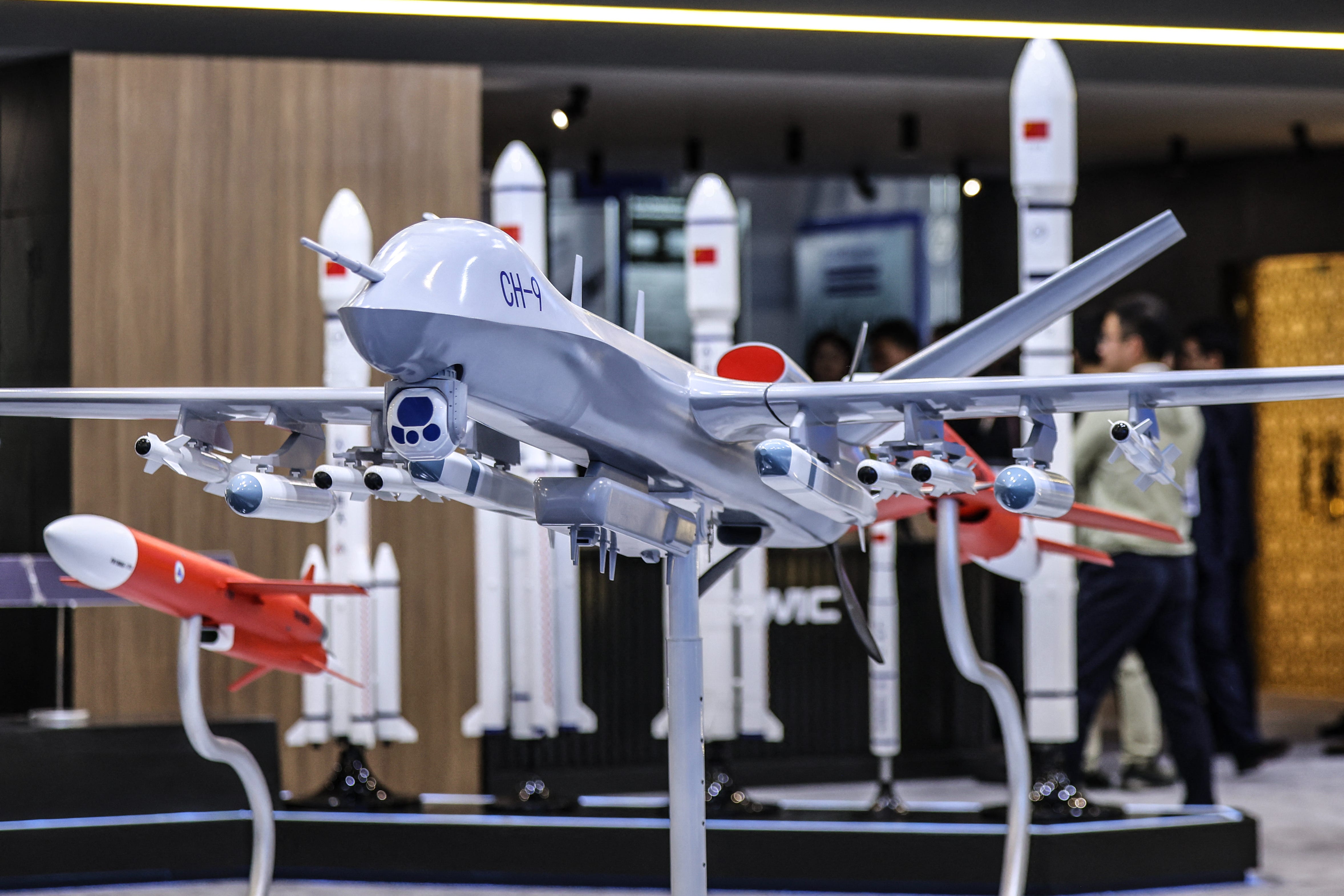
Unmanned systems formed the central focus of the exhibition. In addition to the established Wing Loong (翼龙) and Caihong (CH, 彩虹) series drones, China displayed the Wing Loong-X anti-submarine warfare (ASW) variant, an extended endurance and long-range maritime mission variant of the Wing Loong. Similarly, the CH-9 was presented as a longer-range, heavy-payload UAV platform. Meanwhile, the China North Industries Corporation (Norinco) exhibited the FL-300C loitering munition and introduced the Sharp Shark-10 unmanned surface vessel (USV) concept, combining unmanned platforms with expendable precision strike capability.
On land, the Robotic Wolf unmanned ground vehicle demonstrated swarm-based operational concepts, while the Saudi-optimized VT-4 main battle tank and the FL-50 armored vehicle highlighted desert adaptability.
Finally, in aerospace and air defense, China showcased the JF-17 Block III, J-10CE, and HQ-9BE systems, emphasizing integrated air defense and multi-target interception capabilities.
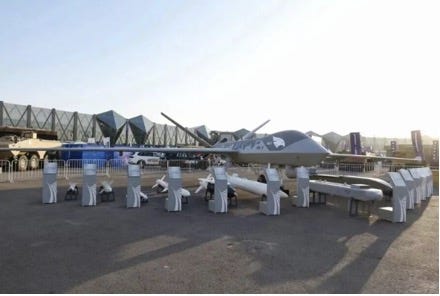
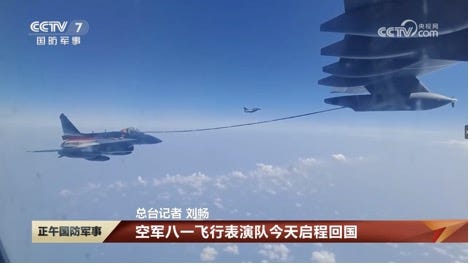
Beyond WDS, China also exhibited advancements in Chinese-manufactured air assets. Seven J-10C fighters flew in formation supported by a Y-20A aerial refueling tanker. The J-10C, equipped with an AESA radar and compatible with PL-10 and PL-15 air-to-air missiles, was presented as a cost-effective 4.5-generation export fighter. At the same time, indoor exhibits featured models of next-generation stealth platforms such as the J-35A and the J-20.
CCA Analysis: These displays are juxtaposed to surprising decreases in Chinese arms exports worldwide. According to the Stockholm International Peace Research Institute (SIPRI), in 2024, the combined revenue of top Chinese arms companies fell by approximately 10% to 145 billion, [JL1] driven by internal corruption and project delays. This drop contrasts sharply with rising global arms sales, with major firms like NORINCO seeing revenues plunge by 31%.
Despite these setbacks, China is positioning itself as a supplier-of-choice for cross-domain packages rather than individual platforms. The combination of amphibious assault ships, destroyers, long-endurance ASW UAVs, heavy-payload drones, unmanned surface vessels, and subsurface assets signal an effort to market multi-domain operational architectures instead of discrete systems.
In particular, China is positioning itself as one of the most potent suppliers of unmanned platforms. ASW-configured UAVs with longer endurance that can extend beyond traditional ISR position China into a lucrative market for maritime surveillance, anti-access, and strategic strike scenarios.
In Asia, the Singapore Airshow showcased China’s attempt to make inroads into a market dominated by U.S. airframes. With approximately 300 F-35s projected to be operational in the Asia-Pacific by 2035, including major fleets in Japan, Australia, and South Korea, the United States retains structural advantages in networked airpower integration. Yet China’s share of arms sales to Southeast Asia has grown [JL2] significantly over the past decade at the same time that U.S. and Russia’s shares have decreased. While most of these sales have been for land-based assets, China hopes that its fourth and fifth-generation fighters will become the next big package that attracts air forces of Southeast Asia.
China’s Un-crewed Systems Trajectory: YH-1000S Maiden Flight and GJ-21 Testing on Type 076
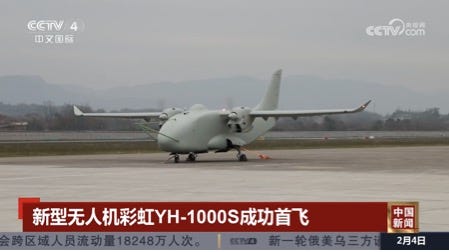
Two recent developments have drawn attention to China’s burgeoning unmanned systems portfolio: 1) the maiden flight of the CH YH-1000S hybrid-powered unmanned transport aircraft; and 2) the GJ-21 stealth attack UAV, with photos circulating on social media appearing to show the aircraft on the deck of the PLA Navy’s Type 076 amphibious assault ship Sichuan during recent testing.
The CH YH-1000S is an upgraded variant of the CH YH-1000 and uses a hybrid propulsion system combining a fuel engine and an electric motor. Official reporting claimed the configuration can shorten takeoff and landing distances and improve payload and range. As a reference point, previously reported CH YH-1000 parameters include a 1,200 kg cargo capacity, 1,500 km range, and over 10 hours of endurance, with the ability to operate in complex terrain.
Separately, photos circulating online show a covered fixed-wing airframe on the Sichuan’s deck during sea trials. Some observers have speculated the aircraft could be the GJ-21 stealth attack UAV, but the timing, location, and platform identity remain unconfirmed. Observers have dubbed the Type 076 a “drone carrier,” reflecting an expectation that the platform is intended to operate fixed-wing unmanned aircraft from an amphibious deck. The introduction of the GJ-21 from the 076’s flight deck only underscores this operational concept.
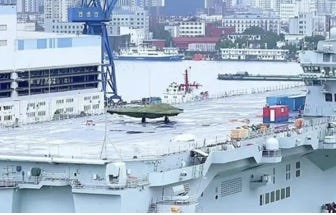
CCA Analysis: China has long invested in unmanned ISR and strike platforms. But what stands out with these two developments is the advancement of longer-range capabilities and the ability to employ such systems from longer-range assets, such as the Type 076.
What sets the YH-1000S apart is the larger payload (1,200 kg), range (1,500 km) and short-takeoff/landing (STOL) capability, allowing it to operate in rough terrain and support autonomous, 24-hour logistics operations. Only the U.S. fields UAVs with similar capabilities, which offers China the ability to operate from austere runways while reducing logistical constraints. A platform like this could sustain high-frequency, small-batch deliveries of ammunition, spare parts, communications equipment, or medical supplies for civilian or military needs.
Deploying the GJ-21 from the Type 076’s “drone carrier” gives China a new dimension of airpower from amphibious assets. Fixed-wing stealth UAVs—whether the GJ-21 or another platform—would support persistent maritime ISR and strike options beyond what helicopter-centric amphibious ships can currently generate.
This matters a great deal for a Taiwan Strait scenario. Sustained fixed-wing UAV sorties from a large-deck amphibious ship provide the PLA Navy and Marines aircover during potential landing operations and joint firepower campaigns. In parallel, the more China can operate large airframe UAVs, such as the YH-1000S from austere airfields, the better the PLA can resupply and support dispersed operations near or on Taiwan. While such systems need to be integrated into joint PLA command platforms, the assumption is that such integration will be achieved as the PLA conducts more sophisticated and larger-scale exercises around Taiwan.
China Expels Defense Industry Officials from Legislature Amid Corruption Crackdown
China’s unprecedented anti-corruption campaign in the PLA has broadened in recent weeks to ensnare senior leaders within China’s defense sector. On February 4, China’s top legislative body, the National People’s Congress (NPC) Standing Committee, announced the removal of three senior officials—former Aviation Industry Corporation of China (AVIC) chairman Zhou Xinmin, veteran nuclear technologist Luo Qi, and former China Academy of Engineering Physics head Liu Cangli—from their positions as 14th NPC deputies.
All three spent decades at the core of China’s military-industrial and strategic technology systems. Their cases are not isolated, coming on the heels of investigations involving colleagues or predecessors within the same defense organizations. At AVIC, Zhou’s predecessor Tan Ruisong was placed under investigation in 2024, while China’s nuclear and aerospace systems have seen multiple senior technologists and executives removed or prosecuted in recent years.
Separately, on February 10, authorities announced that the investigation into Zhang Jianhua, former deputy director of the State Administration of Science, Technology and Industry for National Defense, had concluded and that his case had been transferred to prosecutors for review and indictment. During his tenure, Zhang exercised long-standing authority over defense project review, budgeting, auditing, and, for a period, military export administration.
CCA Analysis: The officials affected in these cases were deeply embedded in weapons research, industrial production, project approval, and funding oversight. Their roles intersected with procurement cycles, classified programs, and large capital flows. As previously reflected in PLA Watch coverage of cases involving major defense conglomerates, these positions have increasingly become focal points for anti-corruption investigations. Moreover, these cases signal that seniority and technical authority offer no insulation from Xi’s aggressive anti-corruption campaign increasingly targeting the defense sector.
Importantly, there is no public indication that these cases are directly linked to the more recent purges of senior Central Military Commission leaders, such as Zhang Youxia. Instead, they appear to reflect a parallel track aimed at tightening discipline within the defense industrial base itself. This suggests Beijing is prioritizing governance, cost control, and reliability in weapons development as the PLA accelerates modernization, treating industrial accountability as a prerequisite for combat readiness rather than a secondary concern.