



In this issue of PLA Watch, we dive into the PLA’s apparent absence from a planned trilateral drill with Iran and Russia prior to the United States launching its strikes on Iran. We also look at recent U.S. allegations of a covert Chinese nuclear test in 2020 which may increase pressure on China to join trilateral arms control talks; the presence of the Type 095 submarine in satellite images, signaling advances in China’s undersea capabilities and blue-water reach; and finally, Xi Jinping’s combat-readiness review during the Spring Festival greeting and its implications for political discipline and consolidation within the armed forces.
Written by:
Lyle Morris, Senior Fellow
Jie Gao, Research Associate
Sheng-wen Cheng, Intern
China Absent From Planned Joint Drill with Iran and Russia Amid Renewed Escalations
The PLA appears to have missed a key joint military exercise with Iran and Russia in the Strait of Hormuz before the United States and Israel launched a new round of attacks against Tehran. In late January and early February, multiple media outlets cited Iran’s semi-official Tasnim News Agency, which reported that Iran, Russia, and China would conduct the eighth “Maritime Security Belt” joint naval exercise in the Northern Indian Ocean in mid-February. On February 17, a Russian official confirmed in an interview that Russia, China, and Iran would hold routine joint naval drills in the Strait of Hormuz under the “Security Belt 2026” framework.
Currently, the only military activity reported by major international media sources is the February 19 bilateral naval exercise between Russia and Iran in the Gulf of Oman. The Russian Ministry of Defense described the activity as a “pre-planned” joint drill and did not use the designation “Maritime Security Belt-2026” in its official statement. Nor did it mention Chinese participation.
Based on currently available public information, China’s Ministry of National Defense and Chinese state media have not issued any formal announcement confirming that the PLA Navy (PLAN) participated in this round of exercises. Although Iranian media in late January and Patrushev’s February 17 remarks characterized the activity as a trilateral “Security Belt 2026” exercise, the only verifiable military activity at present remains a bilateral operation between Russia and Iran.
On February 28, President Trump authorized Operation Epic Fury against Iran. After losing its supreme leader and other senior officials, Tehran launched retaliatory attacks on U.S. facilities in the Gulf region.
CCA Analysis: It is plausible that China foresaw the possibility of Washington’s preemptive attacks against Tehran when it postponed or canceled the joint drill. By avoiding force deployment near the flashpoint, Beijing appears to have minimized the risks of unwanted entanglement or misperception by Washington amid imminent escalation.
In previous episodes of U.S.-Iran confrontations, Beijing did not withdraw from the joint drills with Iran when the attacks were exchanged through the proxies. In December 2019, despite the Trump administration’s ongoing “maximum pressure” campaign, China launched the inaugural “Security Belt” exercise together with Iran and Russia. Ahead of the March 2024 joint drill, the U.S. Air Force launched a series of airstrikes targeting Iran’s forces and proxies in Iraq and Syria. Yet China dispatched its naval force to the Gulf of Oman, labeling the drills as regular military exchanges on maritime safety.
In the past, Beijing tried to downplay political sensitivities related to its military drills in regional hotspots by presenting them as non-combat activities, including anti-piracy operations, merchant ship escorts, and search-and-rescue missions. However, as the United States intensifies military pressure on Tehran, China increasingly risks being perceived as part of an “anti-West” quasi-alliance, particularly due to Russia’s involvement. As the Xi-Trump summit approaches, Beijing is likely to prioritize a stable strategic environment and avoid opening a new front in the Middle East against Washington.
However, the absence of the PLAN alone does not necessarily indicate strategic distance. Beijing can keep defense ties with Iran without deploying naval assets in a high-visibility drill. Although Beijing has denied recent reports regarding Tehran’s potential acquisition of supersonic anti-ship cruise missiles from China, it remains plausible that China will provide intelligence support and transfer dual-use electronics and components to Iran, as has occurred with supplies to Russia in Ukraine.
Read more: Jie Gao, Re-Engaging With the World: China’s Military Diplomacy in 2023
Nuclear Test Allegations Renew U.S.-China Arms Control Frictions
Washington has ratcheted up pressure on Beijing over allegations that China carried out a covert nuclear test in 2020. On February 6, a U.S. official alleged that China conducted a “yield-producing” underground nuclear explosive test near Lop Nur — China’s former nuclear test site in Xinjiang — on June 22, 2020. Speaking at the Conference on Disarmament in Geneva, he also suggested Beijing may be preparing more low-yield tests and using “decoupling” techniques to reduce seismic detectability.
The Comprehensive Nuclear-Test-Ban Treaty Organization (CTBTO) responded that its International Monitoring System (IMS) did not detect an event consistent with a nuclear weapon test at that time. Chinese diplomats pointed to that statement to reject the U.S. charge as “completely groundless” and criticized Washington for manufacturing a pretext to resume nuclear testing.
The dispute intensified after the U.S. Assistant Secretary Christopher Yeaw cited a magnitude 2.75 seismic signal recorded at 09:18 UTC on June 22, 2020 by a station in Kazakhstan. He argued that it resembled a single underground explosion rather than an earthquake or routine mining, while acknowledging that possible “decoupling” could muffle the signal, making the true yield hard to classify.
The CTBTO later clarified that it did detect two very small seismic events 12 seconds apart near the area, but said they were far below its identification threshold and insufficient, by themselves, to determine the cause.
During the U.S.-Japan Extended Deterrence Dialogue in Washington, D.C., Under Secretary of State Thomas DiNanno later briefed Japan on the test, underscoring an effort to alert allies and partners about the gravity of the incident.
China’s nuclear weapons testing is overseen by the Central Military Commission, executed by PLA testing units at Lop Nur, and scientifically led by the China Academy of Engineering Physics — not by a single civilian government agency.
CCA Analysis: This is one of the first instances of a U.S. official publicly disclosing a nuclear test outside the confines of the treaty. It represents an effort by Washington to put pressure on Beijing to enter a new trilateral arms control treaty with the U.S. and Russia, citing Beijing’s rapidly expanding arsenal over the past decade. Beijing views the accusation as a deliberate attempt to coerce China into joining arms control dialogue with Washington, given the expiration of New START — the last binding cap on U.S. and Russian strategic warheads. Chinese officials likely view the Lop Nur claim as a means to justify expanded U.S. options, including renewed nuclear testing, if China refuses to engage.
However, such a public pressure campaign is unlikely to bring Beijing to the negotiation table. In its November 2025 arms control white paper, China argued that those with the biggest arsenals (i.e., Russia and the U.S.) should lead on arms control and warhead reductions, while wider multilateral negotiations should proceed only when “conditions are conducive.” It also presents nuclear transparency as a voluntary, confidence-building practice shaped by each country’s security environment.
In that context, Beijing is unlikely to be persuaded to join formal arms control talks with Washington, especially if it believes it would be negotiating from a disadvantageous position. Chinese writings suggest that treaty-style caps and intrusive verification could constrain modernization and transparency in ways that weaken a smaller force’s survivability — especially given concerns about U.S. missile defense and long-range conventional strike. As a result, U.S. efforts to use allegations and public messaging to compel negotiations may exert limited coercive leverage over Beijing.
Read more: Unpacking Chinese Views of Deterrence
China Makes Waves with New Nuclear-powered Submarine
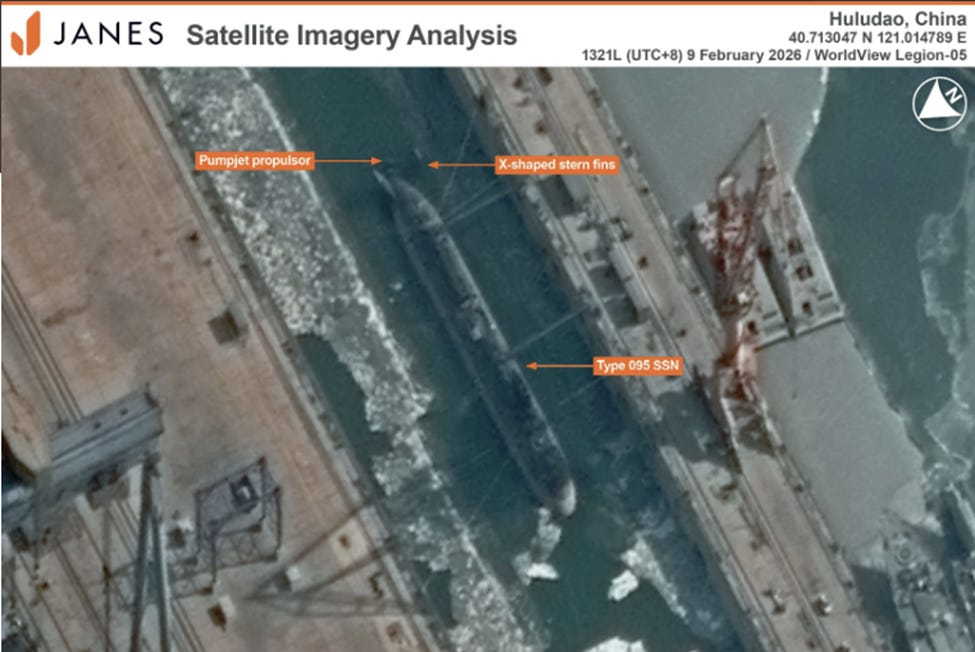
Commercial satellite imagery dated February 9 showed what analysts believe to be the first Type 095 nuclear-powered attack submarine (SSN) at Bohai Shipbuilding Heavy Industry (BSHIC) in Huludao, Liaoning. Additional imagery dated February 13 indicated that the Type 095 hull had been moved into a launch bay or flooded drydock at the same facility.
The clearest change analysts noticed from imagery is the SSN’s new hull and tail design, increasing its stealth capabilities. This includes a new “X-tail” rudder configuration — a first for Chinese SSN — as well as improved underwater maneuverability and hydrodynamics. These design features will significantly reduce acoustic noise and increase survivability.
Based on satellite-derived estimates, the Type 095 is roughly 110 meters long, with a beam of approximately 12–13 meters and a displacement of 9,000 tons. Open-source assessments suggest the Type 095 may include vertical launch systems (VLS) for cruise missiles and torpedoes, which would enhance the PLA Navy’s land-attack and anti-ship capabilities. All indications suggest the Type 095 has similar capabilities to the U.S. Virginia-class SSN and Russian Yasen-class SSN.
The Type 095 is likely to be fully operational by 2029.
CCA Analysis: The Type 095’s appearance is notable for several reasons. First, it will likely be much quieter and more survivable compared to older models. An Office of Naval Intelligence assessment highlighted how the Type 094’s noise made it easier to track. Acoustic noise reduces a submarine’s survivability, thereby limiting China’s sea-based deterrence credibility and range.
Second is the implications for regional deterrence. When operationally deployed, the Type 095 will provide the PLAN with an enhanced deterrence posture beyond the first island chain. China’s existing SSNs have a limited range due to noise and stealth limitations. This new variant will allow China to operate farther out into the Pacific and Indian Oceans, bringing nations such as Australia and India into range. The U.S. Navy (USN) is the only military power in the region that can match the PLAN in quantitative and qualitative capabilities. As a result, allies and partners will rely even more than before on USN undersea capabilities to offset the threat from China’s burgeoning SSN assets.
Finally, the Type 095’s appearance at BSHIC in Huludao suggests an accelerated operational timeline surpassing regional expectations. According to an IISS analysis, from 2021 to 2025, China’s nuclear submarine launches and aggregate tonnage exceeded U.S. totals. This will compel the U.S. and key allies to plan against a larger and faster-growing undersea inventory, with rising ASW demand under shorter force-planning timelines.
Read more: Unpacking Chinese Views of Deterrence
Xi Jinping Reviews PLA Combat Readiness and Issues Spring Festival Guidance
On February 11, Chairman Xi Jinping reviewed the combat readiness and ongoing operations of the PLA via video link in Beijing, while delivering Spring Festival greetings to military personnel. The remarks reinforced themes of political loyalty, anti-corruption efforts, and sustained operational vigilance during the holiday period.
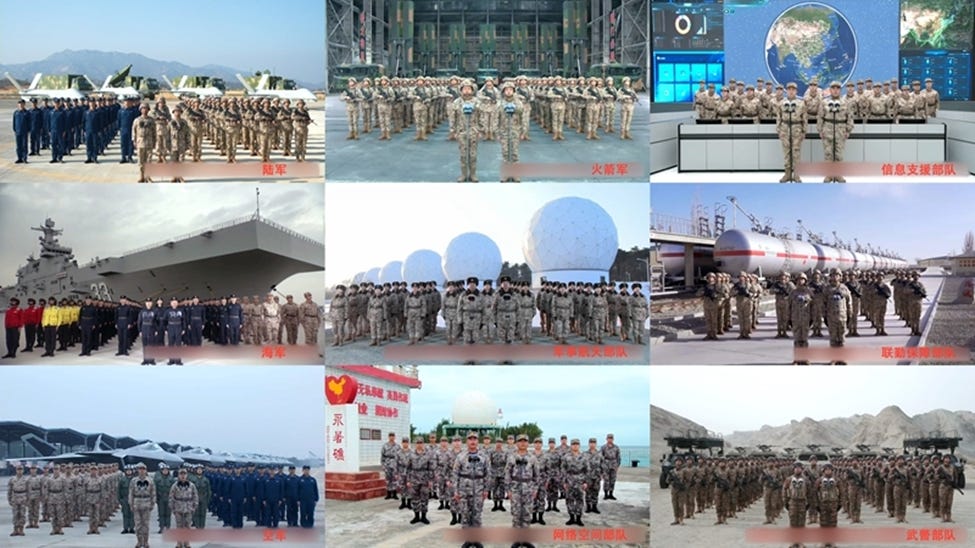
Speaking on behalf of the CPC Central Committee and the CMC, Xi extended greetings to PLA personnel, PAP forces, civilian staff assigned to nine PLA and PAP units across different services, as well as reserve and militia members, emphasizing continued top-level oversight of operational readiness and morale.
Xi characterized the previous year as “highly unusual and extraordinary,” highlighting progress in political rectification, management of risks and challenges, and intensified anti-corruption efforts within the armed forces. He described these reforms and the corruption campaign as a form of “revolutionary tempering.”
Xi praised officers and enlisted personnel — particularly at the grassroots level — for demonstrating loyalty to the Party and reliability in executing assigned missions, reinforcing the primacy of political discipline within military professionalism.
Finally, Xi emphasized that maintaining combat readiness during major holidays remains a core PLA tradition and called for continued vigilance to protect national security and public well-being during the Spring Festival period.
CCA Analysis: It was notable that Xi virtually briefed the PLA this year. During last year’s Lunar New Year message, for example, Xi visited the PLA Northern Theater Command to personally deliver the message. Given the unprecedented purges in the PLA, the recent upheaval is the likely reason for the virtual format. The remarks were clearly targeting themes of political control and anti-corruption, suggesting continued concern over trust issues within the PLA. Also notable was the inclusion of the Aerospace, Cyberspace, and Information Support Forces as units receiving the remarks, which had not been featured in previous Spring Festival reviews.
Read more:

If you prefer to receive only PLA Watch-related emails, you’ll be able to adjust your subscription preferences on your desktop following the instructions below:
Navigate to your Home page (https://substack.com/home) and log into your account
Select “☰ More” at the bottom left and go to “Settings”
Scroll down to “Subscriptions” and select Center for China Analysis
Under “Notifications,” choose which sections you would like to receive