


In this issue of PLA Watch, we highlight the deployment of the Y-20B heavy transport aircraft for the first time to South Korea to repatriate the remains of Chinese People’s Volunteer Army soldiers from the Korean War. We also examine a pilot project by a People’s Liberation Army Rocket Force unit for anonymous feedback using an internal “Strong Army” message board. Third, we dig into tit-for-tat naval exercises between China, Japan, and the United States near Taiwan and in the South China Sea. Finally, we assess the symbolism behind the PLA Navy’s promotional film marking the 77th founding anniversary of the service.
Y-20B’s First Overseas Mission Highlights Advances in China’s Military Airlift Capacity
On April 20, 2026, the PLA Air Force deployed the Y-20B heavy transport aircraft for the first time to South Korea to carry out the 13th repatriation mission for the remains of Chinese People’s Volunteer Army soldiers from the Korean War. Chinese state media noted that this marked the Y-20B’s first deployment for such a mission and first publicly confirmed overseas flight. Upon re-entering Chinese airspace, the aircraft was escorted by four J-20 fighters. The Y-20B’s primary upgrade over the baseline Y-20 is the replacement of Russian D-30KP-2 engines with domestically produced WS-20 turbofan engines that improve range, payload capacity, and fuel efficiency. While the mission itself was ceremonial, China chose to publicly announce the overseas operation to highlight the Y-20B’s operational debut.
The Y-20B sits within a broader, layered Chinese military airlift architecture. At the top tier, the Y-20A, Y-20B, and YY-20 tankers represent the PLA’s long-range strategic airlift and aerial refueling capabilities. The medium tier features the Y-30 – a four-turboprop medium tactical transport aircraft. In December 2025, the Y-30 completed its maiden flight at Xi’an. The Y-30 is designed for point-to-point distribution to forward and austere locations, with short-takeoff-and-landing capability on unpaved runways suited to environments such as South China Sea outposts and Himalayan border positions. At the lower tier, the Y-8 and Y-9 form the backbone of China’s special mission aviation. The Y-8 has been adapted for electronic reconnaissance, maritime patrol, and airborne early warning variants since the 1980s. The Y-9 has emerged as the next-generation successor in the special mission role. At the September 2025 military parade, the PLA displayed for the first time a coordinated formation of three Y-9 special-mission types: the Y-9Q maritime patrol and ASW aircraft, the Y-9DZ electronic reconnaissance aircraft, and the Y-9LG standoff jamming aircraft.
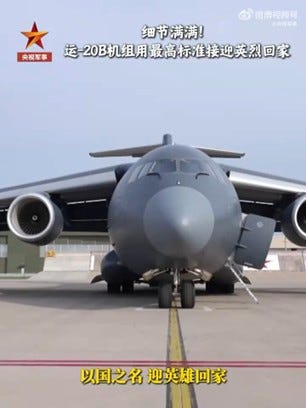
CCA Analysis: The Y-20B demonstrates the PLA’s evolution in reducing external dependence on propulsion systems for its large military transport aircraft. Early Y-20s relied on Russian D-30KP-2 engines. The adoption of the WS-20 engine marks the first case of China achieving indigenous development over both the airframe and engine of a heavy transport platform, utilizing 3D printing technology for part of the manufacturing process. The PLA has launched aerial refueling variants of the Y-20, such as the YY-20, as well as the KJ-3000 airborne early warning and control aircraft. The KJ-3000, which completed its maiden flight in late 2024, is based on the Y-20B airframe and is believed to have the capability of detecting stealth aircraft.
The U.S. Department of Defense’s 2025 Report noted that China is progressing on indigenous engine development, while cautioning that advancement will likely be gradual as China works to resolve longstanding technological barriers in advanced propulsion.
PLA Rocket Force Unit Experiments with Anonymous Online Message Board Feedback
A People’s Liberation Army Rocket Force (PLARF) unit created an anonymous online message board on its internal “Strong Army Website” (强军网) to allow officers and enlisted personnel to directly raise complaints, concerns, and suggestions to leadership. The initiative, reported by the PLA Daily, came after the unit’s Party Committee found during a soldiers’ reception day that many grassroots concerns were either not being addressed or were being distorted as they moved up the chain of command.
The unit Party Committee decided to establish a platform modeled on local government “online governance” systems. Despite concerns that the board could become a venue for negativity or harm internal relations, leadership insisted that Party organs must prioritize “grassroots first, soldiers first” and treat solving soldiers’ practical problems as a key measure of performance.
Once launched, soldiers raised issues ranging from malfunctioning duty-room equipment and broken family-compound fitness machines to outdated library resources in remote posts. One notable case involved a staff officer who assigned multiple reports on a Friday night with a Sunday deadline, prompting a soldier to complain that “one word from headquarters, and the grassroots are running themselves ragged” (机关一句话,基层跑断腿). The officer publicly apologized and promised immediate correction, while senior leaders identified the deeper issue as a weak service mentality toward grassroots units.
CCA Analysis: This is an interesting trial for improving internal governance, morale, and combat readiness within the PLA. Rather than relying on formal reporting channels, the unit is experimenting with direct feedback mechanisms through social media to ensure leadership hears frontline concerns unfiltered. In that sense, the platform is a problem-solving mechanism and a channel for strengthening trust between leadership and troops.
This reflects a broader political priority within the PLA of streamlining direct feedback from “grassroots units” to solve practical problems for soldiers. The unit Party Committee explicitly frames this as rejecting “vanity projects” and evaluating cadres based on whether they address real troop concerns, reinforcing Xi Jinping’s longstanding emphasis on combat effectiveness and addressing the welfare of soldiers.
The article also suggests that morale and operational performance are closely connected. Leadership argues that when soldiers feel heard and supported, their sense of belonging and ownership increases, which translates into stronger commitment during training and missions. The article closes by linking the success of the feedback system to strong performance during a recent live-fire assault exercise, implying that improved welfare and trust directly support readiness.
Sensitive Waterways, Sharp Signals: China and Japan’s Escalating Naval Standoff
On April 17, Japanese Maritime Self-Defense Force destroyer JS Ikazuchi transited the Taiwan Strait from 4:02 a.m. to 5:50 p.m. for approximately 14 hours. The transit fell on the 131st anniversary of the signing of the Treaty of Shimonoseki, the 1895 unequal treaty under which the Qing dynasty ceded Taiwan to Japan following its defeat in the First Sino-Japanese War. The war is a recurring symbol of national humiliation in Chinese historical memory.
China’s Ministry of National Defense condemned the transit as a “deliberate provocation” (蓄意挑衅) and lodged a formal protest with Tokyo, accusing Japan of sending the wrong signal to Taiwan independence forces. In a commentary, PLA Daily accused Tokyo of “harming the feelings of the Chinese people” by timing the transit to coincide with the anniversary.
On April 19, the Eastern Theater Command announced that PLA Navy 133rd task group, centered on Type 052 destroyer Baotou (包头), had transited the Yokoate Channel into the Western Pacific for open-water training exercises. The Eastern Theater Command characterized the deployment as “routine annual training” conducted in accordance with international law and “not directed at any specific country.”
On April 20, Taiwan’s Ministry of National Defense detected the aircraft carrier Liaoning (辽宁) transiting the Taiwan Strait southward. The PLA Navy simultaneously announced that the Sichuan (四川), China’s first Type 076 amphibious assault ship, had departed Shanghai for the South China Sea for sea trials and training. These movements coincided with the opening of US-Philippines “Balikatan 2026,” in which Japan participated for the first time in a combat capacity. On April 22, PLA Navy 133rd task group completed its Western Pacific exercises and returned via the Yonaguni-Iriomote Strait, which runs close to Taiwan’s eastern coast.
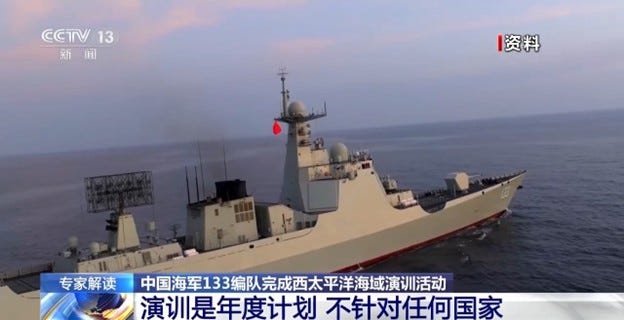
CCA Analysis: This was the first time that the PLA proactively announced a Yokoate Channel transit. In the past, Japan was the first to disclose such operations. Beijing’s decision to get ahead of the news cycle can be interpreted as an expression of displeasure over Japan’s Taiwan Strait transit and a willingness to publicize naval movements as a signal of deterrence. This episode is just the latest iteration of an ongoing cycle of reciprocal operational deterrence signaling by both sides.
The JS Ikazuchi‘s transit was Japan’s fourth through the Taiwan Strait since September 2024. Its 14-hour duration and timing with the Treaty of Shimonoseki anniversary gave Beijing grounds to frame the passage as politically provocative rather than a routine freedom of navigation action. China’s response was swift, dispatching the PLA Navy’s 133rd Task Group through the Yokoate Channel into the Western Pacific just 48 hours later. The deployment of the Liaoning through the Taiwan Strait and the Sichuan’s training in the South China Sea coincided with the opening of “Balikatan 2026” joint exercise between the United States, Philippines and Japan.
The Balikatan 2026 added another layer to an already charged week. Japan joined for the first time in a combat role, deploying roughly 1,400 troops and conducting live-fire sinking drills using Type 88 anti-ship missiles off northern Luzon. It was the first time Japanese forces have used the system outside their territory at a location facing the Taiwan Strait. It was also the first time the JMSDF projected forces into the South China Sea for joint exercises.
The geographic scope of China-Japan maritime interaction has expanded considerably since late 2025. Friction that was previously concentrated around the Senkaku/Diaoyu Islands and the Miyako Strait has extended into the Western Pacific and the eastern side of the First Island Chain. CSIS ChinaPower data shows the PLA conducted a record 163 operations in the South China Sea in 2025, while the aircraft carriers Liaoning and Shandong combined for 58 days of operations beyond the First Island Chain, up from 32 days in 2024.
China’s Navy Anniversary Film Points to Nuclear Carrier, Sends Message on Taiwan
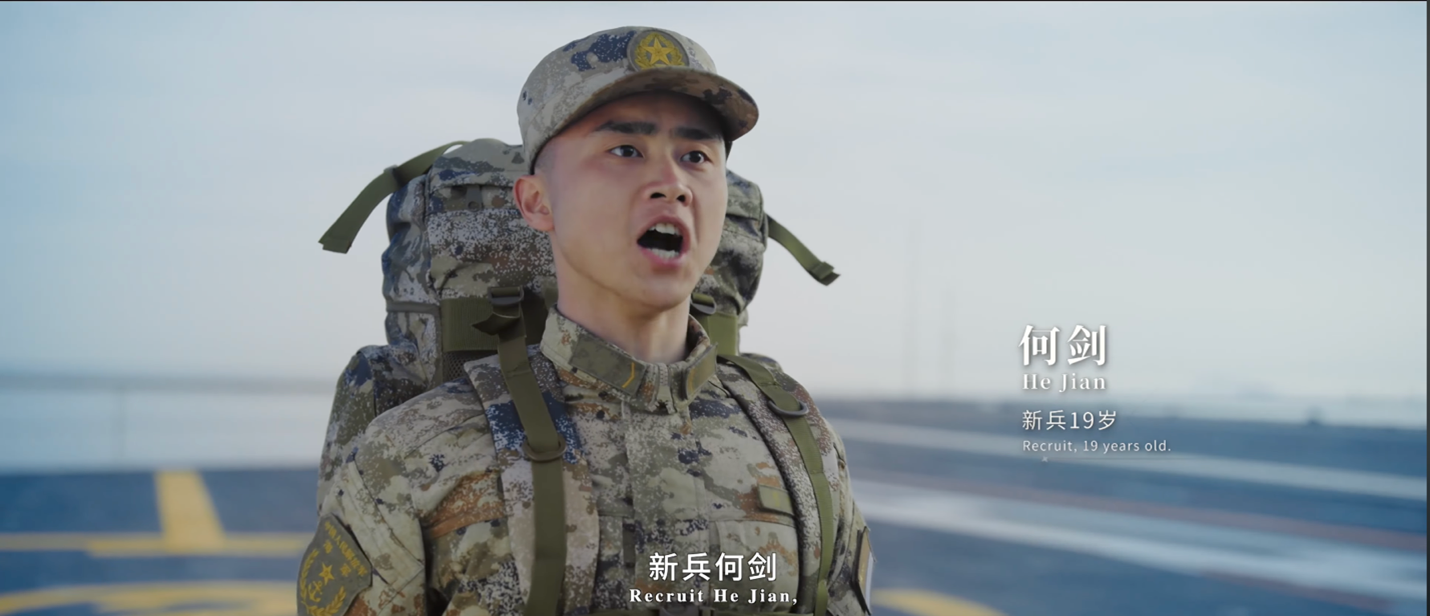
On April 22, the PLA Navy released a seven-minute promotional film titled Toward the Ocean (向大洋) to mark the 77th founding anniversary of the People’s Liberation Army Navy. The film follows four characters whose names are Mandarin homophones of China’s three active carriers: Liao Ning (辽宁/Liaoning), Shan Dong (山东/Shandong), and Fu Jian (福建/Fujian), alongside a new recruit named He Jian (何剑). The name He Jian is a near-homophone of “nuclear vessel” (核舰, hé jiàn) in Mandarin. In the film, He Jian is aged 19, which follows sequentially from the hull numbers of China’s three existing carriers (16, 17, 18), leading analysts to interpret the character as an allusion to a forthcoming nuclear-powered fourth carrier. His noticeably taller backpack was further interpreted as a hint at greater displacement, beyond the Fujian’s 80,000 tons, toward the 100,000-ton class of U.S. supercarriers.
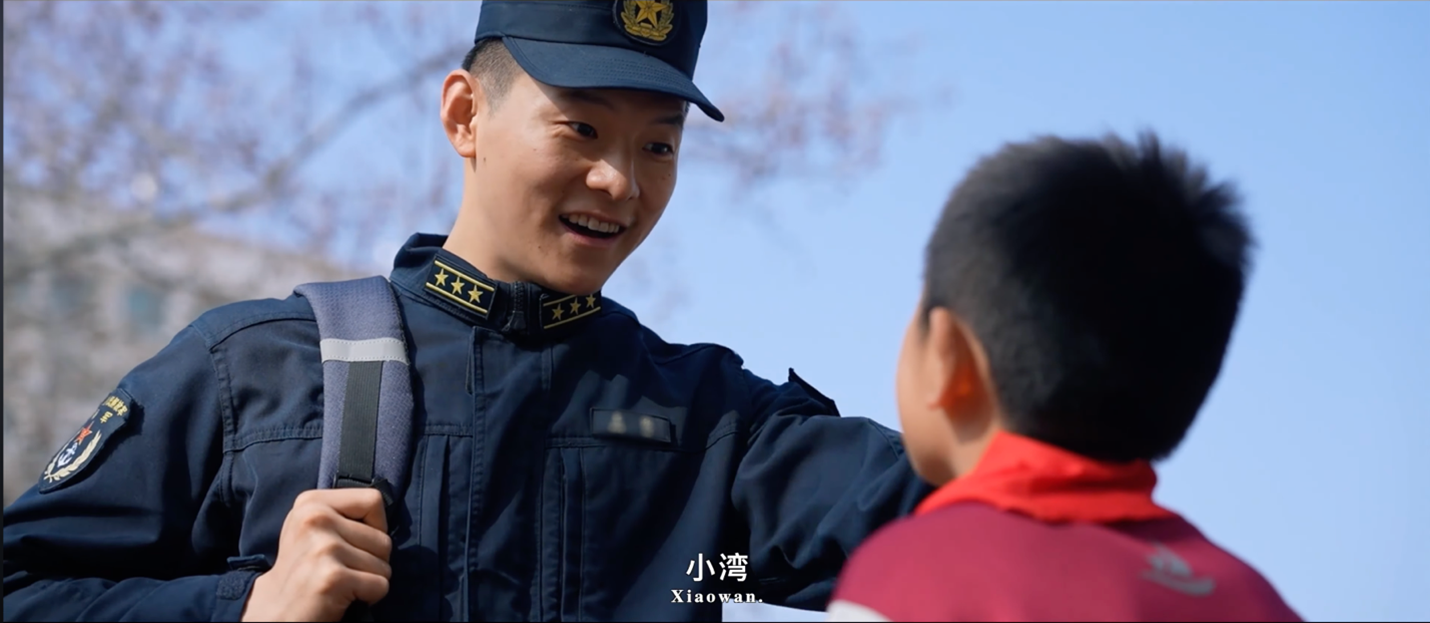
The film closes with a scene at Unification Road Primary School (统一路小学) in Weihai city, where one of the characters picks up his son, nicknamed “Xiao Wan” (小湾) — a common affectionate abbreviation for Taiwan. The boy says he does not want to go home yet, and his father replies that his mother is waiting. The exchange was widely read as an allegory for Taiwan’s eventual “reunification” with the mainland. Some commentators also noted that the phrase “don't be shameless” (别耍赖皮) contains the character “Lai,” a homophone for Lai (赖) as in President Lai Ching-te (賴清德). The framing of Taiwan’s current leader as the obstinate child refusing to come home was a clear symbol of Beijing’s frustration over Lai’s “pro-independence” policies.
CCA Analysis: The video’s rich symbolism offers a window into PLA Navy political and capability priorities. The He Jian character appears to be a deliberate reference to the Type 004 carrier currently under construction at Dalian Shipyard. Janes’s satellite imagery analysis from December 17, 2025 confirmed that construction of the carrier is underway. The U.S. Department of Defense’s 2025 Report assessed that China plans to field nine carriers by 2035, of which six may be Type 004-class vessels.
The closing sequence is a clear reference to Taiwan. The film was released 12 days after KMT chair Cheng Li-wun (鄭麗文) met Xi Jinping in Beijing. The choice of Weihai’s Unification Road School as the closing location also carries historical resonance. The city has deep historical ties with Wokou (倭寇) pirates — the Japanese and Chinese coastal raiders who harassed China’s coastline from the 13th to 17th centuries. It is also associated with the Battle of Weihaiwei (威海卫之战) in 1895, where China’s Beiyang Fleet (北洋水师) was destroyed in the First Sino-Japanese War. In 1950, newly appointed PLAN Navy commander Xiao Jingguang (肖劲光) visited nearby Liugong Island (刘公岛) by fishing boat, lamenting that the PLAN’s weakness in a remark since inscribed on a monument there. Closing a naval power narrative at this location links the current era into a century of maritime humiliation and recovery, with Taiwan remaining the only piece of “lost territory” yet to be “reunified” with the mainland.