


In this issue of PLA Watch, we highlight new assessment metrics centered around joint training within the Southern Theater Command. We also examine a new campaign from the Discipline Inspection Commission targeting officers’ “social circles”. Finally, we analyze the deployment of the aircraft carrier Liaoning near Japan and its implications for Sino-Japan relations.
Recent Southern Theater Command Exercises Highlight New Joint Training Thinking
A PLA Daily article, published on May 23, highlights ongoing efforts within the PLA to pursue joint, “real combat” training criteria over individual accolades. Of course, “jointness” is not a new push within the PLA, but the specifics of this report reveal new dimensions, and struggles, in honing a truly joint force.
The PLA Daily reporter follows several recent joint training exercises in the Southern Theater Command (STC), in particular involving the PLA Navy (PLAN) and Air Force (PLAAF). During one exercise, a pilot reportedly locks onto enemy aircraft, ready to fire, but the “real-time data-sharing and integrated battlefield awareness” (数据链实时共享战场态势一体感知) detects that friendly forces have not yet completed their attack deployment. The pilot assesses that launching an attack would “prematurely expose their own position, disrupt the entire combat plan, and even lead to the failure of the system-wide operation.” (提前暴露己方位置,打乱整个作战部署,甚至导致体系作战失利). The report says the pilot immediately abandons his attack and disengages to coordinate with friendly forces, concluding that “the system’s power created a formidable synergy, allowing them to quickly gain the upper hand on the complex and ever-changing battlefield” (体系威力形成强大合力,让他们很快在复杂多变的战场上占据主动).
The takeaway, according to the after-action report, is as follows:
“In the past, we always focused on individual air combat performance and the pass rate of individual subjects; but when we actually went to the joint training ground, we realized that no matter how excellent an individual is, it is difficult to form a cohesive force without the system; no matter how outstanding the performance is, it is difficult to achieve effective training without coordination.” (过去, 我们总盯着单机空战成绩, 单课目优秀率; 可真到联合训练场上才明白: 个体再优秀, 脱离体系也难成合力; 成绩再突出, 没有协同也难有练兵实效).
The unit’s leader explained that every officer and soldier should have this sense of the “big picture” in mind when training within joint simulated environments.
The article went on to describe the ongoing challenge for troops and officers in changing their mindset from seeking individual accolades and scores to adopting “joint force” standards. The author repeatedly mentioned instances of pilots and officers sacrificing personal rewards for the betterment of the joint force. Or, as the article says, “pooling their collective wisdom around the principles of ‘unified command, unified discourse, and unified action’” (统一指挥, 统一话语, 统一行动集智攻关), and “breaking away from traditional evaluation models to adopt the system contribution rate as the main standard for measuring training effectiveness” (打破传统考评模式,将体系贡献率作为衡量训练质效的主要标准).
CCA Analysis: This is a useful reminder that the PLA has a long way to go to achieve a true joint force. The examples cited in the article about progressing step by step from joint training with the “same type of aircraft,” to “mixed training with different types of aircraft,” and then to “integrated ship-aircraft training” are illuminating. For the U.S. joint force, many of these scenarios would seem rudimentary (granted, the U.S. military has by no means “perfected” joint operations; it is always a work in progress). It is also illuminating to read what a massive mindset shift is required for the PLA to train under true joint requirements and environments. This is a historically army-based military which, as the article concedes, has relied on individual exercise scores that likely inflate their sense of accomplishment. For all the handwringing these days in Washington that the PLA is 10-feet tall and outpacing the United States in several net assessment metrics, it still struggles with adopting a joint force mindset and accurately assessing training in joint settings. To me, RAND’s 2015 report on “China’s Incomplete Military Transformation” still applies to the PLA in 2026.
“Comradeship Should Not Become a Loophole in Discipline”: PLA Discipline Organs Target Officers’ “Social Circles”
The PLA is in the midst of one of the largest purges of senior officers in recent history. This is no surprise to anyone who has followed recent developments involving Zhang Youxia and Liu Zhenli, for example.
But a recent PLA Daily article identifies a new campaign undertaken by Party Committees and Discipline Inspection departments within the PLA — cracking down on “personal social circles” among PLA officers, especially while off duty.
The article, titled “An Army Unit Strictly Regulates the ‘Social Circles’ of Its Leading Cadres,” follows a “leading cadre” who recently took leave and received several phone calls from former comrades and family members asking for favors. The article reads as both a cautionary tale and a training guide, warning PLA cadres of new regulations imposing restrictions on meeting with and doing favors for family and friends while on vacation.
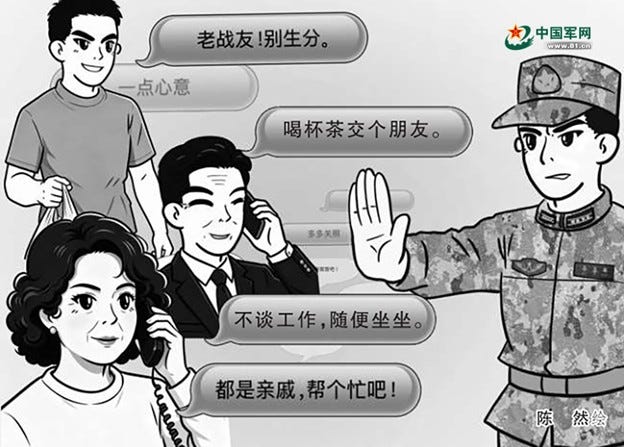
The scenarios themselves are revealing: one involves a call from a former comrade-in-arms who invites the officer out to drink; another from a family member who requests the officer’s help getting his nephew a civilian position in a local PLA unit; and a third from a manager of a local construction company.
The first scenario paints the following picture: a retired army veteran reaches out, asking to get together. He says, “It’s been a long time since we’ve seen each other. You’re the only one still in the army. Let’s get together and catch up!” The officer responds, “Feelings are feelings, and discipline is discipline. Our camaraderie doesn’t need to be maintained by eating and drinking. Let’s play a game of badminton tomorrow morning, work up a sweat, and chat. Wouldn’t that be great?” The friend agrees and, after badminton, asks the officer, “Does your company need to purchase training equipment recently? I have resources and connections.”
Upon hearing this, the officer waves his hand and says, “Lao Liu, if you’re going to talk about this, then that’s enough for today. You know the regulations in the army. We’re comrades-in-arms, but there’s no room for personal relationships when it comes to rules. Don’t make me make a mistake.”
The second scenario involved a phone call with a relative, during which a military officer was asked to use his connections to help a nephew secure a civilian position in another military unit. The cousin urged him to “put in a good word” and ask recruiters to “‘take care’ of him.” The officer firmly refused, explaining that the recruitment process is now “entirely supervised by the discipline inspection department” and that every stage is “open and transparent.” When the cousin expressed disbelief that he lacked enough “influence” after years in the military, the officer responded that “this isn’t about saving face; it’s about the bottom line of discipline.” He emphasized that cadres are prohibited from using their authority to benefit relatives and concluded that if the nephew truly wanted the position, he should “prove himself based on his abilities.”
The last scenario starts when the officer receives a call from a local construction company manager inviting him to “relax” at a newly opened fishing park, insisting they “absolutely would not talk about work.” The officer recognizes the caller as a manager from a company that had recently lost a bid for a military repair project. Rejecting the overture, the officer bluntly explains that the company failed in its bid not because it lacked “connections in the military,” but because “your quote and proposal were indeed inferior to those of the winning bidder.” Recalling a corruption case in which a PLA official was gradually compromised through seemingly harmless leisure invitations, the officer stressed that PLA engineering projects are now “completely open and transparent,” with the Discipline Inspection Commission supervising “the entire process.” He added that “if the conditions are met, there’s no need to treat anyone to meals or entertainment,” before ending the call.
CCA Analysis: This article is super interesting for several reasons. First, the three scenarios reveal sources of corruption that have long plagued the PLA for decades: family members and business colleagues using “guanxi” networks within the PLA to enrich themselves. Zhang Youxia was reportedly accused of failing to control “close associates, family members and relatives” tied to graft networks, and Li Shangfu and Wei Fenghe were also accused of abusing their authority over procurement within the Central Military Commission (CMC) Equipment Development Department in exchange for financial gain and political favors. There has also been speculation that China’s nuclear silo lids not operating properly as a result of embezzlement.
More noteworthy is the fact that the CMC Discipline Inspection Commission (中央军委纪律检查委员会) has apparently launched new “anti-corruption education classes” throughout the PLA, including having Party Committee Secretaries and Deputy Secretaries to conduct “one-on-one reminder talks” with members of the unit leadership teams on “hunting” scenarios involving family members and business associates. To quote the article, “purify your ‘three circles’ (自觉净化 “三圈”) (i.e. circles of influence, social circles, and personal relationships), and that the use of power must be “based on evidence and interactions must leave a trace.” (用权需有据, 交往应有痕).
The article is almost comical in its admonition for officers not to speak with or attend social gatherings with family friends or close associates during leave. But it’s no laughing matter: this is one of the most common avenues for corruption to take place in the PLA. Good luck enforcing it.
Liaoning Departs for Another Exercise Near Japan
On May 19, the PLA dispatched the Liaoning — China’s first aircraft carrier — for a new round of naval exercises in the western Pacific that included live-fire drills, tactical flight operations, and support missions, according to the Ministry of National Defense website. The PLA Navy described the drills as “routine annual exercises” intended to improve combat readiness and operational capabilities.
A day later, Japan’s joint staff tweeted that its JASDF Southwestern Air Defense Force’s fighters scrambled to interdict suspected PLA intrusions into Japan’s airspace over the East China Sea.
The PLA Navy deployment follows a series of increasingly ambitious Chinese naval operations beyond the first island chain, including previous exercises east of the Miyako Strait and near Guam. Last year, Chinese and Japanese aircraft were involved in a tense encounter near Okinawa during a similar carrier deployment, with Japan accusing Chinese J-15 fighters of locking fire-control radar onto Japanese aircraft.
CCA Analysis: China is still seething over Japanese Prime Minister Sanae Takaichi’s public remarks that a Taiwan Strait crisis could justify Japanese military intervention, comments Beijing condemned as crossing a “red line.” China is sending the PLA to remind Tokyo of Beijing’s indignation. China has noticeably expanded unilateral military activity around Japanese territory, with Japan’s latest defense white paper warning that growing Chinese military operations in nearby waters and airspace pose a threat to Japan’s security. Sino-Japan relations have reached the lowest level in years, and these latest carrier drills are China’s attempt at normalizing sustained naval and air operations in the western Pacific near Japan.