


In this issue of PLA Watch, we delve into China’s “Nantianmen Project” – a new, science-fiction-based space force concept with potential military application. We also examine China Coast Guard (CCG) and the PLA Navy drills near Taiwan in response to Tokyo and Manila’s decision to begin maritime boundary delimitation talks.
CCTV Reveals New Details of the “Nantianmen Project” — China’s Futuristic Space Combat Force
On May 31, CCTV.com revealed the latest progress of the “Nantianmen Project” (南天门计划) – a future-oriented aviation-themed science fiction program under development since 2017. The project is a Chinese aerospace science fiction universe combining novels, videos, concept art, air-show exhibits, and full-scale mockups of futuristic military systems. It is an imaginative framework that integrates hypersonic flight, air-space vehicles, dual-mode aerospace propulsion, directed-energy weapons, metamaterial stealth, and AI-assisted autonomous swarms and drones into a future military ecosystem. The project is part of China’s long-term plan to construct a global space-based strategic defense system consisting of large strategic aerospace carrier platforms and aerospace fighters.
CCTV-7’s National Defense and Military Channel (国防军事频道) introduced new conceptual designs of the project, which included the 100,000-ton-class aerospace carrier “Luan Niao” (鸾鸟); the unmanned aerospace fighter “Xuan Nü” (玄女); a full-band stealth fighter “Bai Di” (白帝); and a universal vertical takeoff and landing platform “Zi Huo” (紫火).
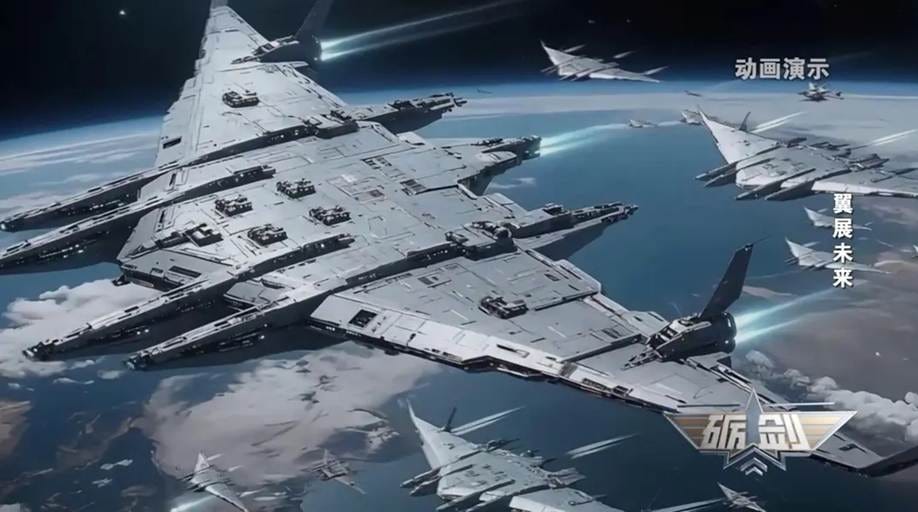
Screenshot of the “Luan Niao” aerospace carrier. Source: CCTV News
The project aligns with Shanghai’s “15th Five-Year Plan” strategic deployments regarding the digitalization of cultural tourism, commercial aerospace, artificial intelligence, and intelligent robots. The project recently opened an exhibit in the Lingang New Area aerospace industry cluster in Shanghai, creating China’s first immersive cultural tourism science fiction park based on aviation science fiction IP. Lingang New Area is at the forefront in positioning Shanghai as a globally influential science and technology innovation center.
The Nantianmen Project was created by AVIC Global Culture & Technology (Beijing) Co., Ltd., a subsidiary of the SOE conglomerate Aviation Industry Corporation of China (AVIC). AVIC envisioned using real-world technology to construct a science fiction world for the future aerospace era.
The three previously unveiled concept fighter jets differ from modern fighter jets already in existence in terms of aerodynamic layout, drive engine, flight mode, and payload.
The centerpiece of the universe is the “Luan Niao,” an enormous “aerospace carrier” capable of operating in near-space and launching multiple subordinate aircraft. It is often depicted as a strategic command platform. It is 100,000 tons, 242 meters long, has a wingspan of 684 meters, and is capable of carrying 88 “Xuan Nü” fighter jets.
The “Xuan Nü” fighter jet is conceptually designed as an unmanned air superiority fighter. It features meson circulation generators on both sides of the fuselage, and is capable of using particle acceleration cannons, hypersonic missiles, and other weapons. Combined with its forward-swept wing design, it has a visually striking effect and can operate outside the Earth’s atmosphere.
The “Bai Di” full-band stealth fighter jet employs full-band stealth and can switch between manned and unmanned flight modes. It uses a variable-wing structure to adjust its aerodynamic layout in real time according to altitude, speed, and flight attitude.
Finally, the “Zi Huo” is a universal vertical takeoff and landing platform featuring a sharply defined fuselage, a force field duct, and a tiltable power nacelle. A prototype was unveiled at the 7th China Tianjin International Helicopter Exposition in October 2025.
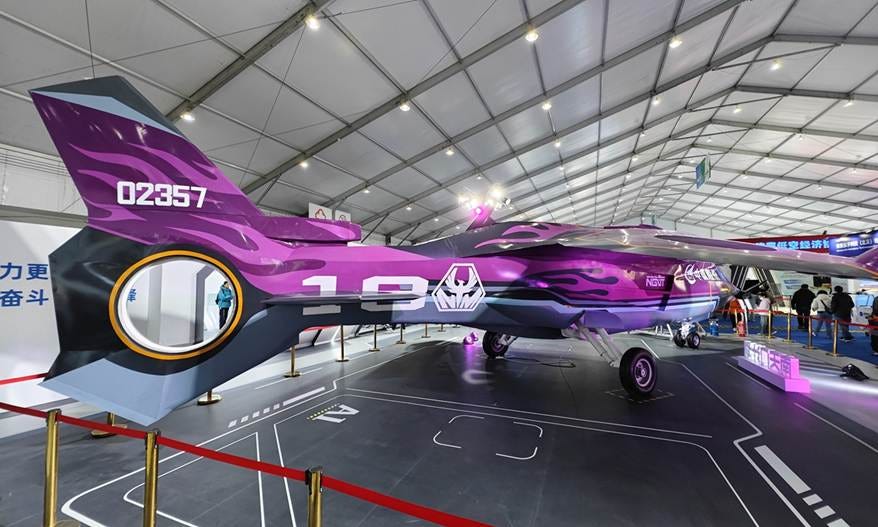
“Zi Huo” multi-purpose vertical takeoff and landing platform. Source: Global Times
CCA Analysis: None of these capabilities have been demonstrated in reality. For the PLA, the Nantianmen Project is therefore best interpreted as a window into China’s aspirational aerospace future rather than a catalog of actual PLA capabilities. Nonetheless, the project provides a venue for Chinese engineers, designers, and science-fiction enthusiasts to conceive of future aerospace warfare without committing to specific procurement programs, and many concepts could influence real research decades later. Chinese state media have explicitly framed the project as a way to popularize aerospace science and inspire young people to pursue careers in aviation and defense technology.
Many of the systems, like the “Luan Niao,” are almost Star Wars-esque in their rendering with a Chinese twist. The appearance of full-scale mockups at major air shows inevitably blurs the line between fiction and future capability. Some Chinese analysts believe this helps generate discussion about China’s long-term aerospace ambitions, even if the systems themselves are fictional.
For analysts of Chinese military modernization, the Nantianmen Project is useful because it offers insight into how components of China’s aerospace-industrial community envision warfare in the 2040–2060 timeframe. Many of the themes align with real-world PLA and Chinese aerospace research priorities, such as the integration of air and space operations and distributed swarm technology.
China Launches Naval and Coast Guard Drills Near Taiwan
In the past week, China has deployed both the China Coast Guard (CCG) and the PLA Navy to signal opposition to expanding Japan–Philippines security cooperation, particularly Tokyo and Manila’s decision to begin maritime boundary delimitation talks in waters that overlap with maritime areas near Taiwan that are claimed by Beijing.
Between June 1 and 7, China’s Ministry of Transport (MoT) announced a “Special Maritime Traffic Law Enforcement Action” and for the first time dispatched MoT vessels alongside CCG vessels to patrol east of Taiwan. The “law enforcement patrols” explicitly linked the operation to the Japan–Philippines maritime boundary initiative, which Beijing described as an “infringement” on China’s maritime rights.
Taiwan subsequently reported increased Chinese maritime activity in waters southeast of Taiwan, including near Orchid Island (Lanyu) and the strategically important Pratas (Dongsha) Islands. Chinese coast guard vessels repeatedly entered waters claimed by Taiwan around Pratas, leading to multiple confrontations with Taiwan’s Coast Guard Administration. One confrontation included a tense exchange between the Taiwanese and Chinese coast guard in which a Taiwan coast guard officer relayed the following message over the radio: “China Coast Guard, these are not your waters. You don’t belong here. Turn around and leave now!”
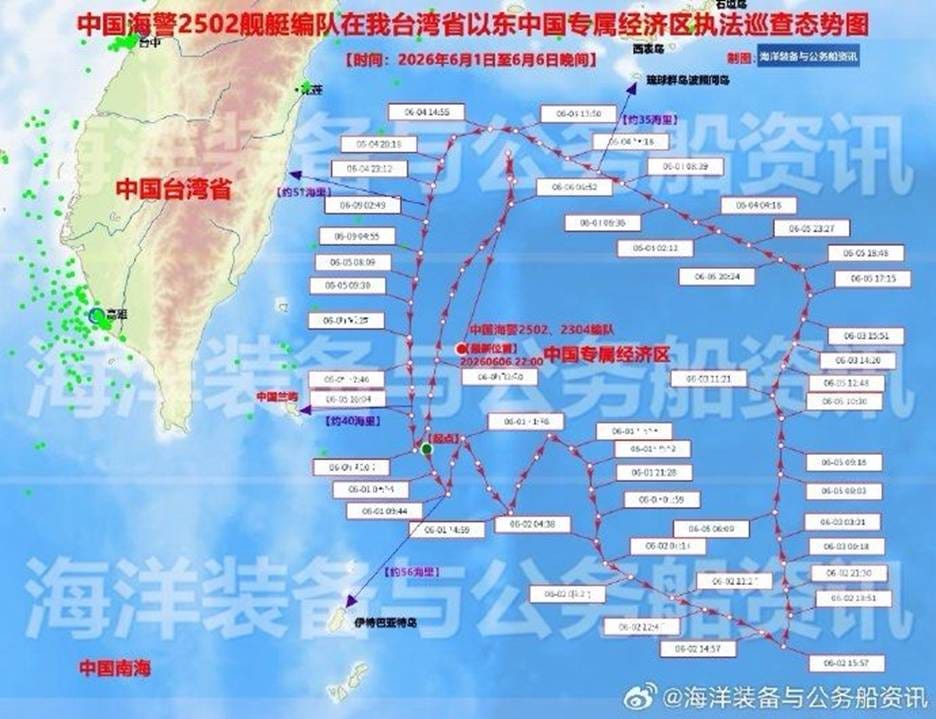
Screenshot of a China Coast Guard social media post tracking the movements of CCG vessel 2502 east of Taiwan. Source: China Coast Guard Via Weibo.
Around the same time, the PLA Navy maintained a higher operational tempo in the western Pacific. Japan reported that the aircraft carrier Liaoning and its escorts conducted extensive flight operations east of the Philippines, including roughly 170 aircraft and helicopter sorties, demonstrating China’s ability to operate beyond the First Island Chain.
CCA Analysis: The delimitation talks are problematic for Beijing because they implicitly treat waters east of Taiwan as an area that can be legally negotiated between Japan and the Philippines without Chinese participation. China has therefore used Coast Guard patrols east of Taiwan to reinforce its claim that Taiwan-related maritime zones fall under Chinese jurisdiction. The choice of the CCG rather than an overt PLA Navy operation is consistent with China’s broader “gray-zone” approach of asserting sovereignty and jurisdiction while remaining below the threshold of a major military confrontation.
The Chinese response appears calibrated to send three messages. First, to show Japan and the Philippines that Beijing rejects any maritime arrangements that could strengthen legal or operational cooperation in waters it claims. Second, to show Taiwan that China is increasingly using the Coast Guard to normalize its presence around Taiwan-controlled islands and challenge Taipei’s jurisdiction. This is the first time MoT and CCG vessels have conducted coordinated patrols east of Taiwan, and it represents a new form of MoT-CCG integration near Taiwan. Finally, it sends a message to the broader region that carrier operations east of the Philippines and coast guard patrols east of Taiwan demonstrate China’s ability to apply pressure simultaneously in the Taiwan Strait, the South China Sea, and the western Pacific.
From a PLA-watching perspective, the noteworthy trend is the growing integration of CCG “law enforcement’ operations with PLA military signaling, allowing Beijing to apply pressure below the threshold of major military exercises while steadily expanding its operational presence around Taiwan.