


This issue of PLA Watch focuses on ongoing efforts to hone “combat effectiveness” and cultivate “political reliability” throughout the PLA. We also examine a recently concluded 40-day combat training mission of the Liaoning task force – one of the longest deployments on record – which included accusations from China that the Japanese military “interfered” with PLA operations.
Old Wine, New Bottle: Why “Combat Effectiveness” Remains an Elusive Endeavor
You can learn a lot about PLA weaknesses simply from reading what they emphasize. In particular, three recent PLA Daily articles collectively illustrate a deliberate effort by political work departments within the PLA to reshape the values, training incentives, and leadership practices of the force. Read another way, their repeated emphasis on “combat effectiveness” and “political reliability” suggests training standards are not meeting expectations and ongoing purges in the PLA are having lasting reverberations throughout the military.
Although the articles focus on different services — including operational units, support organizations, and defense researchers — the common thread is that officers should prioritize long-term contributions to combat capability, organizational effectiveness, and national defense modernization over individual accolades.
Correcting Political Performance
The most prominent theme across the three articles is the need to establish a “correct political performance outlook” (政绩观). One article highlights an Air Force brigade explicitly warning against allowing short-term metrics to shape military activities, stating that personnel had developed a “utilitarian mindset that prioritizes evaluations and scores over practical utility” (重考核,轻实用的功利思想). Brigade leaders concluded that “simply staring at the current report card and not aiming at success on the battlefield of the future” (只盯着当前成绩单,不瞄准未来战场打赢) represented “a deviation in the view of political performance” (政绩观出现偏差). It added: “If not corrected in time, it will inevitably damage the combat effectiveness of the troops.”
Similarly, another article focused on the revolutionary PLA defense scientists who created China’s first ICBM and nuclear warhead, praising the older generation for “consciously making political achievements for the people and making political achievements with practical work” (自觉为民造福,以实干创政绩). It further encourages contemporary researchers to pursue achievements with the mindset that “I do not have to personally achieve success, but I must contribute to achieving success” (功成不必在我,功成必定有我).
“Combat Effectiveness” as the Central Standard
The three articles repeatedly emphasized “combat effectiveness” (战斗力) as the organizing principle for political work. The Air Force brigade article directly states that officers and soldiers must “resolutely correct ideological understandings and training styles that deviate from the combat effectiveness standard” (坚决纠正偏离战斗力标准的思想认识和训练作风). The brigade subsequently emphasized the principle of “how to fight, how to train” (怎么打仗就怎么训练), promoting realistic combat courses and developing complex opposition environments. One brigade officer summarized this approach: “Training is not for first place, but only for winning on the battlefield” (训练不是为了争第一,而是为了战场打赢). Likewise, an article about the party committee of an Information Support Force unit argues that resolving “long-standing administrative issues” allows officers and soldiers to “devote more energy to the main responsibility and main business of training and preparation for war” (把更多精力投入练兵备战主责主业).
Overcoming “Short-Termism” Through Party Committee Leadership
A third theme is an admonition not to pursue short-term behavior and rewards at the expense of long-term combat effectiveness goals, portraying party committees as essential actors in improving military effectiveness. The Information Support Force article credits the new party committee with taking historical problems as “an important annual task” (作为年度重要任务来抓) and maintaining continuity during leadership transition. The Air Force article describes party committee members conducting research, identifying shortcomings, and leading personnel to front-line training sites to solve difficult operational problems.
The same article offered this anecdote to underscore the leading role of party committees:
“For a period of time in the past, the brigade’s training courses did not match the actual combat requirements. At one meeting of the brigade, when the relevant departments of the organ and the major teams reported on the training situation, the members of the brigade party committee team raised a sharp question: the training content was old-fashioned and lacked breakthroughs, and new courses could not be added based on the requirements of the actual battlefield. In the face of the merciless questioning of the members of the party committee, the head of the training section of the brigade said frankly: “When formulating the training plan, there is indeed a preference for emphasizing evaluation and neglecting practical application; for the new courses that need to be tackled, due to the long effect cycle and the difficulty of quantifying the results, they are not included in the daily training plan.”
Finally, the article on missile scientists similarly connects political values and scientific innovation, praising earlier generations who “served the country wholeheartedly and worked tirelessly” (赤诚报国,忘我奉献). In each article, party organizations are presented as responsible for aligning personnel behavior with organizational goals and military requirements.
CCA Analysis: Taken together, these articles suggest that the PLA leadership remains concerned about organizational behaviors that can undermine military effectiveness, including what the PLA calls “careerism,” leadership turnover, bureaucratic incentives, and training practices disconnected from operational requirements. The recurring theme of “correcting deviations in political performance” and “focusing all minds and energy on combat effectiveness” indicates an effort to align individual incentives with the demands of military modernization.
The articles also imply that the PLA increasingly views professional competence and institutional responsibility as important components of political reliability. By linking political work to combat readiness and innovation, these narratives seek to shape the behavior of officers, commanders, and defense researchers as the PLA prepares for more complex operational missions and continued force modernization.
But all these traits — including seeking individual rewards and “box-ticking” training exercises — are deeply ingrained in the culture of the PLA. Clearly, the PLA is worried its lack of battlefield experience will impact its ability to simulate and achieve a high standard of “combat effectiveness” in training. What was noteworthy was the continued emphasis that party committees are taking the lead in holding the PLA to a higher standard. Given all the purges of senior officers in the Political Work department, one interpretation of this emphasis is that Xi Jinping and the CMC are worried about the image of the Political Work officers, especially political commissars.
Liaoning aircraft carrier task force completes one of the longest far-sea combat trainings on record
Chinese aircraft carrier Liaoning concluded 40 days of far-sea combat training and returned safely to its home port of Qingdao on Monday, June 22, the Chinese navy reported.
During the training, the task force operated in multiple sea and air spaces, including the South China Sea and the western Pacific, conducting carrier-based aircraft tactical flight drills and task force search and rescue exercises. The task force included the cruiser CNS Wuxi (104), destroyer CNS Kaifeng (124), frigate CNS Luohe (545), and fast combat support ship CNS Hulunhu (901). The Type 075 amphibious assault ship Anhui also took part in the exercises.
Footage was released appearing to show the first public video of a J‑15T carrier‑borne fighter jet being refueled in mid‑air from a PLAAF Yun‑20U tanker. Tanker refueling operations are a critical component of China’s blue water naval ambitions.
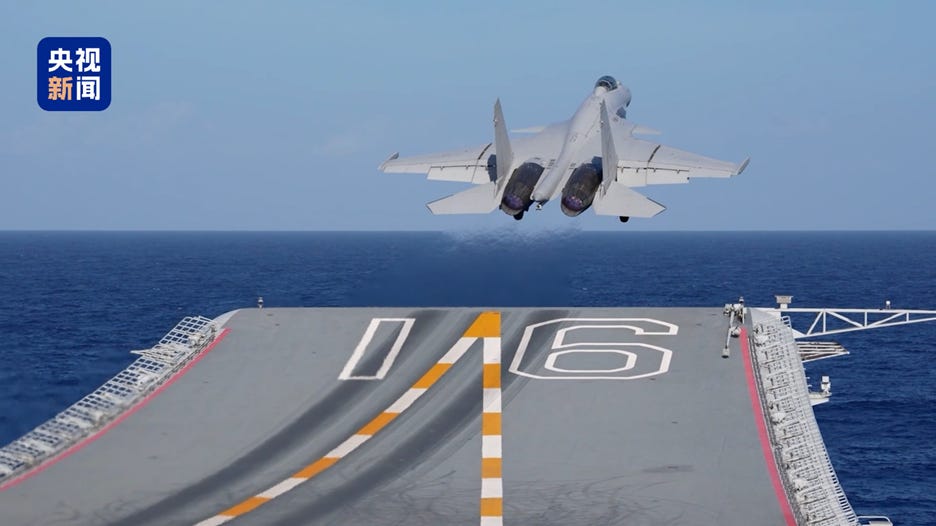
During the training, China’s Ministry of National Defense claimed that Japanese vessels and aircraft repeatedly conducted “close-range tracking and surveillance,” causing “disturbances and provocations.” The Global Times later released a video on X claiming to support China’s claim of harassment.
While China claimed the training was a “routine exercise in accordance with the PLA Navy’s annual plan,” Japan’s Maritime Self-Defense Force (JMSDF) reportedly shadowed the carrier group as it passed through the Okinawa and Miyako islands into the Philippine Sea, as it has done in the past in this strategically important waterway. Tokyo confirmed it monitored the fighter launches and movements, and later issued a statement that Japanese self-defense forces will “continue to conduct professional and steady vigilance in the surrounding sea and airspace of our country…under a calm and resolute stance.”
CCA Analysis: The current 40-day far-sea combat training deployment appears to be either the longest or tied for the longest continuously reported deployment in Liaoning’s operational history. Chinese state media explicitly emphasized the unusually long duration and the extensive combat-oriented nature of the training.
Several previous deployments approached this duration:
December 2021: The Liaoning operated in the Yellow Sea, East China Sea, and western Pacific for roughly three weeks before returning to port.
May 2022 western Pacific deployment: The carrier group conducted extensive operations near Japan’s southwestern islands and recorded more than 300 aircraft sorties over about 20 days at sea.
September–October 2024 Joint Sword-related operations: The Liaoning participated in extended exercises around Taiwan and the western Pacific lasting approximately two to three weeks.
June 2025 dual-carrier operations with Shandong: The Liaoning spent several weeks operating in the western Pacific alongside China’s second carrier, the Shandong, but publicly available reporting did not indicate a deployment exceeding one month.
Based on the publicly available record, this recent deployment is very likely the longest continuously reported operational deployment in Liaoning’s 14-year service history. It also appears to be the longest far-sea training deployment ever publicly acknowledged by the PLA Navy for any Chinese aircraft carrier. The PLA Navy rarely publishes precise deployment start and end dates, and some earlier deployments may have involved brief port calls or logistics stops that were not publicly disclosed. As a result, it is difficult to establish a definitive historical record of China’s aircraft carrier deployments.
Finally, regarding the accusation that Japan “interfered” with PLA operations, we have seen this movie before. The video evidence does not support the claim. In fact, my review of the footage suggests the Japanese military maintained a safe distance and operated professionally. This is more about Sino-Japanese politics than it is about operational safety.