


This issue highlights the recent incident between Chinese and Philippine military personnel near the BRP Sierra Madre at Second Thomas Shoal and what it means for China-Philippines relations. We also analyze the Eastern Theater Command live-fire drills near Taiwan and what stood out. Finally, we examine the first overseas deployment of China’s third hospital ship, the Auspicious Ark, and how it fits into the PLA’s broader military diplomacy mission.
Beijing Hardens Language, Operations at Second Thomas Shoal
On July 20, Chinese and Philippine military personnel came to blows alongside the BRP Sierra Madre, the vessel the Philippines grounded at Second Thomas Shoal (仁爱礁, which the Philippines calls Ayungin Shoal) in 1999 in the South China Sea (SCS). The Philippine military said China Coast Guard (CCG) personnel in a rigid-hull inflatable boat struck a Philippine Navy sailor on the head with a wooden baton, injuring the sailor and damaging the boat. The CCG said the two Philippine boats ignored warnings and rammed its patrol craft, and that “Philippine personnel first used oars, long poles, and other implements to maliciously attack Chinese law enforcement personnel.”
Neither side has released full unedited footage, and the Philippine military says the version Beijing circulated was “spliced or incomplete.”
China Coast Guard Personnel Strike Philippine Navy With Wooden Batons in Ayungin Shoal Incident
The clash broke two years of relative calm. Under the provisional resupply arrangement reached in July 2024, the Philippines ran 13 rotation-and-resupply missions through March 4, 2026—roughly every six weeks—and Philippine officials said those runs passed without dangerous encounters.
The clash also overlaps with the 10th anniversary of the 2016 UNCLOS arbitral tribunal award, which struck down China’s expansion claims in the SCS, including over Second Thomas Shoal. On July 11, the United States and 13 other governments issued a joint statement to commemorate the award, calling on China to respect the findings. China’s foreign ministry responded the next day, calling the award “an illegal and void scrap of paper with no binding force” (一张非法无效没有拘束力的废纸). Chinese state media went further, calling the arbitration a “political farce dressed up in legal disguise.”
Among other things, the 2016 arbitral tribunal ruled that:
Second Thomas Shoal is a low-tide elevation, meaning it cannot be claimed as sovereign territory by any state on its own.
The shoal lies within the Philippines’ exclusive economic zone.
China’s “nine-dash line” claim has no legal basis under UNCLOS to the extent it exceeds the convention’s maritime entitlements.
China interfered with the Philippines’ lawful exercise of its rights in the SCS, including on Second Thomas Shoal.
China continues to claim the area as part of its “historic rights,” and has maintained that Philippine activities there are unlawful. As a result, there have been repeated confrontations between Chinese and Philippine vessels around the shoal.
CCA Analysis: Beijing is hardening its rhetoric and response to the Philippines’ exercise of its lawful maritime rights on Second Thomas Shoal. The CCG’s July 20 statement included new language not found in previous announcements regarding Second Thomas Shoal, labeling the incident as a “malicious attack” (恶意攻击). The PRC foreign ministry called Philippine actions a “violent assault” (暴力袭击). For comparison, in June 2024, when Chinese personnel boarded Philippine boats armed with knives and axes and severed a Filipino sailor’s thumb, CCG statements only referred to a “dangerous approach” and “deliberate collision,” and the PRC defense ministry acknowledged only that stones had been thrown.
The wording matters because of the claim riding on it. On July 21, the CCG said it had “permitted” the Philippines to move the wounded sailor by small boat to a Philippine coast guard vessel, and that it had “supervised the transfer from start to finish.” Manila rejected the framing a day later, saying the Philippines “does not need, nor does it require, any foreign nation’s permission” inside its own exclusive economic zone, and any claim of permission is “a false narrative intended to project illegitimate authority.”
The PLA appears to have stayed out of the fray. The operation was carried out by the CCG and framed by the foreign ministry, a familiar division of labor that sustains pressure while staying below the threshold of kinetic conflict that might invoke the U.S.-Philippines Mutual Defense Treaty. China’s defense ministry did not issue a statement and did not respond to press queries about the incident. The PLA Southern Theater Command issued a statement after the clash, protesting Philippine-organized “joint patrols” with “outside countries” but did not mention Second Thomas Shoal.
Beijing’s rejection of the arbitration ruling remains unchanged. A decade after the landmark binding judgement, China’s intransigence has caused material harm to its relations with the Philippines in diplomatic and soft power terms. But it has allowed the CCG and PLA to hone a new brand of gray-zone coercion and operational tactics. From Beijing’s perspective, the benefits of rejecting the ruling outweigh the diplomatic blowback, because acceptance would deprive China of its core claims to waters and territory in the SCS.
PLA Initiates Live-Fire Artillery Drills near Taiwan
From July 23 to 24, the PLA Eastern Theater Command (ETC) conducted live-fire artillery drills near Taiwan, in apparent response to a speech by Taiwanese President Lai Ching-te. The exercise occurred east and south of Dongshan Island, off Fujian province, and involved troops from the ETC’s 73rd Group Army. It reportedly involved the amphibious assault ship Hubei, which undertook landing and take-off training and employed army helicopters.
The drills appeared to be in response to a speech given by Lai during the DPP’s annual party convention several days earlier, in which Lai called for Taiwan to oppose a “red terror” by China, adding that the DPP would never allow a “democratic Taiwan” to “regress into a ‘China’ Taiwan.” The speech drew criticism from the PRC’s Taiwan Affairs Office, which said the remarks “expose Lai’s unchanging ‘Taiwan independence’ stance,” and that Lai had “recklessly challenged the ‘One China’ principle.”
CCA Analysis: China has boxed itself in by responding militarily to every major speech by Lai. Digging in its heels may stoke nationalist sentiment in China and help justify increased PLA training requirements near Taiwan. But this approach also takes cross-Strait relations down a narrower path with fewer avenues for de-escalation that do not involve military escalation. 2028 remains a pivotal year in both Taiwan and the United States, with presidential elections determining the future trajectory of peace and conflict across the Strait. Yet there is little evidence that Beijing is amenable to creative approaches or policies that involve engagement with Taiwanese authorities.
China’s Third Hospital Ship Sails on Its First Overseas Mission
On July 22, the PLA Navy hospital ship Auspicious Ark (吉祥方舟, hull number 868) departed a naval port in Qingdao for Africa and South Asia to carry out Mission Harmony-2026 (和谐使命-2026), the vessel’s first overseas medical deployment.
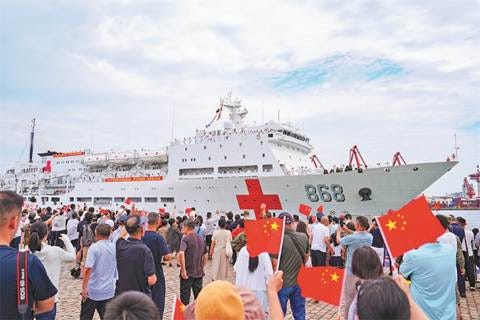
This is the twelfth Mission Harmony deployment since 2010. The first ten were conducted by the Peace Ark (和平方舟), while the Silk Road Ark (丝路方舟) conducted the eleventh, a 234-day voyage covering roughly 36,000 nautical miles across the Pacific Islands and Latin America—the longest in the series to date. The Auspicious Ark is the PLA Navy’s third 10,000-ton-class hospital ship, first unveiled in May 2025. With its entry into service, each of the PLA Navy’s three theater commands now operates one hospital ship.
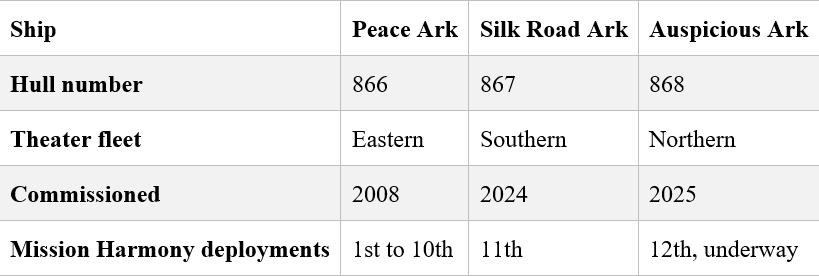
CCA Analysis: Humanitarian deployments are not in themselves a new development. It is the tempo that merits attention. Deployments of three different vessels in two years represent a high operational tempo. The Peace Ark returned to port in January 2025; the Silk Road Ark deployed from September 2025 to April 2026; and the Auspicious Ark’s current deployment is scheduled to run into early 2027. With three hulls available, Beijing can now keep one ship forward-deployed on a near-continuous basis while a second undergoes refit and a third remains on domestic duty. What was once an episodic goodwill voyage has become a routine, standing presence.
The tonnage and configuration of these vessels are calibrated for long-term deployments. According to the Center for International Maritime Security, the U.S. Navy’s USNS Comfort and USNS Mercy each carry roughly 1,000 beds and 12 operating rooms, compared to approximately 300 beds and eight operating rooms aboard the Peace Ark. This is an instrument for securing strategic access rather than generating wartime medical capacity, providing a relatively low-cost means of building familiarity with foreign ports and cultivating local goodwill.
The program’s implementation details reveal its broader significance. During its last deployment, the Silk Road Ark conducted joint drills with the Fijian, Tongan, and Brazilian navies in addition to providing outpatient medical work. The PRC Ministry of National Defense has described the Auspicious Ark as having “a functional layout adapted to the demands of preparing for combat” (具有适应备战打仗需求的功能布局). Should Mission Harmony-2026 follow the same template, it would amount to naval engagement with doctors aboard and would represent an opportunity for the PLA Navy to rehearse wartime medical evacuation and treatment through military diplomacy.
Hello,
I am pursuing a PhD from the University of Warwick in the United Kingdom. My Doctorate is examining the East China and Yellow Sea disputes in China's relations with Japan and South Korea. What are 3-5 issues pertaining to China, the Yellow or East China Sea disputes PLA Watch might benefit from by having additional information about? The PhD will include a Policy Chapter. I'm interested in exploring the issues of curiosity to PLA Watch, the Asia Society - and proposing potential policy solutions to those topics.
Take care, and I look forward to hearing from you soon.
Regards,
Matthew Kennedy
PhD Candidate
Politics and International Studies
University of Warwick
Reading RG1 7QF - United Kingdom
Ph. +44 - 77635 12262
Email: matthew.kennedy.4@warwick.ac.uk