


Welcome to the July edition of PLA Watch, a monthly newsletter from the Center for China Analysis that provides insights into the latest developments in Chinese military affairs and writings using primary sources.
PLA Watch is divided into five sections: PLA News covers major announcements, leadership visits, and military exercises; PLA Strategy examines interpretations of Xi Jinping’s military thought and writings by PLA strategists on doctrine and warfare; PLA Modernization focuses on how PLA authors propose integrating new technologies into operations; PLA Research Highlights curates recent academic publications by PLA scholars; and PLA Observers features Western research on the PLA.
This month’s issue highlights key developments in PLA operations, diplomacy, and modernization. China demonstrated integrated drone and anti-drone capabilities in a recent exercise, while new footage of a 2024 intercontinental ballistic missile launch showcased its strategic capabilities. The PLA also conducted live-fire drills in response to Taiwan’s Han Kuang Exercise and held its first joint special forces training with Serbia, deepening military ties in Europe. On the political front, the Central Military Commission issued new regulations on political work, further tightening Chinese Communist Party control and linking ideological discipline to combat readiness. The modernization feature examines the PLA’s growing use of robotics, including armed quadrupeds and plans for humanoid systems.
Written by:
Lyle Morris, Senior Fellow, Center for China Analysis
Jie Gao, Research Associate, Center for China Analysis
With support from:
Ian Lane Smith, Research Associate (Editorial), Center for China Analysis
Section I: PLA News
Weapons: China Showcases Integrated Drone and Anti-Drone Capabilities
On July 21, China North Industries Group (Norinco) staged a large-scale live-fire demonstration in Inner Mongolia, showcasing its latest unmanned and counter-unmanned combat capabilities. The exercise simulated a six-phase border seizure campaign, integrating reconnaissance, strike, and denial operations across multiple domains. Norinco deployed a wide range of platforms, including the BZK-005E long-endurance reconnaissance drone, Feilong-series loitering munitions for deep strike, and Flying Dragon 30 vehicle-mounted swarm launchers. On the defensive side, the company highlighted its modular counter-drone architecture featuring layered interceptors, electronic jammers, and the OW5 high-power laser system, capable of disabling drones within seconds without requiring ammunition resupply.
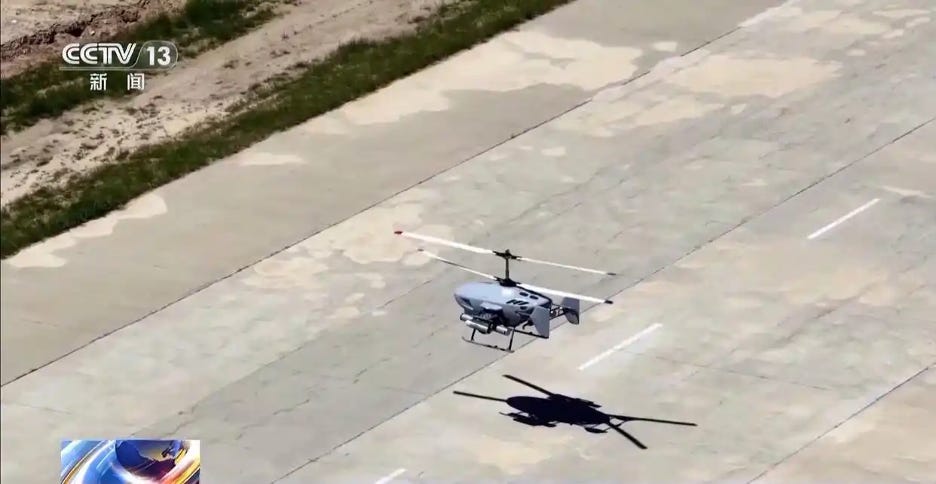
CCA Analysis: Norinco is positioning itself at the forefront of unmanned warfare by offering a full-spectrum operational architecture. This approach reflects lessons learned from recent conflicts where low-cost drones and loitering munitions have proven decisive in overwhelming traditional defenses. By tightly integrating target acquisition, command and control, and precision firepower, Norinco is promoting a unified “sensor-to-shooter” chain tailored for expeditionary or regional clients. The emphasis on affordable, mobile countermeasures—especially laser and radio-frequency systems—also aligns with the increasing need to defend against drone saturation attacks. As Beijing grows its international arms footprint, Norinco’s systems exemplify China’s broader effort to export battlefield-tested, high-efficiency unmanned solutions.
Diplomacy: China and Serbia Hold First Joint Special Forces Exercise
From July 19 to 28, China and Serbia conducted their first joint special forces training, Peace Guardian-2025, in Hebei Province. The drill involved Serbia’s 72nd Special Operations Brigade and a PLA special operations unit, with mixed combat teams rehearsing urban and rural missions supported by unmanned platforms. According to Serbia’s Ministry of Defense, the training emphasized drone tactics, mountaineering, and firearms proficiency to enhance joint operational readiness “in international environments.” The exercise builds on deepening China-Serbia bilateral defense cooperation in recent years—including Serbia’s purchase of Chinese FK-3 air defense systems and CH-series drones, which makes it the only European country operating Chinese military platforms.
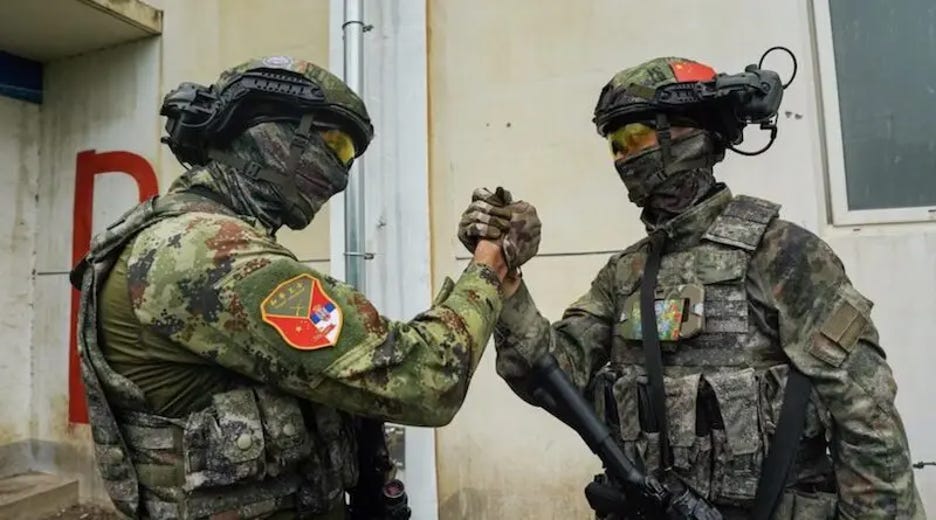
CCA Analysis: Peace Guardian-2025 enhances the China-Serbia defense relationship, evolving it from arms transfers to joint operational training. For China, Serbia has long been a “natural partner” in Europe: a militarily neutral state outside of NATO, politically aligned with Beijing on issues such as Kosovo, and deeply integrated into the Belt and Road Initiative. Since establishing a comprehensive strategic partnership in 2016—and pledging to build a “shared future” during Xi Jinping’s 2024 visit to Belgrade—the two sides have expanded cooperation in high-tech industries, counterterrorism, and, increasingly, military affairs.
From Belgrade’s perspective, China helps offset growing Western pressure. As Serbia distances itself from a Russia constrained by war and sanctions, China fills the void with its advanced defense systems and training support. The partnership also bolsters domestic narratives of sovereignty and strength. The latest announcement that President Vučić will attend China’s upcoming military parade in September—the first foreign leader to confirm—highlights the symbolic convergence taking shape.
While Serbia continues to profess aspirations to join the EU, exercises like Peace Guardian-2025 and arms cooperation with China signal a more ambiguous alignment. For Beijing, deepening security ties with a European country normalizes its defense presence in the region. This could raise strategic concerns about influence and interoperability in the Balkans among EU and U.S. policymakers.
Exercise: PLA Responds to Taiwan’s Han Kuang Exercise
On July 9, Taiwan conducted its annual Han Kuang Exercise, featuring new scenarios beyond coastal defense to include “gray-zone tactics,” “deep defense,” and “battles of attrition” to simulate how the PLA may carry out a military invasion of the island. The exercise lasted 10 days, making it the largest and longest edition in its 41-year history.
Taiwan’s Ministry of National Defense (MND) said the drills began with exercises to counter China Coast Guard and maritime militia harassment, along with fortifying ports and potential landing points on the island. Anti-landing exercises featured Taiwan’s regular forces and 22,000 reservists as well as U.S.-procured Abrams M1A2T tanks and the High Mobility Artillery Rocket System (HIMARS). The Army's 53rd Engineer Group led obstacle placement and remote detonations along the Tamsui River—a critical entry point to Taipei—in the military’s first public demonstration involving live explosives. On July 15, counties and cities across the island took part in an “urban resilience exercise,” the first time Taiwan’s MND worked with central and local governments on an “organized but unscripted” drill testing the resilience and adaptability of Taiwan’s civ-mil architecture.
In response, the PLA launched four days of air and maritime drills around Taiwan, simulating joint fire maneuvers. Exercises included nighttime flight training, sorties that crossed the median line of the Taiwan Strait and entered the island’s self-declared air defense identification zone, electronic warfare, and drills responding to mock air and submarine threats. When asked to comment on the Han Kuang Exercise, a spokesperson for China’s Ministry of National Defense said the Taiwanese exercise was “merely a show” that “cannot change the inevitable demise of Taiwan independence… The more they are performed, the more they expose the DPP authorities' sinister plot to harm and destroy Taiwan under the guise of defending it, and to coerce the people into serving as cannon fodder.”
CCA Analysis: This year’s Han Kuang Exercise is a milestone in Taiwan’s evolution from traditional military deterrence scenarios to urban-based mock battles integrating civilian actors with the Taiwanese military. The PLA has taken note of the shift. This year saw more median-line crossings than in previous years, signaling the PLA’s intent to increase readiness in response to what it views as Taiwan’s provocation.
Exercise: PLA Reveals New Video of September 2024 ICBM Launch
China released never-before-seen footage of its September 25, 2024, intercontinental ballistic missile (ICBM) launch via a five-episode documentary on August 1. The series, titled Gong Jian (Forging Ahead), shows officers and technicians of the PLA Rocket Force partaking in a full-range test launch of a nuclear-capable ICBM. The video coverage, made public for the first time, unveiled details of one of the PLA’s most sensitive strategic forces.
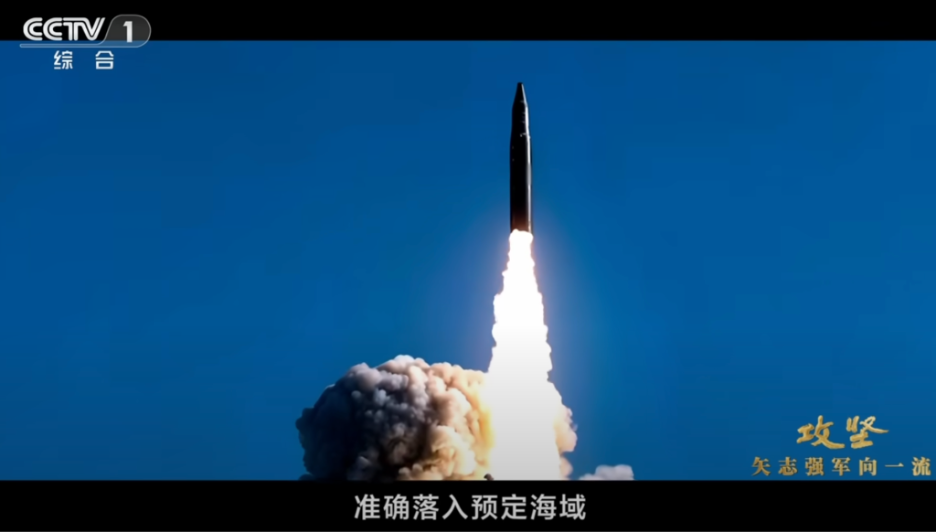
The clips show the missile launch, scenes of PLA Rocket Force soldiers operating and maintaining large missile launch vehicles, and the firing of multiple short-range ballistic missiles. These scenes are followed by a clip of Senior Colonel Zhang Xiaogang declaring that the PLA Rocket Force launched an ICBM, carrying dummy warheads, into open waters in the Pacific Ocean on the morning of September 25. The launch was the first time in more than four decades that China publicly released footage of an ICBM flight test. The last public test was in May 1980, when the baseline model of the DF-5 was fired from the Jiuquan Satellite Launch Center and hit a preset area in the South Pacific.
CCA Analysis: The video’s release coincided with the 98th anniversary of the PLA’s founding. The Gong Jian documentary series is geared toward a domestic Chinese audience and meant to enhance the PLA’s accomplishments and image. The September launch was destabilizing for countries in the region. French Polynesia and Kiribati expressed shock and concern after the launch, stating they had received no prior notice. A Japan Coast Guard official stated that Japan was notified of falling "space debris," but a top Japanese government spokesperson confirmed that China did not inform them of an ICBM launch.
Section II: PLA Strategy
CMC Issues New Regulations on Political Work in the People’s Liberation Army
The Central Military Commission (CMC) recently issued “Vigorously Promoting Fine Traditions, Fully Eliminating Toxic Influences, and Rebuilding the Credibility and Authority of Political Cadres,” setting new guidelines for implementing Xi Jinping’s “political rectification” in the PLA. According to the PLA Daily, the provisions focus on “restoring and carrying forward the Party and military’s glorious traditions and fine conduct, firmly establishing the authority of political work, and more effectively highlighting its status as the ‘lifeline’ of the military.” They also set strict rules and standards for political cadres, requiring them to lead by example, eliminate “residual toxic influences,” and “rebuild their credibility and authority.”
The measures take a “build before dismantling” approach that combines positive and negative guidance by specifying required and prohibited conduct. Political cadres are reaffirmed as “representatives of the Party” tasked with earning troop trust and confidence through conduct and image. The provisions stress that Party committees at all levels must take primary responsibility, with political organs enforcing these rules rigorously and routinely.
A PLA Daily commentary stressed, “Loyalty to the Party is the soul and true nature of political cadres; it is the foremost political requirement for them. Once loyalty is diluted or falsified, in the face of complex struggles and tests of interest, the ‘self’ will outweigh the ‘greater good,’ even to the point of betraying the original aspiration of joining the military and abandoning the oath of Party membership.”
CCA Analysis: The new provisions are Xi’s way of instilling discipline into the PLA after years of scandal. In November 2024, Miao Hua, former director of the CMC Political Work Department, which manages personnel and Party affairs, was suspended for “serious violations of discipline” before being formally removed from the CMC last month. Two other CMC members, Li Shangfu and He Weidong, have been removed or are rumored to be under investigation for corruption. The PLA Daily commentary is telling in its suggestion of systemic issues with discipline in the senior ranks of the Political Work Department. Miao’s downfall reverberated throughout the PLA and cast doubt on the political future of cadres in his patronage network. The impact of these new provisions on Party-Army relations will be minimal, however, as corruption is an endemic and deep-seated problem in the PLA.
Section III: PLA Modernization
Weaponizing Robotics for the Next Battlefield
On July 13, in a televised exercise by the PLA’s 76th Group Army, robot wolves—a new unmanned ground system—made their public debut. These 70-kilogram quadrupeds, capable of carrying rifles or reconnaissance payloads, maneuvered across rugged terrain alongside human infantry in a joint drone-human assault drill. Developed by China South Industries Group, the robot wolves were deployed in roles ranging from reconnaissance and precision strike to direct support in breakthrough operations. Their integration marks a tangible step in China’s efforts to operationalize human-machine collaboration for ground combat.
Beyond quadrupeds, the PLA is also exploring humanoid robots for urban combat, vehicle operation, logistics, and high-risk environments. A July 10 PLA Daily commentary outlines the phased development plan from non-combat support roles to full-combat autonomy and swarm-enabled operations. The article places strong emphasis on the need for clear rules of engagement and safeguards that ensure human involvement, especially in granting robots lethal authority. Rules of engagement must consider time, space, and target type, with human verification required in some scenarios. The authors also stress legal and ethical safeguards: humanoid robots must obey humans, distinguish between combatants and civilians, and use force proportionally to avoid accidental harm.
CCA Analysis: The increasing visibility of robots in PLA exercises and publications signals a new phase in China’s military modernization. Chinese military experts argue that ground-based robots may offer even greater tactical advantages than aerial drones, including the ability to sustain pressure, conduct persistent assaults, and inflict psychological stress on opposing forces. Meanwhile, the PLA is closely observing recent battlefield developments, including reports from Ukraine, where robotic systems were used to capture enemy soldiers without infantry support. These cases are seen as early signs that unmanned ground systems could redefine battlefield dynamics and accelerate a shift toward machine-dominated warfare.
At the same time, PLA strategists are keenly aware of the risks posed by integrating robotics into combat, as reflected in the July 10 commentary. Other PLA authors have raised additional concerns about the technological and operational limitations of humanoid robots, pointing to unresolved challenges in energy supply, motion control, and the reliability of AI algorithms. High production costs also remain a barrier to large-scale deployment. Despite these constraints, PLA analysts remain optimistic that continued advances will eventually enable humanoid robots to transform logistics systems and reshape future warfare.
Section IV: PLA Research Highlights
Title: Air-based Kill Chain Network Critical Edge Identification Method [空基杀伤链网络关键边识别方法]
Authors: LI Zheng [李争]1,2, HE Minghao [何明浩]1, HU Qiaolin [胡乔林]1, FENG Mingyue [冯明月]1
Affiliation: 1. Department of Information Countermeasure, Air Force Early Warning Academy [空军预警学院信息对抗系], Wuhan, Hubei; 2. Unit 95786 [95786部队], Chengdu, Sichuan
Publisher: Acta Armamentarii [兵工学报]
Date: 2025-07-09
Abstract: This paper proposes an adaptive key edge detection framework based on deep reinforcement learning to address the challenge of identifying key edges in air-based kill chain networks. This method first uses complex networks to model the air-based kill chain; secondly, a template kill chain search method is proposed by introducing the idea of backtracking search; then, based on deep reinforcement learning, a key edge exploration paradigm was constructed that combines a layered experience replay mechanism with a dynamic ε-greedy strategy. Through multi-dimensional state representation, precise localization of key edges was achieved. The experiment shows that in the simulation of air-based kill chain network testing, the Top-10 recognition accuracy of this method reaches 85%, which is 89.5% higher than the traditional betweenness centrality method and 19.7% higher than the benchmark of deep Q-network (DQN). In terms of network robustness indicators, the global efficiency reduction rate η is 37.4% higher than the edge betweenness centrality, and the prediction error of the maximum connected component retention rate is controlled within 5%.
Link: https://link.cnki.net/urlid/11.2176.TJ.20250709.1124.004
Title: Sensitivity Analysis of Kill Web Operation Effectiveness Based on Simulation Deduction [基于仿真推演的杀伤网作战效能敏感度分析]
Authors: Xiong Rongling [熊蓉玲]1,2,3, Yang Qing [杨庆]1,2, Zhang Yanwei [张晏玮]1,2, Zhang Luyou [张陆游]4, Duan Chunyi [段春怡]1,2
Affiliation: 1. The 10th Research Institute of China Electronics Technology Group Corporation [中国电子科技集团公司第十研究所], Chengdu, Sichuan; 2. National Key Laboratory of Complex Aviation System Simulation [复杂航空系统仿真全国重点实验室], Chengdu, Sichuan; 3. School of Computer Science and Engineering, University of Electronic Science and Technology of China [电子科技大学计算机科学与工程学院], Chengdu, Sichuan; 4. PLA 93216 Troops [中国人民解放军93216部队]
Publisher: Modern Defence Technology [现代防御技术]
Date: 2025-07-10
Abstract: Kill web has the potential to replace kill chain as the primary combat power generation mode in new operational concepts, with its capability to offer dynamic and flexible combination of combat nodes. Addressing the characteristics of kill web such as its multitude of combat nodes, complex interaction relationships, and lack of experimental data, a method for evaluating the operation effectiveness of kill web in typical mission scenarios based on simulation-based modeling is proposed. By comparing operation effectiveness across different performance boundaries of kill web, sensitivity analysis is conducted to quantify the contribution of performance improvements to operation effectiveness. This provides technical means for requirements demonstration and design optimization of kill web performance metrics. The simulation results show that this method effectively quantifies and evaluates the rationality of kill web performance metrics in typical mission scenarios, thereby supporting requirements demonstration and overall scheme development for kill web performance metrics.
Link: https://link.cnki.net/urlid/11.3019.TJ.20250709.1454.002
Title: Combat Effectiveness Evaluation of Air-to-Air Defense Killer Chain Network Based on Order [基于订单的空天防御杀伤链作战效能评估]
Authors: Jiang Longfei [姜龙飞]1,2, Zhao Jianbing [赵建兵]1
Affiliation: 1. PLA National Defense University [中国人民解放军国防大学], Beijing; 2. Unit 71352 of PLA [中国人民解放军71352部队], Zhangjiakou, Hebei
Publisher: Modern Defence Technology [现代防御技术]
Date: 2025-07-22
Abstract: In order to adapt to the changes of operational effectiveness generation mode and evaluation means of informationized intelligent air defense system, this paper adopts military theory and technical practice to combine energy energization, and analyzes the operational mechanism of space defense chain based on order. Two methods of combat effectiveness evaluation—based on system theory positive and negative feedback mechanism, and complex network analysis based on combat cloud—are studied respectively. These are used to quantify the effectiveness of order-based kill chain operations in future air defense operations. The paper describes the complex correlation and dynamic coupling mechanism among operational elements in different operational areas within the system in space defense operations. In addition, it provides data support and theoretical reference for improving the overall operational effectiveness of air defense systems. Finally, the feasibility and effectiveness of the two evaluation methods are verified using a typical air defense kill chain example.
Link: https://link.cnki.net/urlid/11.3019.TJ.20250722.1358.003
Section V: PLA Observers
Mike Casey, “China’s Military Satellite Communications,” Orders & Observations, Substack, July 2, 2025.
Kristin Burke, “China’s SJ-6 Satellites—Tactics, Techniques, and Procedures,” China Aerospace Studies Institute, July 7, 2025, https://www.airuniversity.af.edu/CASI/Articles/Article-Display/Article/4235738/chinas-sj-6-satellitestactics-techniques-and-procedures.
Brendan S. Mulvaney, “China Is Practicing Orbital Warfare to Win in Space,” SpaceNews, July 8, 2025, https://spacenews.com/china-is-practing-orbital-warfare-to-win-in-space.
Kristen Gunness, “What Is the U.S. Doing to Counter China in the Indo-Pacific?” Rand Corporation, Policy Minded, podcast audio, July 8, 2025, https://www.rand.org/pubs/podcasts/policy-minded/2025/what-is-the-us-doing-to-counter-china-in-the-indo-pacific.html.
Derek Solen, “The Truth About the Sino-Russian Combined Patrols,” China Aerospace Studies Institute, July 9, 2025, https://www.airuniversity.af.edu/CASI/Articles/Article-Display/Article/4237734/the-truth-about-the-sino-russian-combined-patrols.
John Costello, “PLA Military Aerospace Force: On the Frontier of Innovation and Competition,” Jamestown Foundation, China Brief 25, no. 13, July 11, 2025, https://jamestown.org/program/pla-military-aerospace-force-on-the-frontier-of-innovation-and-competition.
“CASI Toolkit for China- PLA Army Article,” China Aerospace Studies Institute, July 14, 2025, https://www.airuniversity.af.edu/CASI/Display/Article/4237911/casi-toolkit-for-china-pla-army-article.
Mike Casey, “Passive Detection and China's Counter-Stealth Radar Capabilities,” Orders & Observations, Substack, July 14, 2025.
Lauren Edson and Phillip Saunders, “Rightsizing the PLA Air Force: Revisiting an Analytic Framework,” National Defense University, Joint Force Quarterly 118, July 15, 2025, https://ndupress.ndu.edu/Media/News/News-Article-View/Article/4244397/rightsizing-the-pla-air-force-revisiting-an-analytic-framework.
Julia Famularo, “China Maritime Report #48: Great Inspectations: PRC Maritime Law Enforcement Operations in the Taiwan Strait,” U.S. Naval War College, China Maritime Studies Institute, July 16, 2025, https://digital-commons.usnwc.edu/cmsi-maritime-reports/48.
Ben Bland and William Matthews, “Beijing’s Dominance of the South China Sea Is Not Inevitable,” Foreign Policy, July 17, 2025, https://foreignpolicy.com/2025/07/17/south-china-sea-disputes-southeast-asia.
M. Taylor Fravel, “Is China’s Military Ready for War?” Foreign Affairs, July 18, 2025, https://www.foreignaffairs.com/china/chinas-military-ready-war-xi-jinping-taylor-fravel.
Brennan Deveraux and Joshua Arostegui, “More Than a Numbers Game: Comparing U.S. and Chinese Landpower in the Pacific Requires Context,” U.S. Army War College, July 22, 2025, https://ssi.armywarcollege.edu/SSI-Media/Recent-Publications/Article/4251847/more-than-a-numbers-game-comparing-us-and-chinese-landpower-in-the-pacific-requ.
Yu-cheng Chen and K. Tristan Tang, “PLA Navy Shifts Training Focus from Near-Shore to Blue-Water Operations,” Jamestown Foundation, China Brief 25, no. 14, July 25, 2025, https://jamestown.org/program/pla-navy-shifts-training-focus-from-near-shore-to-blue-water-operations.
Gregory Poling, “Beijing’s South China Sea Campaign of Intimidation Has Run Aground,” War on the Rocks, July 25, 2025, https://warontherocks.com/2025/07/beijings-south-china-sea-campaign-of-intimidation-has-run-aground.
Sze-Fung Lee, “Taiwan Bounty: PRC Cross-Agency Operations Target Taiwanese Military Personnel,” Jamestown Foundation, China Brief 25, no. 14, July 25, 2025, https://jamestown.org/program/taiwan-bounty-prc-cross-agency-operations-target-taiwanese-military-personnel.
Kris Osborn, “A Look at the J-20 AESA Radar,” China Aerospace Studies Institute, July 28, 2025, https://www.airuniversity.af.edu/CASI/Display/Article/4250249/a-look-at-the-j-20-aesa-radar.
Zachary Burdette, “Why the United States Should Not Fear a Space Pearl Harbor,” Rand Corporation, July 28, 2025, https://www.rand.org/pubs/commentary/2025/07/why-the-united-states-should-not-fear-a-space-pearl.html.
Li Bin, “China and the United States Need a Framework for Nuclear Arms Control. It Isn’t New START,” Bulletin of the Atomic Scientists, July 30, 2025, https://thebulletin.org/2025/07/china-and-the-united-states-need-a-framework-for-nuclear-arms-control-it-isnt-new-start/#post-heading.
Mark F. Cancian, Matthew F. Cancian, and Eric Heginbotham, “Lights Out? Wargaming a Chinese Blockade of Taiwan,” Center for Strategic and International Studies, July 31, 2025, https://www.csis.org/analysis/lights-out-wargaming-chinese-blockade-taiwan.
Strong agree PLA wolves sound very psychologically stressful