


Welcome to the August edition of PLA Watch, a monthly newsletter from the Center for China Analysis that provides insights into the latest developments in Chinese military affairs and writings using primary sources.
PLA Watch is divided into five sections: PLA News covers major announcements, leadership visits, and military exercises; PLA Strategy examines interpretations of Xi Jinping’s military thought and writings by PLA strategists on doctrine and warfare; PLA Modernization focuses on how PLA authors propose integrating new technologies into operations; PLA Research Highlights curates recent academic publications by PLA scholars; and PLA Observers features Western research on the PLA.
This month’s issue tracks PLA maritime operations, a new publication on Xi’s military thought for a “new era,” merit awards for PLA officers, and commentary on lessons from the War of Resistance Against Japanese Aggression (i.e., World War II). A violent collision in the South China Sea underscored the risks of China’s increasingly aggressive naval behavior, while joint exercises with Russia highlighted growing alignment against U.S. presence in the western Pacific. Ahead of PLA Day on August 1, Xi Jinping awarded first-class merits to both a space command unit and a carrier aviator. Politically, the release of the fourth volume of Xi Jinping Thought on Strengthening the Military further entrenched Chinese Communist Party control and set doctrinal benchmarks for reaching the 2027 centenary goals. And celebrations marking the end of the World War II show how historical memory is being reinterpreted to guide the PLA’s intelligentized warfare and civil-military integration.
Written by:
Lyle Morris, Senior Fellow, Center for China Analysis
Jie Gao, Research Associate, Center for China Analysis
With support from:
Ian Lane Smith, Research Associate (Editorial), Center for China Analysis
Section I: PLA News
Incident: Collision in South China Sea Highlights Risky Chinese Naval Behavior
On August 11, the Philippine Coast Guard shared dramatic footage of China Coast Guard (CCG) cutter vessel 3104 in hot pursuit of Philippine patrol ship BRP Suluan near the contested Scarborough Shoal in the South China Sea (SCS). As the CCG vessel, which was firing a water cannon at the Suluan, closed in, a larger Chinese Navy Type 052D destroyer crossed its bow, causing a violent collision. The video showed both Chinese vessels bearing significant hull damage, with the bow of CCG 3104 crippled, in one of the worst accidents involving Chinese maritime assets in the SCS.
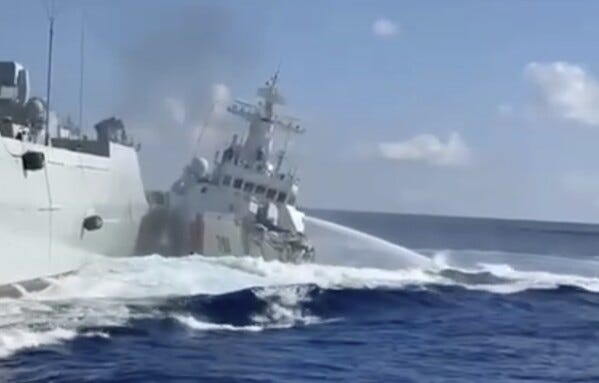
The involvement of a Type 052D destroyer, a multirole guided-missile ship, rather than a coast guard or maritime militia vessel, marks an escalation for China’s maritime assertiveness in the SCS. In previous Sino-Philippine clashes, Beijing typically relied on maritime assets masquerading as fishing vessels, leaving naval forces on standby.
Philippine Coast Guard spokesperson Jay Tarriela said that the CCG vessel “performed a risky maneuver” leading to the impact. He said the damage to the Chinese cutter’s bow rendered it “unseaworthy.” China’s Ministry of National Defense issued a statement that its coast guard “had taken measures such as surveillance, external coercion, and interception in accordance with the law to drive [the Philippines] away.” While China did not offer information on the accident, it appears, based on video analysis, that multiple CCG crewmembers may have died.
CCA Analysis: China’s navy and coast guard habitually violate the International Regulations for Preventing Collisions at Sea and disregard military norms of professionalism. These risky maneuvers increase the likelihood of accidents, including potential friendly-fire incidents. Normally, such an incident would prompt a reassessment of operational safety to ensure such accidents do not happen again. However, in the case of the PLA Navy and CCG, this is unlikely. Beijing appears to view these high-risk tactics in the South China Sea as a means of strengthening deterrence against other claimants, believing that assertive behavior forces opponents, such as the Philippines, to back down in the face of PRC pressure.
Read more: The South China Sea and the Trump Factor by Andrew Chubb (Non-Resident Fellow on Foreign Policy and National Security, Center for China Analysis), April 16, 2025.
Exercise: China-Russia Security Ties Deepen with Joint Sea 2025
From August 1 to 5, China and Russia held their eleventh Joint Sea exercise in the Sea of Japan, bringing together a range of modern naval platforms from both sides. Russia deployed destroyer Admiral Tributs, corvette Gromkiy, rescue vessel Igor Belousov, and submarine Volkhov, while China sent destroyers Urumqi and Shaoxing, fleet oiler Qiandaohu, rescue ship Xihu, and submarine Great Wall 210. Building on past iterations that emphasized “safeguarding strategic sea lanes,” this year’s exercise introduced a new theme of “responding to threats in the western Pacific.” Over several days, the two navies carried out a series of complex drills, including joint anti-submarine warfare, air and missile defense, surface combat, submarine rescue operations, anchorage defense, replenishment at sea, and live-fire training.

CCA Analysis: Joint Sea 2025 signals that the China-Russia partnership at sea is evolving from routine coordination into more integrated operations, demonstrating higher levels of mutual trust. The new theme reflects a sharper strategic intent compared to previous Joint Sea exercises, signaling growing Sino-Russian concerns about U.S. military activities in the region. The exercise comes on the heels of large-scale U.S.-led drills, such as REFORPAC 2025 and Talisman Sabre, and coincides with U.S. submarine deployments announced in response to heightened tensions with Moscow. Given this context, Joint Sea 2025 was as much about messaging as training.
The forces committed this year highlight the modernization and operational ambition of both navies. The inclusion of newer vessels, such as Shaoxing and Xihu, showcases the progress of China’s naval modernization. The drills also served as a platform for both navies to experiment with new tactics, exchange operational practices, and gain familiarity with each other’s equipment, thereby strengthening their capacity to handle complex maritime scenarios.
Read more: China-Russia Relations Since the Start of the War in Ukraine by Pierre Andrieu (Non-Resident Senior Fellow on China-Russia Relations, Center for China Analysis), August 20, 2025.
Commendation: Xi Awards First-Class Merits to a Space Center and a Carrier Pilot
Before PLA Day on August 1, Xi Jinping signed an order granting commendations to two PLA units and five individuals. Among them, two first-class merits stand out: PLA Unit 63920’s Second Office, widely believed to be part of the Beijing Aerospace Flight Control Center and central to China’s space command and control, and Ding Yang, a special-grade PLA Navy pilot and carrier-based fighter instructor. Ding has accumulated more than 2,600 safe flight hours, participated in multiple carrier missions and military parades, and has a record of repeated commendations for combat readiness training and technological contributions.
CCA Analysis: Xi’s annual award orders can be viewed as an indicator of priority domains in military modernization. Since 2013, first-class merits have been consistently awarded to both operational units and research institutions, underscoring a dual emphasis on combat readiness and technological advancement. Commending Unit 63920 signals the increasing significance Beijing places on space as a warfighting domain, particularly in satellite communications and counter-space operations. Meanwhile, honoring Ding elevates the profile of carrier aviation, a relatively new but fast-developing pillar of PLA power projection.
Read more: CCA’s Unpacking Chinese Views of Deterrence series.
Section II: PLA Strategy
In early August, the Central Military Commission (CMC) published and distributed the fourth volume of Xi Jinping Thought on Strengthening and Rejuvenating the Military (《习近平论强军兴军》), part of a series of authoritative collections of Xi’s speeches, writings, and instructions on military affairs and defense building that adds his imprimatur to PLA doctrine and leadership. This volume is important in four ways:
First, it codifies Xi’s military thought in a “new era” by enshrining Xi Jinping Thought as the guiding ideology for the PLA. It also serves as both a theoretical guide and handbook for military cadres at all levels.
Second, it firmly establishes Xi’s ideological control and reaffirms the Party’s absolute leadership over the military (党对军队绝对领导). It also functions as a political education tool, ensuring PLA officers and soldiers align with the Party center and with Xi as the “core leader” of the CCP and CMC. For example, the book highlights that “following the Party’s command is paramount in our military's development and the lifeblood of our army,” which “fully reflects the dialectical unity between politics and the military and profoundly reveals the natural connection between the Party and the military.”
Third, it offers a blueprint for PLA modernization. The volume repeatedly emphasizes achieving the CCP’s “centenary goals” of military modernization by the PLA’s 100th anniversary in 2027. It also lays out steps toward building a “world-class military” by mid-century, aligned with China’s national rejuvenation strategy.
Finally, it offers practical guidance on training and reform. It covers issues such as combat readiness, training, civil-military integration, technological innovation, and rule of law in the armed forces.
CCA Analysis: The fourth volume is politically significant because it cements Xi’s role as the architect of China’s military modernization and ensures the PLA’s loyalty. Strategically, it outlines the doctrinal and institutional path for China to transform the PLA into a modern, high-tech, globally capable force. The political and leadership elements of Xi’s status as “paramount leader” of the PLA are evident.
Section III: PLA Modernization
Lessons from the War of Resistance Against Japanese Aggression for Modern Warfare
To mark the 80th anniversary of victory in the War of Resistance Against Japanese Aggression (i.e., World War II), PLA Daily rolled out a series of commentaries that broke from formulaic tributes to the indispensable leadership of the Chinese Communist Party. Authors instead mined the war for lessons to prepare for and seize the initiative in today’s high-tech warfare. Four themes stood out.
First was the imperative of opening new spaces for combat. Writers recalled how Hebei’s tunnel warfare created a “second battlefield” underground, turning a position of weakness into an arena of advantage. Today, they argued, the PLA must do the same in outer space, cyberspace, and the electromagnetic spectrum. Second was the lesson of flexibility and asymmetry. The Eighth Route Army offset inferior firepower with night raids, ambushes, and guerrilla tactics tailored to terrain and weather. Commentators suggested that future conflicts will require the same spirit of adaptation. Third was the importance of integrated preparation. Bases not only defended territory but produced weapons in makeshift arsenals, launched mass production campaigns, and ensured self-sufficiency. This experience is recast as a blueprint for modern resilience. Finally, the articles stressed comprehensive mobilization. Political, social, and cultural campaigns once rallied the population into a “people’s war.” Today, the PLA envisions updating that model through cognitive mobilization, dual-use technologies, and civil-military fusion.
Beyond the essays, the PLA has sought to bring history into its training cycle. In a report about wargame exercises, it restaged the Battle of Pingxingguan (平型关) as a testing ground for how to adapt modern equipment to difficult terrain. Officers and soldiers turned to simulation platforms to work through tactics, coordination, and command, gradually shifting the focus from single-branch maneuvers to integrated multidomain operations.
CCA Analysis: The PLA’s effort to mine World War II for lessons provides meaningful insights. Themes of resilience, asymmetric tactics, and civil-military integration remind officers that wars are not won by firepower alone, but through adaptability, endurance, and the ability to mobilize society at scale. In that sense, the PLA’s experience fighting Japan illuminates how to prolong conflict and carve out advantages against a superior foe.
Yet these historical analogies have sharp limits. What ultimately ended World War II in Asia was not guerrilla innovation but the United States’ introduction of the atomic bomb. The implication for modern warfare is clear: if the PLA focuses too narrowly on retooling lessons of “people’s war” without grappling with the disruptive potential of next-generation technologies, it risks preparing for the last war rather than the next.
Section IV: PLA Research Highlights
Title: Multi-Agent Aerial Confrontation Autonomous Decision in Incomplete Information Observation [非完备信息观测条件下多智能体空中对抗自主决策方法]
Authors: ZHANG Yuan¹ [张原], LI Xuan¹ [李璇], LI Chao¹ [李超], and ZHOU Xiaoguang² [周晓光]
Affiliation: 1. College of Aviation Fundamentals, Naval Aviation University [海军航空大学航空基础学院], Shandong; 2. People’s Liberation Army Unit 91475 [中国人民解放军91475部队], Liaoning.
Publisher: Electronics Optics & Control [电光与控制]
Date: 2025-08-05
Abstract: The battlefield environment, engagement situation and information acquisition in modern warfare are highly complex, dynamic and uncertain. Aiming at the problem of air combat decision-making under incomplete information observation, this paper proposes a data filling strategy based on MLP with incomplete information. The research results show that this strategy can effectively complete the incomplete information data. In order to solve the problem of insufficient training guidance caused by low intelligence during opponent selection in air combat, this paper proposes a multi-environment parallel training framework based on population self-game method. The simulation results show that this framework can shorten training time on parallel computing platforms, accelerate algorithm convergence, and guide the gradual improvement of the tactical level of air combat agents.
Link: https://link.cnki.net/urlid/41.1227.TN.20250805.1345.002
Title: Analysis of UAV and Passive Radar Collaborative Networking Passive Positioning Strategy [无人机与被动雷达协同组网无源定位策略研究]
Authors: YAN Wenjuan¹,² [闫文娟], GUAN Zhijun¹ [关志军], TONG Yingyi² [童颖裔], and LIU Su³ [刘苏]
Affiliation: 1. College of Information and Navigation, Air Force Engineering University [空军工程大学信息与导航学院], Shaanxi; 2. People’s Liberation Army Unit 95894 [中国人民解放军95894部队], Beijing; 3. People’s Liberation Army Unit 94691 [中国人民解放军94691部队], Fujian.
Publisher: Radio Engineering [无线电工程]
Date: 2025-08-15
Abstract: Aiming at the tracking and positioning issues of airborne early warning aircraft and other long-range targets, a high-precision passive positioning strategy based on the collaborative networking of unmanned aerial vehicles (UAVs) and passive radar is proposed. By analyzing the impact of the layout of multi-station passive radar on positioning accuracy, a layout strategy that can improve positioning accuracy and reduce layout costs is designed. The Time Difference of Arrival (TDOA) positioning method is applied in the study, and on this basis, the Geometric Dilution of Precision (GDOP) for multiple stations is analyzed to evaluate the impact of the layout form on positioning accuracy. A collaborative strategy is proposed that, when the initial direction of the target is unknown, first uses a star-shaped layout for initial positioning and then switches to an inverted triangular layout for high-precision secondary positioning. The optimal secondary stations are selected using the “virtual structure method,” and the flight trajectory of the UAV is optimized using an improved Particle Swarm Optimization (PSO) algorithm to achieve high-precision layout. Simulation results show that this strategy can significantly improve positioning accuracy. Compared with traditional passive radar systems, the positioning error is significantly reduced, and the system response speed is faster. The research results have certain application value in practice.
Link: https://link.cnki.net/urlid/13.1097.TN.20250814.1616.006
Title: Research on the Similarity Evaluation of Complex Electromagnetic Environment [复杂电磁环境相似性评估研究]
Authors: TIAN Miaomiao [田苗苗], PENG Jinxian [彭进先], GENG Dan [耿丹], ZHAO Chao [赵超], WANG Xiao [王晓], and QIN Jianqi [秦剑琪]
Affiliation: People’s Liberation Army Unit 63611 [中国人民解放军63611部队], Xinjiang
Publisher: Modern Defence Technology [复杂电磁环境相似性评估研究]
Date: 2025-08-27
Abstract: Setting up the complex electromagnetic environment is a basic part of training conditions construction. It is important to evaluate the similarity between training electromagnetic environment and required environment. In view of the unclear index system for electromagnetic environment construction and the incomplete similarity evaluation, the similarity evaluation index system is constructed by Euclidean distance. By the way, the similarity characterizations of basic arguments and mode arguments are analyzed based on the basic principles of similarity theory and electromagnetic environment constructing practice. According to the electromagnetic environment properties, the similarity degrees are calculated in multiple dimensions such as threatening electromagnetic environment, objective electromagnetic environment and background electromagnetic environment, the environment mentioned above are aggregated to obtain the expression for evaluating the similarity of electromagnetic environment. The methods can be used to evaluating electromagnetic environment constructing effect, and provide reference to optimize the electromagnetic environment construction.
Link: https://link.cnki.net/urlid/11.3019.tj.20250826.1907.004
Section V: PLA Observers
Tong Zhao, “Is China Changing Its Nuclear Launch Strategy? Certain Behaviors Suggest It May Be Preparing to Adopt One of the Cold War’s Most Dangerous Policies,” Foreign Policy, August 5, 2025, https://foreignpolicy.com/2025/08/05/china-nuclear-weapons-launch-policy-strategy/.
Jacob Stokes, “How Big Will China’s Nuclear Arsenal Get? No One Knows, but We Can Game Out Potential Endpoints of Beijing’s Buildup,” Defense One, August 6, 2025, https://www.defenseone.com/ideas/2025/08/how-big-will-chinas-nuclear-arsenal-get/407230/.
Sunny Cheung, “Embodied Intelligence: The PRC’s Whole-of-Nation Push into Robotics,” Jamestown Foundation, August 9, 2025, https://jamestown.org/program/embodied-intelligence-the-prcs-whole-of-nation-push-into-robotics/.
John S. Van Oudenaren, “China’s Responses to the U.S. ‘Golden Dome’ Missile Defense Initiative,” China Aerospace Studies Institute, August 11, 2025, https://www.airuniversity.af.edu/Portals/10/CASI/documents/Research/CASI%20Articles/2025-08-25%20PRC%20Response%20to%20Golden%20Dome.pdf?ver=3v4D23kFqKZYGkkJx70vXQ%3d%3d.
Shanshan Mei, “The People’s Liberation Army’s Approach to Manned-Unmanned Teaming: Theory and Practice,” RAND Corporation, August 12, 2025, https://www.rand.org/pubs/research_reports/RRA3906-1.html.
Peter W. Singer and Alex Nova, “China Is Working on Reusable Rockets—and a Strategic Leap in Space Power,” Defense One, August 14, 2025, https://www.defenseone.com/ideas/2025/08/china-working-reusable-rocketsand-strategic-leap-space-power/407453/.
Jonathan A. Czin and John Culver, “Why Xi Still Doesn’t Have the Military He Wants: China’s Force Has Been Remade—but Can It Be Trusted?” Foreign Affairs, August 18, 2025, https://www.foreignaffairs.com/china/why-xi-still-doesnt-have-military-he-wants.
Tressa Guenov, “Addressing China’s Military Expansion in West Africa and Beyond,” Atlantic Council, August 21, 2025, https://www.atlanticcouncil.org/in-depth-research-reports/issue-brief/addressing-chinas-military-expansion-in-west-africa-and-beyond/.
Nathan McQuarrie, “Why China Has Not Acted on Western Warnings to ‘Disentangle’ Conventional and Nuclear Missile Capabilities,” Bulletin of the Atomic Scientists, August 22, 2025, https://thebulletin.org/2025/08/why-china-has-not-acted-on-western-warnings-to-disentangle-conventional-and-nuclear-missile-capabilities/#post-heading.
Michael Lynch, “From the Last Frontier to the Final Frontier: The Polar Regions and Space Security,” U.S. Army War College Strategic Studies Institute, August 25, 2025, https://ssi.armywarcollege.edu/SSI-Media/Recent-Publications/Article/4285048/from-the-last-frontier-to-the-final-frontier-the-polar-regions-and-space-securi/.
Maximilian K. Bremer and Kelly A. Grieco, “The Future Is Being Delivered by Chinese Drones: Washington Needs to Move Quickly if It Hopes to Compete in This Critical Industry,” Foreign Policy, August 25, 2025, https://foreignpolicy.com/2025/08/25/china-united-states-drones-logistics-military-commerce-technology/.
Matthew Bruzzese and Devon Johanneson, “A ‘Strategic Pivot for Chinese Weaponry?’ PRC Media Responses to Pakistani J-10’s Combat Success,” China Aerospace Studies Institute, August 25, 2025, https://www.airuniversity.af.edu/Portals/10/CASI/documents/Research/CASI%20Articles/2025-08-25%20PRC%20response%20to%20J-10%20success.pdf?ver=nBwIqKoNK96BxCP2kKBiPQ%3d%3d.
Kainan Gao and Margaret M. Pearson, “Military Parades and Memory Wars: China and Russia Commemorate History to Reimagine International Order,” Brookings Institution, August 27, 2025, https://www.brookings.edu/articles/military-parades-and-memory-wars-china-and-russia-commemorate-history-to-reimagine-international-order/.
Jean-Loup Samaan, “Is the Cautious China-Iran Military Cooperation at a Turning Point?” Atlantic Council, August 29, 2025, https://www.atlanticcouncil.org/blogs/menasource/is-the-cautious-china-iran-military-cooperation-at-a-turning-point/.
Shinji Yamaguchi, “Creating ‘Facts on the Mountains’: China’s Gray Zone Playbook in the Himalayas,” Institute for Security and Development Policy, August 29, 2025, https://www.isdp.eu/publication/creating-facts-on-the-mountains-chinas-gray-zone-playbook-in-the-himalayas/.