


Welcome to the September edition of PLA Watch, a monthly newsletter from the Center for China Analysis that provides insights into the latest developments in Chinese military affairs and writings using primary sources.
Six months after our launch, we’re grateful to have nearly 1,800 subscribers and deeply appreciate your support. Going forward, we want to make the newsletter as valuable and engaging as possible for you. To help us improve, we’d love to hear your feedback. If you have two minutes, please take a moment to fill out this short survey. Thank you!
This month’s issue features a video call between U.S. and Chinese defense leaders, the Pakistani president’s visit to an aerospace conglomerate, and the electromagnetic catapult launch of the J-35. It also delves into the Beijing Xiangshan Forum, an academic report on negative security assurances for non-nuclear states, and a PLA Rocket Force investigation into procurement corruption.
Written by:
Lyle Morris, Senior Fellow, Center for China Analysis
Jie Gao, Research Associate, Center for China Analysis
With support from:
Ian Lane Smith, Research Associate (Editorial), Center for China Analysis
Sheng-wen Cheng, Intern, Center for China Analysis
Section I: PLA News
U.S. and Chinese Defense Heads Hold Video Call
On September 9, U.S. Secretary of Defense Pete Hegseth and People’s Republic of China (PRC) Minister of National Defense Dong Jun held their first video call.
The U.S. readout highlighted that “the United States does not seek conflict with China nor is it pursuing regime change or strangulation of the PRC,” adding that Hegseth “relayed that the U.S. has vital interests in the Asia-Pacific, the priority theater, and will resolutely protect those interests.”
The PRC readout stated that “it is imperative to uphold an open attitude, maintain communication and engagement, and build a sound, stable China-U.S. military relationship that is based on equality, respect and peaceful coexistence.” Dong reportedly “stressed the importance of respecting each other’s core interests,” to include “any attempts or acts of interference to support ‘Taiwan independence’ separatism.” He said that China is “committed to working with other countries in the region to safeguard peace and stability in the South China Sea, and firmly opposes acts of infringement or provocation by certain countries, as well as attempts by certain countries outside the region to stir trouble.”
CCA Analysis: China’s release did not feature new talking points or areas of emphasis from the past. Notably, the first sentence of the U.S. readout stressed that the United States is not interested in conflict or regime change. It is also noteworthy that Hegseth used the term “Asia-Pacific,” appearing to move away from the term “Indo-Pacific,” which had been used by the U.S. Department of Defense since May 2018.
Pakistani President Visits AVIC Chengdu
On September 14, Pakistani President Asif Ali Zardari visited the Aviation Industry Corporation of China (AVIC) complex in Chengdu, the first time a foreign head of state has toured China’s flagship military-aviation production hub. Touring the facility where the J-10C fighter is assembled, Zardari was briefed on AVIC’s broader portfolio, including the JF-17 co-production program with Pakistan, the J-20 stealth fighter, and emerging unmanned and automated systems. He praised the J-10C and the JF-17 for strengthening the Pakistan Air Force, citing their performance in the May 2025 clash with India, and pledged to deepen China-Pakistan cooperation in defense production and aviation technology. Besides aircraft, a former Pakistani senior commander also expressed interest in China’s laser weapons as part of further integrating PRC military technologies into Pakistan’s military.
CCA Analysis: Granting access to one of China’s most important state-owned military aircraft enterprises underscores the closeness of Sino-Pakistan military relations. The combat credibility of the J-10C, now battle-tested in South Asia, is a key asset within the Pakistan Armed Forces. The visit also highlighted Pakistan’s role as China’s largest arms client, with PRC systems accounting for 80% of Islamabad’s imports. Moreover, through frequent joint exercises between the Chinese and Pakistani armed forces, Beijing is transferring both platforms and training packages.
New Aircraft Carrier Launch System Tested
China’s latest and most capable aircraft carrier, the Fujian, used its new electromagnetic catapult to successfully launch three types of aircraft, according to the PRC Ministry of National Defense, which published a feature story to mark the technological breakthrough. In footage released by state broadcaster CCTV on September 22, China’s J-35 stealth fighter, J-15T fighter, and KJ-600 airborne early warning and control aircraft were seen taking off from the aircraft carrier using its electromagnetic aircraft launch system (EMALS). State media hailed the tests as a major “success,” marking “another breakthrough” in the development of China’s naval aviation capabilities.
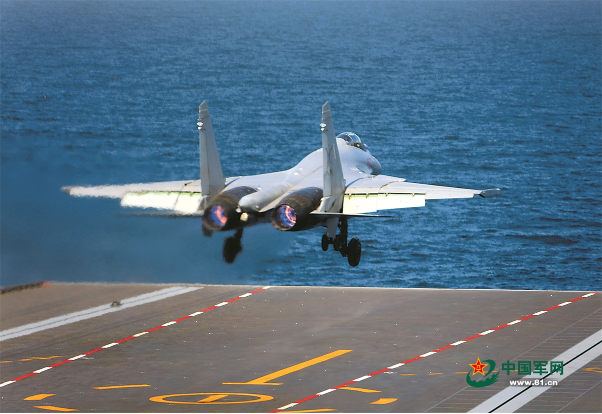
The only other aircraft carrier in the world with an EMALS system is the USS Gerald R. Ford, which was certified for flight deck operations using the system in spring 2022.
The Fujian is China’s third aircraft carrier and its only “flattop” with the EMALS. China’s other two carriers—the Liaoning and the Shandong—use ski jumps for aircraft takeoff, which significantly limit fighter jet payloads.
CCA Analysis: This is no small feat for the PLA Navy, which designs to build a blue-water fleet for far-sea operations. The Fujian’s ability to launch its newest suite of fighters and support aircraft via an EMALS will allow PRC naval aviation to operate farther and with more substantial payloads. The footage of the trials suggests the carrier could be commissioned in the next year.
Section II: PLA Strategy
China’s Vision for Global Governance at the Xiangshan Forum
The 12th Beijing Xiangshan Forum, convened on September 17–19 in Beijing, brought together over 1,800 delegates from more than 100 countries and organizations. Framed under “Upholding International Order and Promoting Peaceful Development,” PRC Defense Minister Dong Jun delivered a keynote that blended historical memory with strategic messaging. He declared that “Taiwan’s return is an integral part of the post-war order” and argued that “the stronger China’s military, the stronger the force restraining war.” Dong criticized “small circles of hegemony” led by external powers (i.e., the United States) while positioning the PLA as a stabilizing “ballast” in global security.
The forum’s agenda included plenary sessions on building a “just and reasonable” global security governance system, Asia-Pacific trust and cooperation, and regional peacebuilding, alongside specialized panels on emerging technologies, arms control, and conflict resolution. Participation was notably weighted toward Global South states, with Western representation downgraded to defense attaché delegations from the United States and its allies.
CCA Analysis: The Xiangshan Forum illustrates Beijing’s effort to embed the newly launched Global Governance Initiative (GGI) into international security discourse. By tying the GGI’s “five core concepts” to the UN Charter and WWII anniversaries, Chinese leaders sought to present themselves as defenders of international law while selectively reinterpreting it to justify positions on Taiwan and the South China Sea. The heavy presence of Global South representatives underscores China’s strategy to build legitimacy through inclusivity and South-South solidarity, even as Western participation declines.
Official reports and Chinese experts emphasized the PLA’s defensive posture and the forum’s inclusiveness. Yet the orchestration of panels and repetitive “peace” and “development” rhetoric suggest an exercise in agenda-setting more than genuine multilateral exchange. For Beijing, Xiangshan has become less about bridging divides with the West and more about consolidating an alternative vision of global governance that could amplify China’s influence but also deepen global fragmentation if it hardens into parallel institutions.
First Academic Report on Security Assurances for Non-Nuclear States
On September 10, the China Arms Control and Disarmament Association and the China National Nuclear Corporation’s Strategic Planning Research Institute jointly released “Negative Security Assurances for Non-Nuclear Weapon States: From Political Commitments to an International Legal Instrument.” This marks the first time Chinese academic institutions have issued a public study focused on negative security assurances (NSA)—commitments by nuclear-weapon states not to use or threaten to use nuclear weapons against non-nuclear-weapon states.
The report argues that transforming political commitments into a universal, unconditional, and legally binding international instrument is the most effective path forward. It urges the Conference on Disarmament to begin substantive negotiations and lays out interim measures: reducing the role of nuclear weapons in security doctrines, abolishing nuclear sharing and extended deterrence, supporting the expansion of nuclear-weapon-free zones, and strengthening existing political commitments. The report also calls for broader international dialogue platforms, including a potential “Friends of NSA” group and greater involvement from think tanks and nongovernmental organizations. While framed as a scholarly initiative, the report aligns with China’s Global Security Initiative and reflects an effort to position itself as a leader in nuclear governance debates.
CCA Analysis: The release is notable against the backdrop of China’s ongoing nuclear modernization and force expansion. Unlike the United States and Russia, which maintain conditional NSA pledges tied to alliance structures and deterrence postures, China continues to highlight its status as the only nuclear-weapon state with a policy of unconditional NSA and “no first use.” By elevating the issue through academic channels, Beijing contrasts its policies with those of Washington and Moscow, presenting itself as a responsible steward in the disarmament process.
However, the report notably avoids any concrete discussion of reducing China’s own nuclear arsenal. Instead, its proposals are framed as risk-reduction measures aimed at constraining others, not as steps toward its own disarmament. This omission illustrates Beijing’s dual-track approach of emphasizing normative leadership in arms control while continuing to expand and diversify its nuclear forces. For non-nuclear states, the report may sound reassuring, but in practice, it reflects China’s preference for declaratory commitments over substantive limitations on its growing nuclear capabilities.
Section III: PLA Modernization
PLA Rocket Force (PLARF) Bans Hundreds of Defense Suppliers
From August 28 to September 1, the Procurement and Asset Management Bureau (PAMB) of the Rocket Force Logistics Department issued 180 notices terminating the military procurement accreditations of 74 bid evaluation experts and 116 suppliers. These included technical experts held accountable for “evaluation errors that affected results” as well as a lifetime ban of one “broker” (Xu Yuanzhao [许元昭]) for falsifying records and submitting fraudulent bids. The news was made public via the China Military Procurement News (军队采购网) website.

Most striking is the retrospective nature of the bans. The investigation gathered nine years of data to search for irregularities, using big-data analysis and new forensic tools. It also broke new ground by targeting “broker experts”—middlemen who facilitate multi-million-dollar procurement deals between state-owned enterprises and the PLA and who exploited their professional authority to conduct shady transactions.
According to the South China Morning Post, some suppliers and experts were banned from procurement projects, while others were stripped of qualifications that entitled them to bid for projects across the entire PLA. The report noted that two experts were cited for “biased scoring in bidding,” while another was banned for “forging credentials.” Most suppliers were penalized for “collusive bidding” and “submitting false materials.” Among the suppliers banned or fined were the Beijing Engineering Bureau of China Communications Construction (中交集团), which engaged in “bid rigging in military procurement projects,” and the China Postal Express & Logistics (中国邮政速递物流), a subsidiary of China Post, which was disqualified from procurement across the PLA for submitting “false materials in bidding.”
The Central Military Commission (CMC) established the “Sunshine Procurement” (阳光采购制度) system in 2016 to fix flaws in the PLA’s procurement system. The system randomly selected PLA contractors for additional screening and enhanced public price disclosures. But loopholes remained.
Manipulation of technical parameters is a common tactic among PLA contractors. Evaluation experts tailor bids to specific companies by limiting parameters such as equipment interface models. For example, in one telecommunications construction project, three of the five bidding companies were controlled by the same group. Brokerage intermediaries are even more covert. Experts received benefits under the guise of “consulting fees” without directly participating in financial transactions. One expert implicated in the case simultaneously manipulated bids from multiple companies, all while his holding company directly participated in the bidding, creating a closed loop of self-dealing. This is referred to as the “black and gray” (黑灰产) system in PLA procurement.
But the PLA and the PAMB made a breakthrough with the launch of a new procurement big data platform in 2023, which featured intelligent bid document comparisons and supplier relationship analysis. A bid-rigging case involving a central state-owned enterprise was uncovered through bid document fingerprinting technology by revealing unusual similarities between bids from different companies. This big data technology explains this most recent nine-year investigation, allowing for electronic archiving and new traceability of records and contract data.
CCA Analysis: The use of correlation analysis technology was key to this investigation. By collating legal personnel, shareholders, and IP addresses, the system identified the characteristics of bid rigging, such as multiple companies registered by the same group of individuals. There have long been rumors of mismanagement of funds within the PLA Rocket Force (PLARF) and the CMC’s Equipment Development Department (EDD), but this recent report provides a clearer picture of the sources of corruption.
For years, the EDD and the PLARF have been the target of anticorruption efforts. Investigations seemed to start with Li Shangfu, who ran the EDD before becoming defense minister, but have since expanded to include Li Yuchao and Xu Zhongbo—commander and political commissar of the PLARF—former PLARF commander Zhou Yaning, head of the PLARF Armaments Department Lu Hong, and former PLARF Deputy Li Chuanguang. Wei Fenghe was also investigated. This most recent investigation lifts the veil on what has been happening behind the scenes regarding procurement issues within the PLA.
Section IV: PLA Research Highlights
Title: Intelligent Identification Method of Maritime Targets Based on Hierarchical Reasoning [基于分层推理的海上目标智能识别方法]
Authors: XU Yingqi [许莹琪], LI Chao [李超], and QIAN Renjun [钱仁军]
Affiliation: People’s Liberation Army Unit 92728 [中国人民解放军92728部队], Shanghai
Publisher: Ship Science and Technology [舰船科学技术]
Date: 2025-09-04
Abstract: Traditional maritime target identification methods relying on manual visual inspection or camera devices can no longer meet modern marine monitoring requirements. Adopting intelligent recognition technology has become a key solution for enhancing maritime safety and resource management efficiency. To meet the demand for real-time and high-precision identification of maritime targets, this paper proposes an intelligent identification method for maritime targets based on hierarchical reasoning. By constructing a hierarchical reasoning model combining YOLOv8 and ResNet50, the study employs a coarse classification and fine recognition logic nested approach to progressively improve identification speed and accuracy. Experiments conducted on the established maritime vessel target dataset demonstrate that our proposed hierarchical inference model achieves 90.2% detection accuracy at 73.0 FPS, outperforming other single-layer image detection models. It effectively balances the precision and efficiency of maritime target image recognition, achieving accurate and rapid identification under fine classification.
Link: https://link.cnki.net/urlid/11.1885.U.20250904.0007.004
Title: FPV Drone Individual Recognition Method Based on Multi-dimensional Features [基于多维特征的 FPV 无人机个体识别方法]
Authors: WANG Zijian [王子健], LI Xinhao [李歆昊], and GU Yewei [谷业伟]
Affiliation: College of Electronic Engineering, National University of Defense Technology [中国人民解放军国防科技大学电子对抗学院], Anhui
Publisher: Telecommunication Engineering [电讯技术]
Date: 2025-09-28
Abstract: Aiming at the problems of low efficiency and large amount of computation in unmanned aerial vehicle (UAV) individual recognition, a first person view (FPV) drone individual recognition method based on multidimensional features is proposed. This method constructs a two-layer architecture of “rapid screening of external features – deep analysis of signal multidimensional features.” First, based on the external feature extraction and threshold judgment of signals, rapid detection of analog image signals is realized and suspected signals are screened out. Then, the Residual Network (ResNet) model is used to fine identify and match the screened suspect signals, so as to improve the accuracy and reliability of identification. Finally, the effectiveness of this method is proved by experiments. The experimental results show that the rejection rate of the fast screening layer of the proposed method is more than 85%, and the average recognition accuracy of the deep parsing layer for FPV drone signals in the 5.8 GHz band is 94%.
Link: https://doi.org/10.20079/j.issn.1001-893x.250912001
Title: Reinforcement Learning-Based Cooperative Trajectory Planning Method for Unmanned Combat Aerial Vehicles and Decoy UAVs [基于强化学习的无人攻击机与诱饵机协同航迹规划方法]
Authors: QI Haozhe¹ [祁昊哲], ZHENG Mingfa¹* [郑明发], HU Xiaorong²* [胡小荣], and YANG Nan¹ [杨楠]
Affiliation: 1. Air Traffic Control and Navigation School, Air Force Engineering University [空军工程大学空管领航学院], Shaanxi; 1*. Fundamentals Department, Air Force Engineering University [空军工程大学基础部], Shaanxi; 2*. National Innovation Institute of Defense Technology, Academy of Military Sciences [军事科学院国防科技创新研究院], Beijing
Publisher: Journal of System Simulation [系统仿真学报]
Date: 2025-09-28
Abstract: Unmanned aerial vehicle (UAV) cooperative combat is crucial in modern warfare. The cooperative mode between unmanned combat aerial vehicles (UCAVs) and decoy UAVs has gained significant attention due to its tactical value. This paper proposes a cooperative trajectory planning method based on the Proximal Policy Optimization (PPO) algorithm for UCAV and decoy UAV strike missions against key enemy targets. We construct a Markov Decision Process (MDP) model incorporating dynamic threat assessment, integrating UAV kinematics and battlefield constraints, and design the state/action spaces and a hierarchical reward function. Simulation results demonstrate that the proposed method effectively guides UCAVs and decoys to achieve efficient cooperation in complex environments, significantly increasing mission success rates while reducing interception risks from enemy air defense systems. This provides theoretical and technical support for intelligent path planning in UAV cooperative operations.
Link: https://link.cnki.net/urlid/11.3092.v.20250928.1109.003
Section V: PLA Observers
Jared McKinney and Robert S. Hinck, Closing the Deterrence Gap in the Taiwan Strait, Air University Press, August 27, 2025, https://www.airuniversity.af.edu/AUPress/Display/Article/4283778/closing-the-deterrence-gap-in-the-taiwan-strait/
Matthew P. Funaiole and Brian Hart, “China’s Military in 10 Charts,” Center for Strategic and International Studies (CSIS), September 2, 2025, https://www.csis.org/analysis/chinas-military-10-charts
Derek Solen, “Beijing’s Response to REFORPAC Projects Calm Confidence,” China Aerospace Studies Institute, September 2, 2025, https://www.airuniversity.af.edu/CASI/Display/Article/4287453/beijings-response-to-reforpac-projects-calm-confidence/
Joshua Arostegui, Brennan Deveraux, and Rick Gunnell, “More Than a Numbers Game: Comparing US and Chinese Landpower in the Pacific Requires Context,” U.S. Army War College, September 3, 2025, https://ssi.armywarcollege.edu/SSI-Media/Recent-Publications/Article/4292281/more-than-a-numbers-game-comparing-us-and-chinese-landpower-in-the-pacific-requ/
Sam Roggeveen, “China’s Military Is Now Leading,” Foreign Policy, September 3, 2025, https://foreignpolicy.com/2025/09/03/china-military-parade-technology-pla-weapons/
Joshua Arostegui, “China’s September 2025 Military Parade: How PLA Ground Forces Are Adapting to Future Wars and Force Projection,” U.S. Army War College, September 5, 2025, https://ssi.armywarcollege.edu/SSI-Media/Recent-Publications/Article/4294886/chinas-september-2025-military-parade-how-pla-ground-forces-are-adapting-to-fut/
Macdonald Amoah, Morgan Bazilian, and Jahara Matisek, “Jet fuel, China, and lanthanum: a hidden risk to US military power projection,” Atlantic Council, September 15, 2025, https://www.atlanticcouncil.org/blogs/energysource/jet-fuel-china-and-lanthanum-a-hidden-risk-to-us-military-power-projection/
Astrid Young, “Shanghai University’s uncrewed vessels support China’s maritime push,” Australian Strategic Policy Institute, September 18, 2025, https://www.aspi.org.au/strategist-posts/shanghai-universitys-uncrewed-vessels-support-chinas-maritime-push/
Greg Hadley, “Intel Leaders: Beware ‘Expeditionary’ China,” Air & Space Forces Magazine, September 22, 2025, https://www.airandspaceforces.com/intel-leaders-beware-expeditionary-china/
Malcolm Davis, “China may soon reach far into the Pacific with many uncrewed bombers,” Australian Strategic Policy Institute, September 25, 2025, https://www.aspi.org.au/strategist-posts/china-may-soon-reach-far-into-the-pacific-with-many-uncrewed-bombers/
Joshua Arostegui, “Adapting to Future Wars: The Reorganization of the PLA Army’s Special Operations Forces and the Move toward Professionalization,” U.S. Army War College, September 26, 2025, https://ssi.armywarcollege.edu/SSI-Media/Recent-Publications/Article/4315889/adapting-to-future-wars-the-reorganization-of-the-pla-armys-special-operations/
Oleksandr V. Danylyuk and Jack Watling, “How Russia is Helping China Prepare to Seize Taiwan,” Royal United Services Institute, September 26, 2025, https://www.rusi.org/explore-our-research/publications/commentary/how-russia-helping-china-prepare-seize-taiwan
Matthew Cox, “Industry Reps: US Can’t Go for One-for-One Kills in Drone Warfare with China,” Air & Space Forces Magazine, September 29, 2025, https://www.airandspaceforces.com/us-china-drone-warfare-one-for-one-kills/
Jeffrey Prescott and Julian Gewirtz, “China Goes on Offense: Beijing’s Plans to Exploit American Retreat,” Foreign Affairs, September 29, 2025, https://www.foreignaffairs.com/united-states/china-goes-offense
China has emerged as a world leader in electric power and battery storage systems, as is currently being seen in multiple civilian industries. It should also be noted that the Fujian uses DC for its integrated power system, which can support higher loads that the Fords AC
It is far too early to assume without proof that the Fujian cant conduct simultaneous launches or that it would need to reduce power to other systems to use it's catapults.
I wish to make two points. First, while it is a positive move to have Secretary Hegseth and the Chinese Defense Minister talking, the Chinese minister's position is not at the same level as Hegseth's. Whereas Hegseth is a cabinet-level position, Dong is not a member of the Central Military Commission; he is subordinate not only to General Secretary Xi but also to the Commission's First Vice Chairman.
Regarding the electromagnetic catapult system, for a conventionally powered carrier, the system presents operational risks. The first problem impacts the aviation group. The system cannot conduct simultaneous launches, whereas the Ford class can. Furthermore, the use of catapults necessitates shifting power away from other systems. This affects the ship's speed, drains electric power, and reduces the operability of defensive systems.