


By Wei-Hao Ho, Intern, and Lyle Morris, Senior Fellow on Foreign Policy and National
This special issue of PLA Watch examines a consequential shift in the composition and geography of Chinese military and gray-zone pressure around Taiwan in 2026. We document what appears to be a sharp decline in PLA air activity, with aircraft sorties falling by roughly half year on year. This is juxtaposed with a major uptick in Chinese “official-vessel” activity, such as coast guard and maritime research vessels. When digging into the aggregate maritime data, we find that the rise is driven principally by China Coast Guard activity, in particular operations east of Taiwan’s main island since June 2026. This extends a gray-zone pattern previously concentrated around Kinmen and Matsu, Pratas, and Itu Aba. Finally, we examine Beijing’s effort to routinize these operations through the language and practice of “normalized law-enforcement patrols,” suggesting that China is not simply shifting pressure from the air to the sea, but broadening the geographic scope and legal-administrative character of its coercion around Taiwan. Taken together, these developments point to a changing coercive strategy in which persistent maritime law-enforcement activity is becoming an increasingly important instrument for asserting Chinese jurisdiction and shaping the operational environment around Taiwan below the threshold of overt military conflict.
Summary and Key Judgements
Overall Summary
PLA aircraft sorties around Taiwan in 2026 appear to be operating at roughly half last year’s rate, while naval activity remains generally the same. However, “official-vessel” activity compiled by Taiwan’s Ministry of National Defense has risen sharply. The increase is driven principally by China Coast Guard (CCG) activity, and since June 2026, its geographic center of gravity has expanded to waters east of Taiwan’s main island. The result is not a one-for-one transfer of pressure from air to sea, but a consequential change in the composition, geography, and legal-administrative character of Beijing’s coercion.
Data Scope and Sources:

Summary of Key Judgments
1. Air activity has halved, at both ends of the distribution. Sorties fell 51.1% year on year, from 3,603 to 1,763 over the same 231-day window. Days with no aircraft rose from 12 to 43, while days above 50 sorties fell from eight to zero. The routine baseline and the surge activity visible from Taiwan Ministry of National Defense (MND) reporting both contracted.
2. The character of air activity did not change. The share of sorties crossing the median line or entering Taiwan’s ADIZ was 71.3% in both years. The change is in frequency, not a shift toward “fewer but more aggressive” sorties.
3. Law-enforcement vessel presence more than doubled and became routine. MND official-ship detections rose from 183 to 457 (+149.7%). Days with five or more official ships rose from one to 33. From June onward, the average was about 3.9 official ships per day, compared with 0.9 in January–May.
4. The MND category masks the agency driving the increase. MND groups non-naval PRC government vessels into a single “official vessel” category. Taiwan Coast Guard Administration (CGA) records disaggregate that category into CCG, Maritime Safety Administration (MSA), and fisheries-enforcement vessels; the CCG makes up by far the largest share. This separate evidence supports attributing the maritime law-enforcement increase principally to the CCG.
5. The geographic center of gravity of PRC law-enforcement gray-zone activity has shifted eastward. Since June 2026, CCG formations have operated east of Taiwan’s main island, extending a pattern previously concentrated around Kinmen/Matsu, Pratas (Dongsha), and Itu Aba (Taiping Island). The sequence suggests geographic expansion of an established gray-zone model rather than an isolated episode.
6. Beijing is attempting to normalize an enforcement presence east of Taiwan. On July 4, a CCG formation led by the cutter Xiushan relieved the Daishan formation and Beijing used the phrase “normalized law-enforcement patrols.” This routinization language resembles terminology used in other contested maritime spaces where China seeks to assert jurisdiction through persistent law-enforcement presence.
7. This is a shift in composition and geography, not a transfer of pressure at constant volume. The official-ship increase of 274 detections offsets only 14.9% of the 1,840-sortie air decline. Total observed activity across aircraft, PLAN vessels, and official ships fell 30% year on year. The stronger conclusion is that the mix and operating pattern have changed.
Analysis
Air activity: Volume Halved, Character Unchanged
The year-on-year decline in PLA air activity is large and consistent across the principal measures in Taiwan’s daily reporting. Sorties fell from 3,603 to 1,763 between 1 January and 19 August, a decline of 51.1%. Median-line crossings and ADIZ entries fell by essentially the same proportion, from 2,570 to 1,257. The decline was already emerging in the fourth quarter of 2025: October was the weakest month of that year, and excluding the two-day surge on 29–30 December, the remainder of December averaged 9.6 sorties per day, close to the 2026 baseline.
The most analytically important continuity is the proportion of air activity entering contested space. As Figure 1 indicates, the median-line/ADIZ share was 71.3% in both years. This stability argues against interpreting 2026 as a deliberate trade of sortie volume for greater per-sortie aggressiveness. Beijing is flying less often, but the observed geographic character of those flights is broadly unchanged.
Figure 1: PLA aircraft sorties detected around Taiwan, by month, 2025 vs 2026

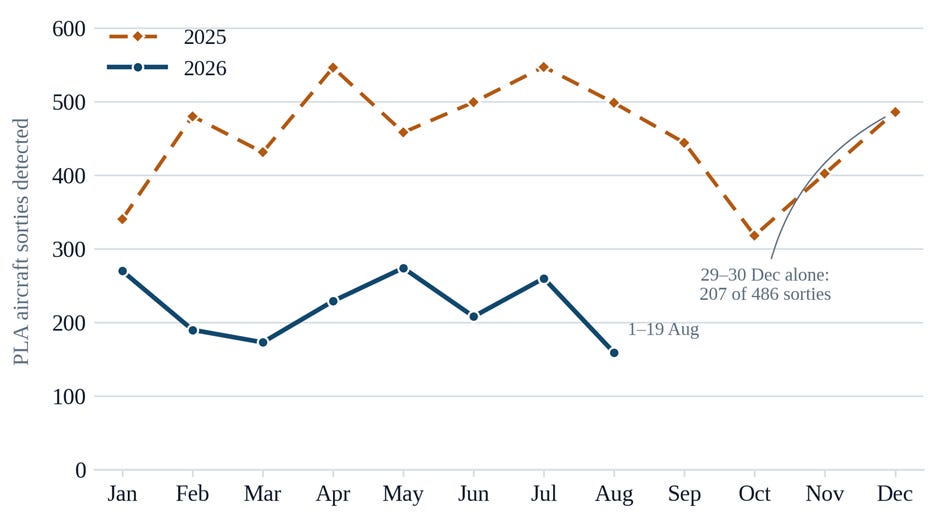
Notes: A sortie is one flight, not one aircraft. 2026 data run to 19 August. Over the same 231-day window (1 January – 19 August), sorties fell from 3,603 to 1,763 (−51.1%); the share crossing the median line or entering the ADIZ was 71.3% in both years. The December 2025 figure is carried by two days: 29 and 30 December account for 207 of that month’s 486 sorties, and the remaining 29 days average 9.6 sorties — already at the 2026 level.
Composition Shifts in Maritime Activity
Against the halving of air activity, the maritime picture is more stable in absolute terms but substantially more important in relative terms. As Table 1 illustrates, PLAN vessel detections fell only 4.9%, from 1,706 to 1,622. Official-ship detections, by contrast, rose from 183 to 457. As a share of all reported detections, aircraft fell from 65.6% to 45.9%, while PLAN and official vessels together rose from 34.4% to 54.1%. For the first time in this comparison, most of what Taiwan’s military reports observing around the island is on the water rather than in the air. Figure 2 below compares official ship detection rates from 2025 and 2026.
Table 1: PLA Aircraft Sorties, PLAN vessels, “official” vessels, and overall detections, 2025 vs 2026.

The change in official-vessel activity is not simply a higher count. It is a change in operating pattern. In the 2025 window, only one day recorded five or more official ships; in 2026, 33 days did. The rise began around 28 May and ramped up over roughly ten days. Monthly totals then remained elevated through June, July, and August, turning what had been an episodic presence into something closer to a standing one.
Figure 2: PRC official ship detections, daily average by month, 2025 vs 2026

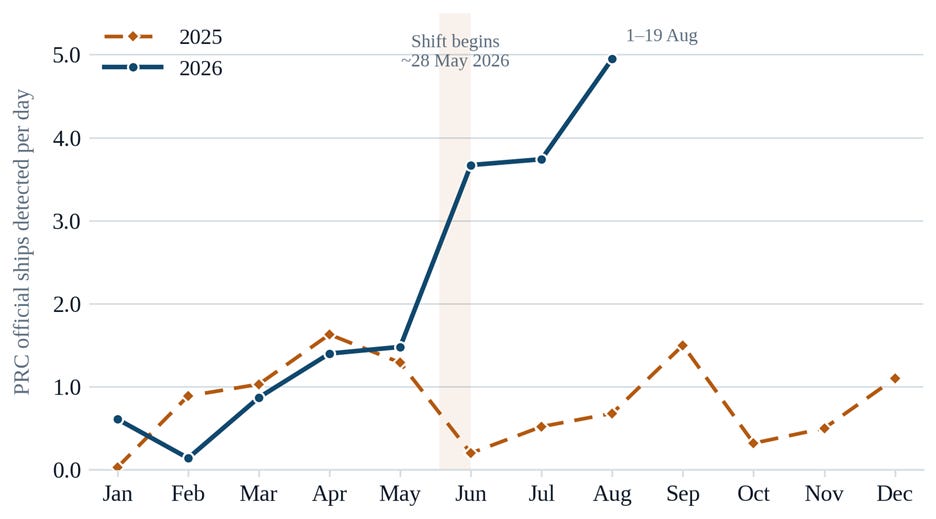
Notes: “Official ships” is the Ministry’s category for PRC government vessels operated for non-commercial purposes; the daily reports do not identify the operating agency. Daily averages divide monthly detections by days in the month. Over the same 231-day window, detections rose from 183 to 457 (+150%), and the number of days with five or more official ships rose from 1 to 33. The shift began around 28 May 2026, when daily counts moved from 0–1 to 3–4 and then to 5–10 through the first week of June. 2026 data run to 19 August; January–April 2026 values are provisional pending confirmation against the primary compilation.
CCG Pressure Moves East
The additional CGA evidence changes the interpretation of the maritime increase in an important way. Prior PRC law-enforcement gray-zone pressure had been concentrated around Taiwan’s offshore holdings and other contested spaces—most notably Kinmen and Matsu, then Pratas (Dongsha) and Itu Aba (Taiping Island). Since June 2026, that pattern has expanded to the eastern side of Taiwan’s main island. CommonWealth Magazine tracking cited in the CCG analysis found no comparable earlier activity east of Taiwan in the prior MND statistics; the June onset therefore marks a geographic expansion of the existing gray-zone model.
This eastward shift matters because waters east of Taiwan have traditionally been strategically significant as an avenue for resupply, reinforcement, and access to the wider Pacific. A persistent PRC law-enforcement presence there broadens the geography in which Beijing can practice surveillance, jurisdictional assertion, merchant-vessel hailing, and other coercive activities below the threshold of overt military force. It also reduces the analytical usefulness of treating gray-zone pressure around Taiwan primarily as a phenomenon of the Taiwan Strait or the offshore islands.
Legal-administrative Coercion and the Logic of Routinization
Taiwan’s cross-strait maritime regime distinguishes “prohibited waters” (禁止水域) and “restricted waters” (限制水域), corresponding broadly to territorial-sea and contiguous-zone functions but with specially delimited polygons around offshore islands close to the mainland. This framework is operationally important because Chinese law-enforcement incursions can be tracked not only as vessel presence but as challenges to Taiwan’s exercise of jurisdiction in specific maritime zones.
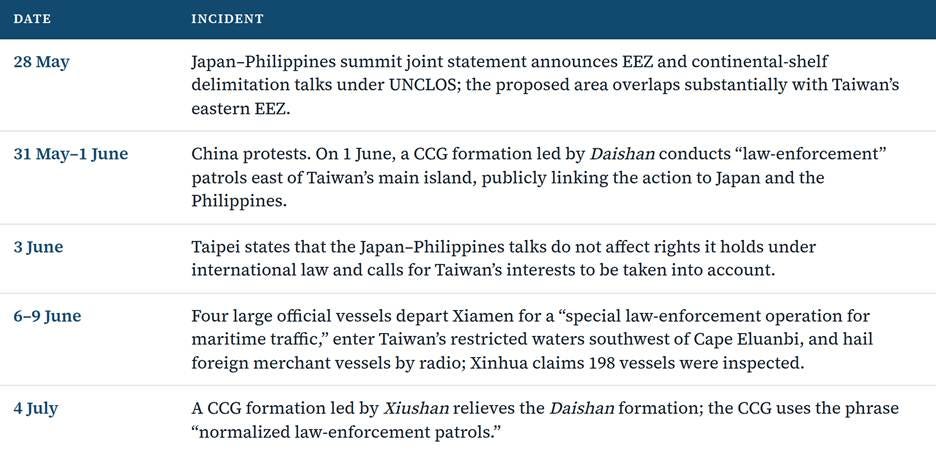
The June–July 2026 sequence suggests Beijing is attempting to establish a new routine rather than conduct a single signaling operation. After a Japan–Philippines summit on 28 May announced EEZ and continental-shelf delimitation talks, China protested and on 1 June dispatched a CCG formation led by Daishan for “law-enforcement” patrols east of Taiwan. From 6–9 June, four large official vessels conducted a special maritime-traffic enforcement operation, entered restricted waters southwest of Cape Eluanbi, and hailed foreign merchant vessels. On 4 July, a formation led by Xiushan relieved Daishan, and the CCG described the activity as “normalized law-enforcement patrols.”
The Japan–Philippines delimitation talks are therefore best understood as the proximate trigger and public legal pretext, not necessarily the underlying strategic driver. The broader pattern—from Kinmen in 2024, to Pratas and Itu Aba in 2025–26, and now east of Taiwan—suggests a sustained effort to widen the geographic scope of PRC law-enforcement jurisdictional claims and make repeated presence appear ordinary.
Analytic Implications
The center of gravity has shifted, but aggregate pressure has declined. The data support an initial conclusion that the observed mix of coercion has tilted from the air to maritime domains.
The CCG is increasingly central to day-to-day coercion. Separate Taiwan Coast Guard Administration (CGA) evidence resolves an important limitation in MND reporting and indicates that coast guard activity is the principal source of the official-vessel increase.
The eastward expansion is strategically more significant than the raw vessel count. Persistent CCG operations east of Taiwan extend jurisdictional gray-zone tactics into a maritime space with direct relevance to Taiwan’s links to the Pacific and to key sea lines of communication (SLOCs).
Routinization may be the objective. The use of “normalized law-enforcement patrols,” rapid replenishment of one CCG formations by another, and sustained elevated counts suggest an effort to convert episodic incursions into a new accepted baseline.
The pattern should be monitored as a sequence, not as isolated incidents. Kinmen, Pratas/Itu Aba, and now waters east of Taiwan exhibit a common logic: repeated law-enforcement presence, legal or administrative justification, and normalization of PRC jurisdictional behavior below the threshold of war.
Timelines, Notes and Sources
Timeline: May–July 2026
What MND’s “Official Vessel” Category Conceals
MND’s daily reporting does not identify the operating agency behind “official ships.” The category follows Taiwan’s legal distinction between foreign military vessels and other foreign official vessels and can include CCG ships, Maritime Safety Administration vessels, and fisheries law-enforcement ships. MND data alone therefore cannot support a specific claim that every additional official-vessel detection is a Coast Guard vessel.
Taiwan CGA records provide the missing disaggregation. The CGA data separate CCG, MSA, and fisheries-enforcement vessels and show that CCG vessels account for by far the largest share of the activity. Read together, the MND and CGA datasets sharpen the original finding: the rise in official-vessel detections is not merely a generic increase in Chinese government shipping but is principally an expansion of coast-guard-centered gray-zone activity.
What the Evidence Does Not Show
The datasets remain observational. MND detections measure what Taiwan’s military observed and reported; they do not directly measure PRC capability or intent. The 51.1% fall in detected air sorties is consistent with reduced activity but does not rule out changes in activity outside the reporting series. Likewise, the CGA disaggregation supports identifying the CCG as the principal contributor to the official-vessel increase, but the strategic purpose attributed to that activity remains an analytic judgment rather than a direct measurement.
Sources and Methodological Note
Taiwan Ministry of National Defense daily reports on PLA activity in the waters and airspace around Taiwan, 1 January 2025–19 August 2026; authors’ compilation with complete daily coverage. Taiwan Coast Guard Administration public records, used to disaggregate MND’s “official vessel” category. CommonWealth Magazine reporting and vessel-track analysis on PRC gray-zone activity around Kinmen and Taiwan, including its 4 August 2026 investigation of CCG operations around Taiwan. The quantitative comparisons preserve the original 231-day year-on-year window.