


By Lyle Morris, Senior Fellow on Foreign Policy and National Security
“The imperialists’ aggressive ambitions know no bounds. On June 25 of this year, the American imperialists launched a war of aggression against Korea. Their sinister plans are by no means limited to destroying the Democratic People’s Republic of Korea. They seek to annex Korea, invade China, dominate Asia, and conquer the entire world...The aggressors are destined for ultimate defeat, while final victory will belong to the peoples who uphold justice.”
— “Joint Declaration of the Democratic Parties,”《各民主党派联合宣言》, November 4, 1950
In early August 2026, I visited my wife’s family in Dandong, Liaoning Province. Not only was it nice to reconnect with my in-laws and extended family, it gave me a front-row seat to China’s narrative of the Korean War, and more broadly, Sino-DPRK relations. Dandong was one of several key battlegrounds during the war. It was the site of major U.S. air force bombings, and an entry point from which Chinese People’s Volunteers (CPV) crossed into North Korea. The Korean War (1950–1953) remains the only major war in which U.S. and Chinese armed forces fought each other directly and on a sustained, large scale. It’s a war that continues to resonate within the PLA, and the legacy that shapes China’s contemporary relations with the DPRK and the United States.
The following is a travelogue of my visit to Dandong – and an account of the Korean War through China’s eyes.
I. Dandong New City (丹东新城区国门湾) and China-North Korea Relations
My first stop was Dandong’s New City (丹东新城区国门湾). Developed within the Guomen Bay and centered on the New Yalu River Bridge (新鸭绿江大桥), the area was created as a modern hub for trade with North Korea, bringing together border-crossing facilities, logistics, commerce, industry, housing, and government services. It also supported ambitions for closer cross-border economic cooperation, including the nearby Hwanggumpyong economic zone in North Korea. However, the New City has been dormant for at least a decade due to inactivity on the DPRK side. That is about to change.
Dandong’s most famous landmark is the Sino–Korean Friendship Bridge (中朝友谊桥), whose history spans Japanese colonial rule, the Korean War, and decades of China–North Korea trade. It stands beside the older Yalu River Broken Bridge (鸭绿江断桥), which is a separate structure.
Built between 1937 and 1943 under Japanese rule, the Friendship Bridge connected northeast China and Korea, supplementing the original 1911 Yalu River bridge. During the Korean War, it carried Chinese troops and supplies into North Korea and was repeatedly bombed by American aircraft. Repairs kept the newer bridge operational, while the older crossing became today’s “Broken Bridge.”
For decades after the Korean War, the Friendship Bridge served as the principal road-and-rail crossing between China and North Korea, carrying a substantial share of bilateral trade.
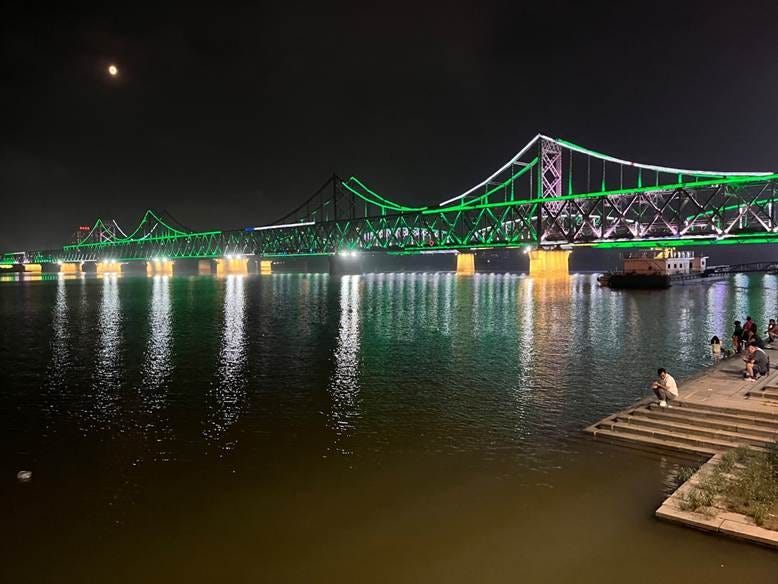
Enter the New Yalu River Bridge, whose construction began in 2010 and whose main structure was completed in 2014. China’s stated goal in building the new bridge was to expand cross-border transport capacity and promote trade and exchanges with North Korea. The four-lane bridge would overcome the limitations of the aging Friendship Bridge, which permits only one-way road traffic and trucks weighing less than 20 tons. It was also intended to support broader economic cooperation, including the planned Hwanggumpyong economic zone and Dandong’s development as a border trade and logistics hub. However, for a variety of political and economic reasons on the DPRK side, the bridge remained dormant for over a decade.
According to the Associated Press, the bridge officially opened for commerce on October 15, 2026.
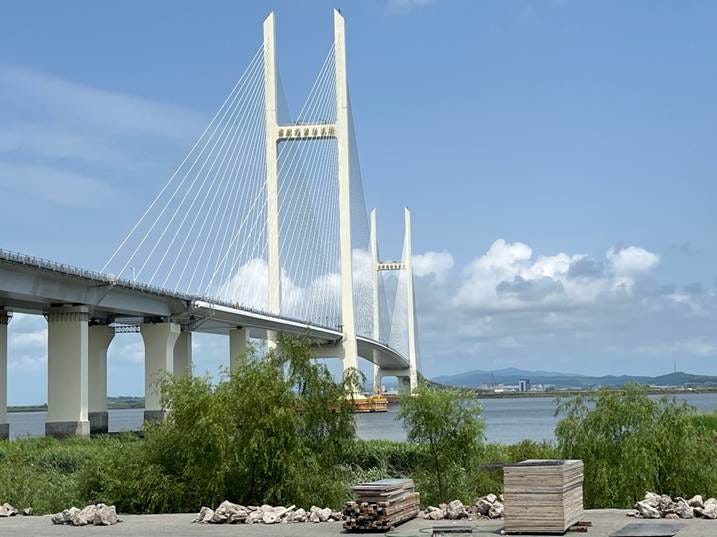
When I visited the bridge, what was remarkable was the significant amount of infrastructure built around it – a new customs building, rows of apartment complexes, parks and playgrounds. But no one was living there. It was virtually a ghost town. When juxtaposed with the towering new bridge, the largely empty development was a useful reminder of how much the Chinese government had invested in anticipation of trade and commerce with North Korea that had yet to materialize. Now that the bridge is open, China is hoping its bet will pay off.
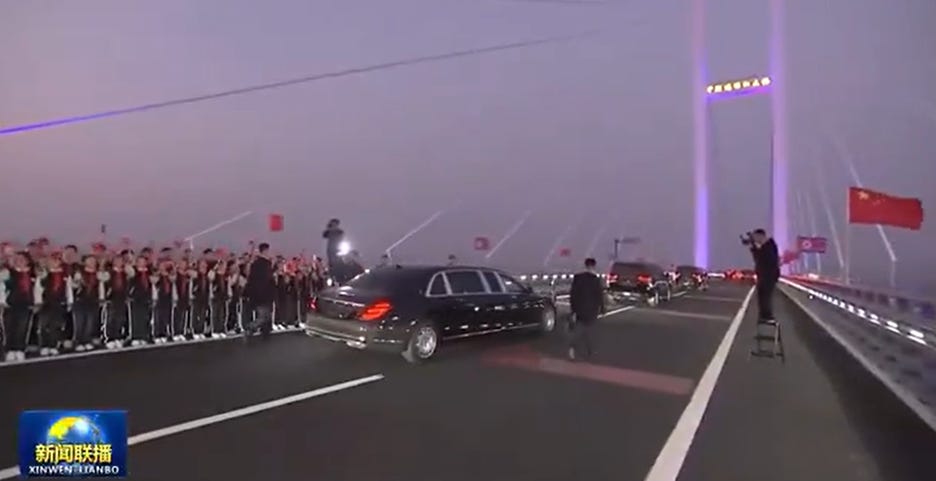
As it happens, Kim Jong Un made a rare visit to Dandong on October 24, 2026, meeting with Wang Huning, Member of the CCP Politburo Standing Committee. After the visit, General Secretary Kim crossed the bridge in his motorcade back to North Korea.
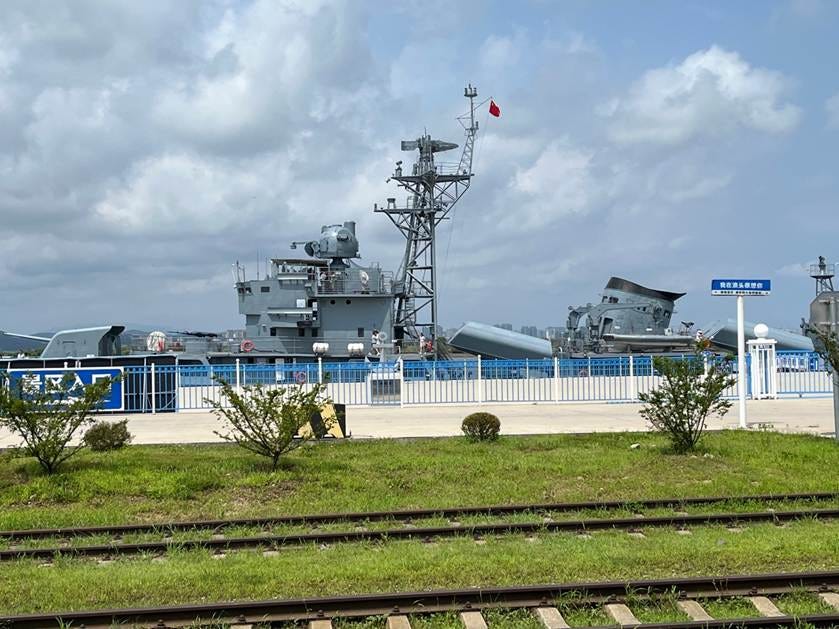
Close to the bridge was another cultural relic - a retired PLA Navy frigate Dandong (丹东舰), hull number 543. It is listed as a Type 053H1 (Jianghu II-class) guided-missile frigate and displayed at Langtou Port (浪头港) as a museum ship and patriotic education attraction. However, it entered service in May 1985 and retired on May 19, 2021. So while it appeared to be billed as a Korean War attraction, it did not serve during the war, despite the “1950” branding visible at the entrance.
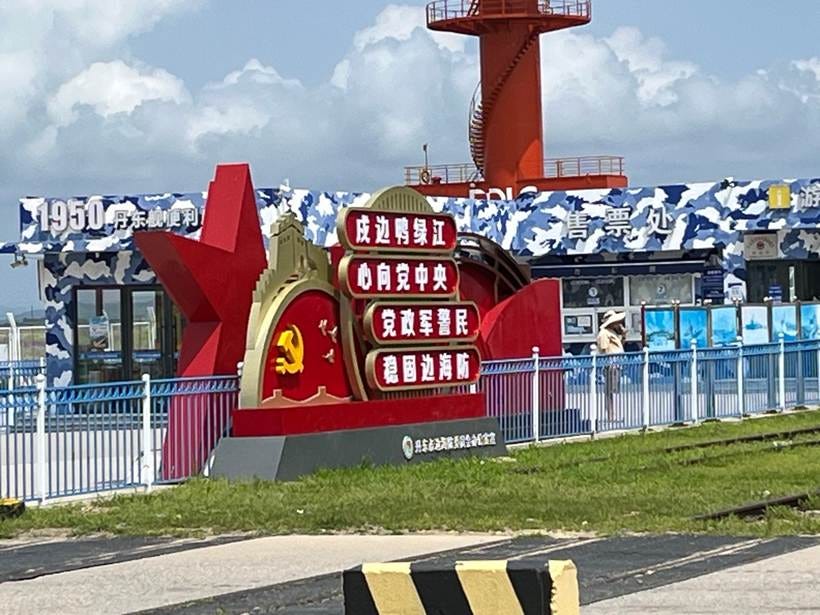
II. Hekou (河口) Village/Kuandian (宽甸)
The next stop was Hekou Village, in Kuandian County – an important gateway for China’s intervention in the Korean War. Located about 40 miles north of downtown Dandong, Hekou Village was on the Chinese side of the Yalu River, where the Chinese People’s Volunteers (CPV) crossed into North Korea on October 19, 1950. It is therefore one of the initial crossing sites associated with China’s entry into the war.
Its significance extends beyond that first crossing. Hekou’s road bridge and nearby pontoon bridges provided routes for troops, vehicles, and supplies, supporting China’s ability to sustain operations in Korea. Successive formations passed through the area, making it an important link between China’s rear bases and the Korean battlefield.
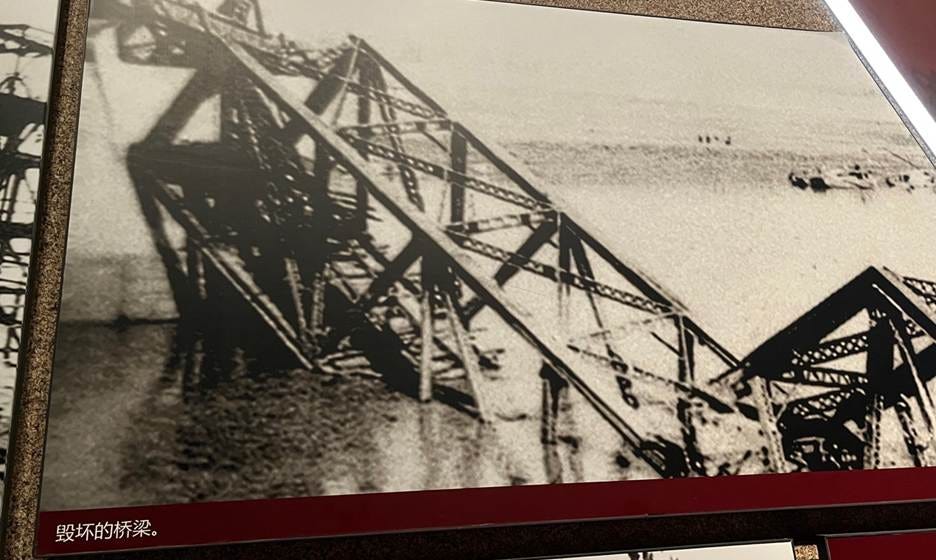
Two major bridges destroyed during the war remain as “broken bridges” (断桥) on China’s side of the Yalu river: the Dandong Yalu River Broken Bridge and the Hekou Broken Bridge in Kuandian. Both were damaged beyond repair by U.S. bombing.
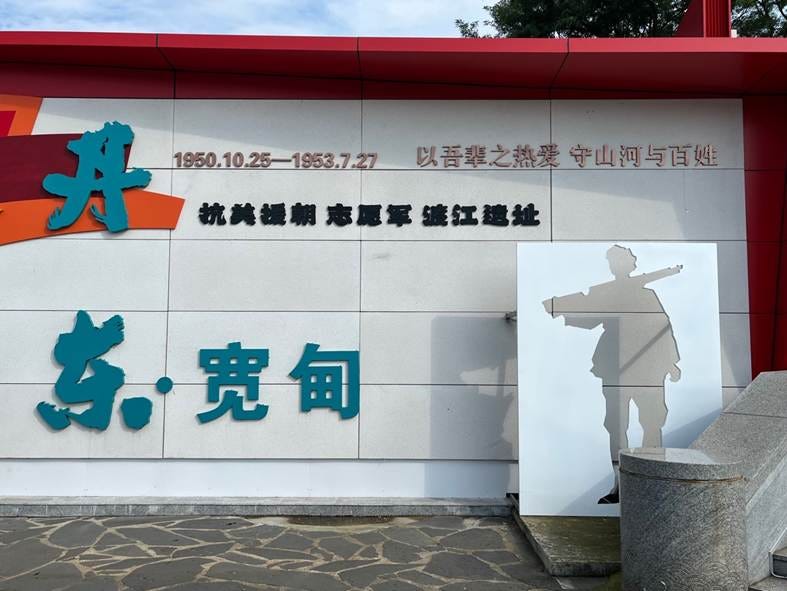
The surviving bridge ruins and commemorative displays connect He Kou village to China’s official narrative of “Resisting U.S. Aggression and Aiding Korea.”
Hekou is also associated with Mao Zedong’s son, Mao Anying, who crossed there and later served at the Volunteers’ headquarters. He died in a U.S. air attack on November 25, 1950.
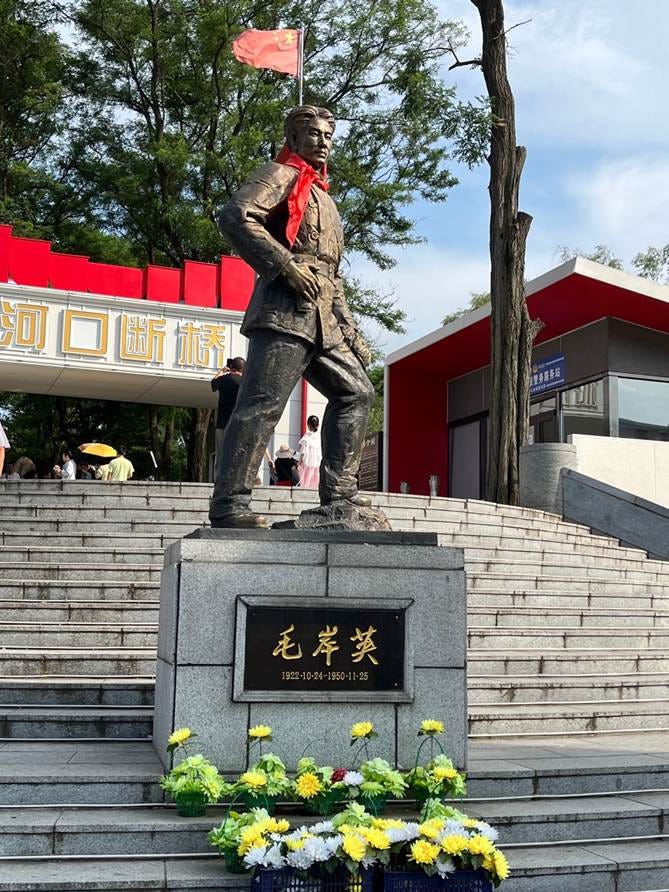
These associations give the site symbolic importance as a place of wartime mobilization and sacrifice.
My family and I took a boat cruise on the Yalu, traversing the Chinese side of the China-DPRK border area. I got as close as an American can come to North Korea without stepping foot in the country, offering a rare view into life in the North Korean town of Chongsu (청수, 清水). Below are some pictures from the cruise.
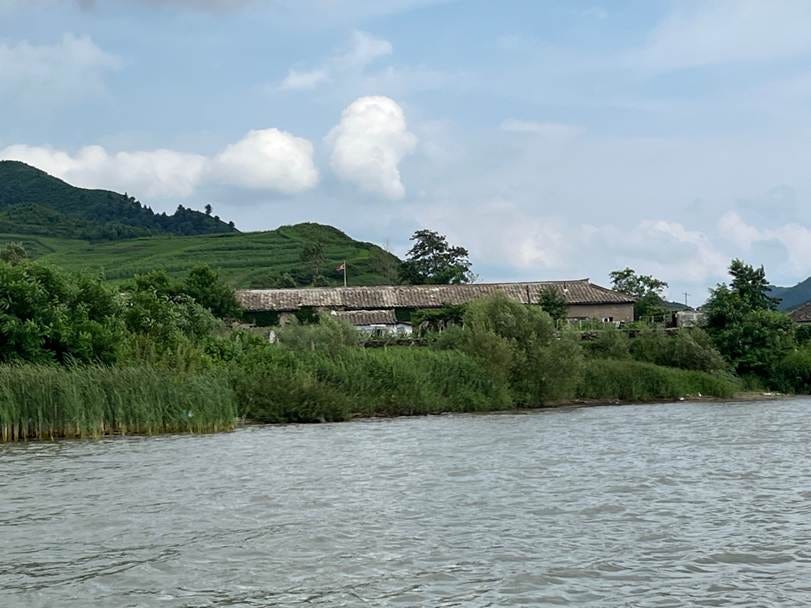
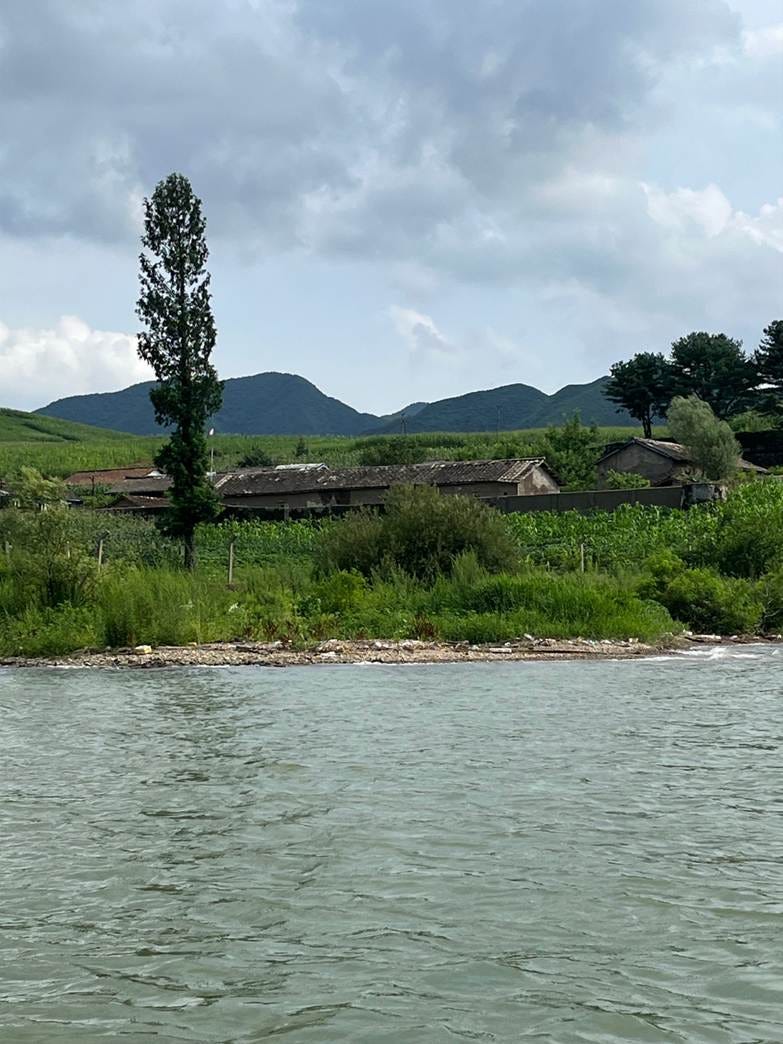
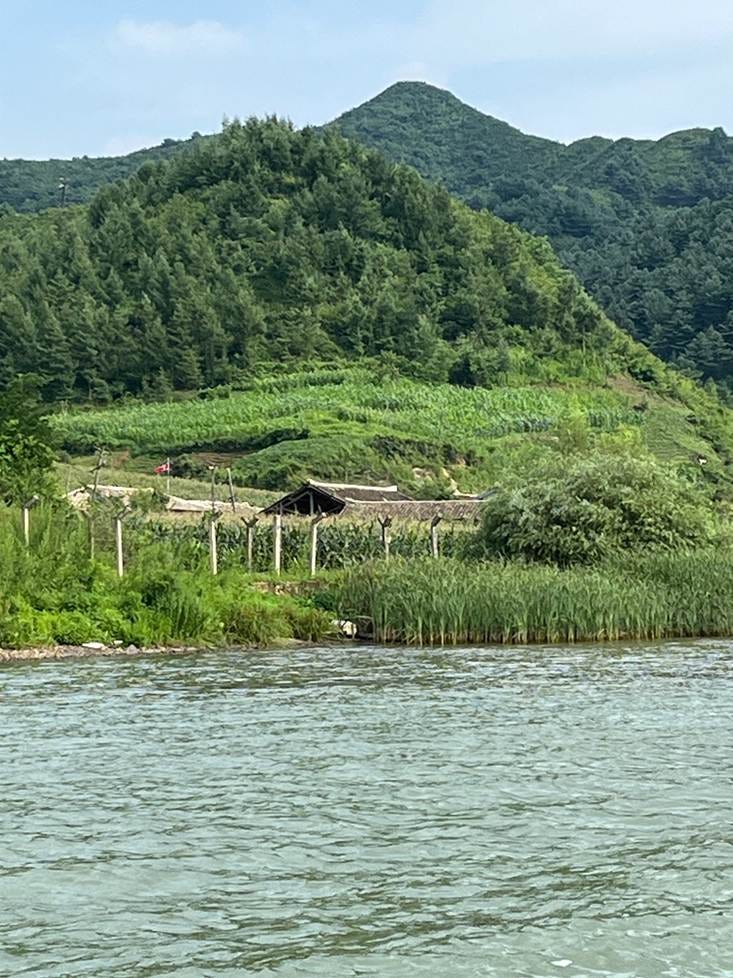
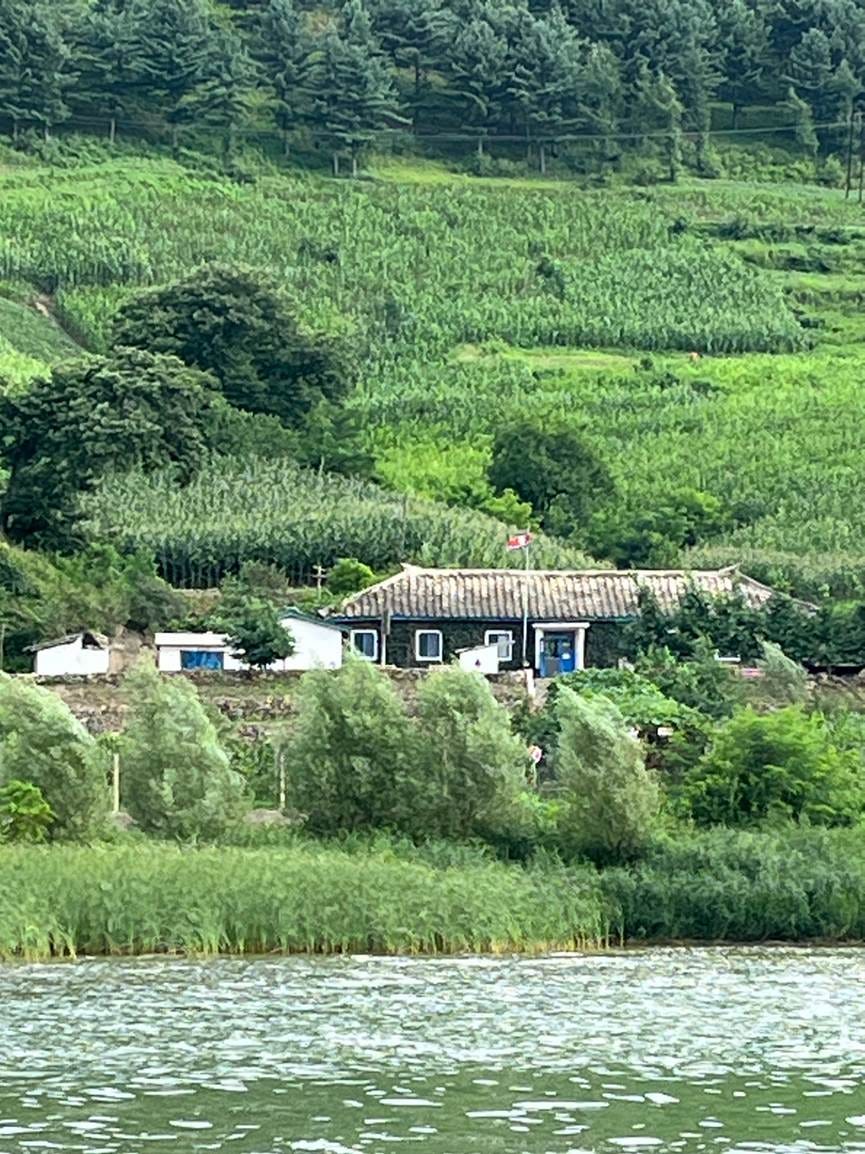
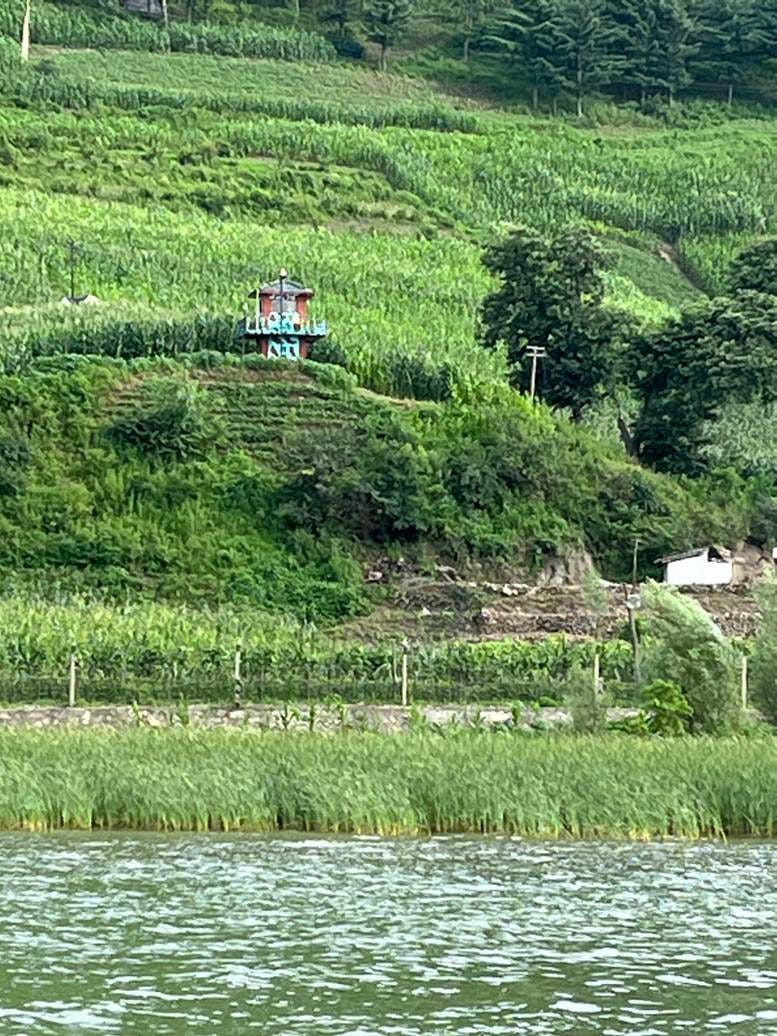
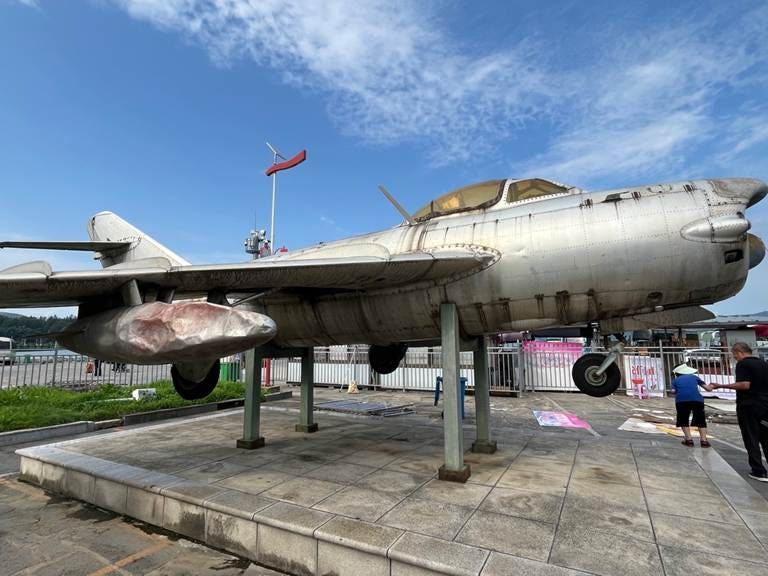
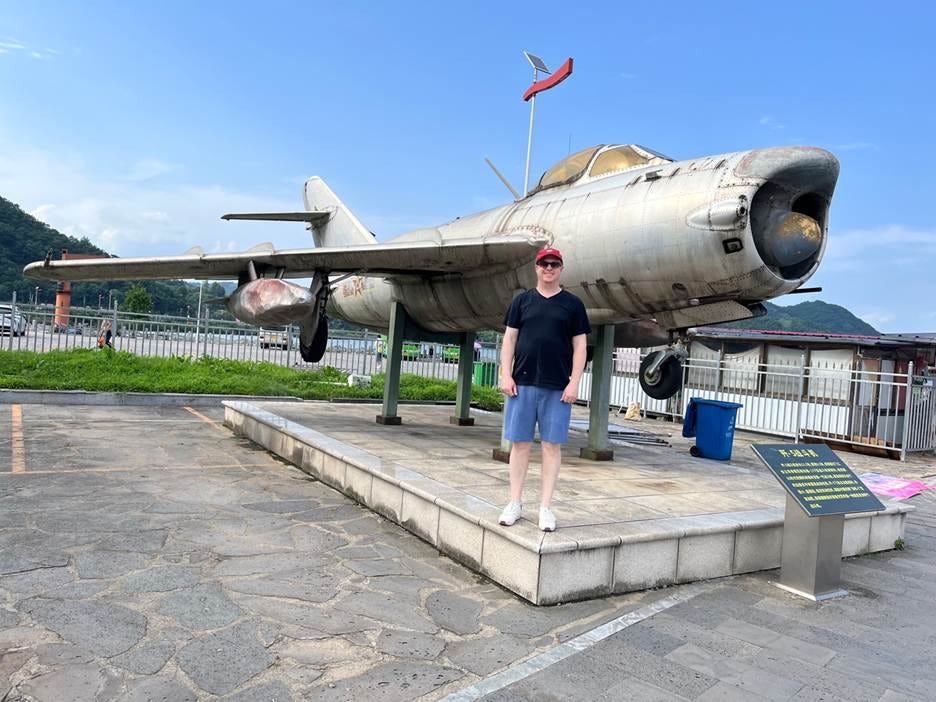
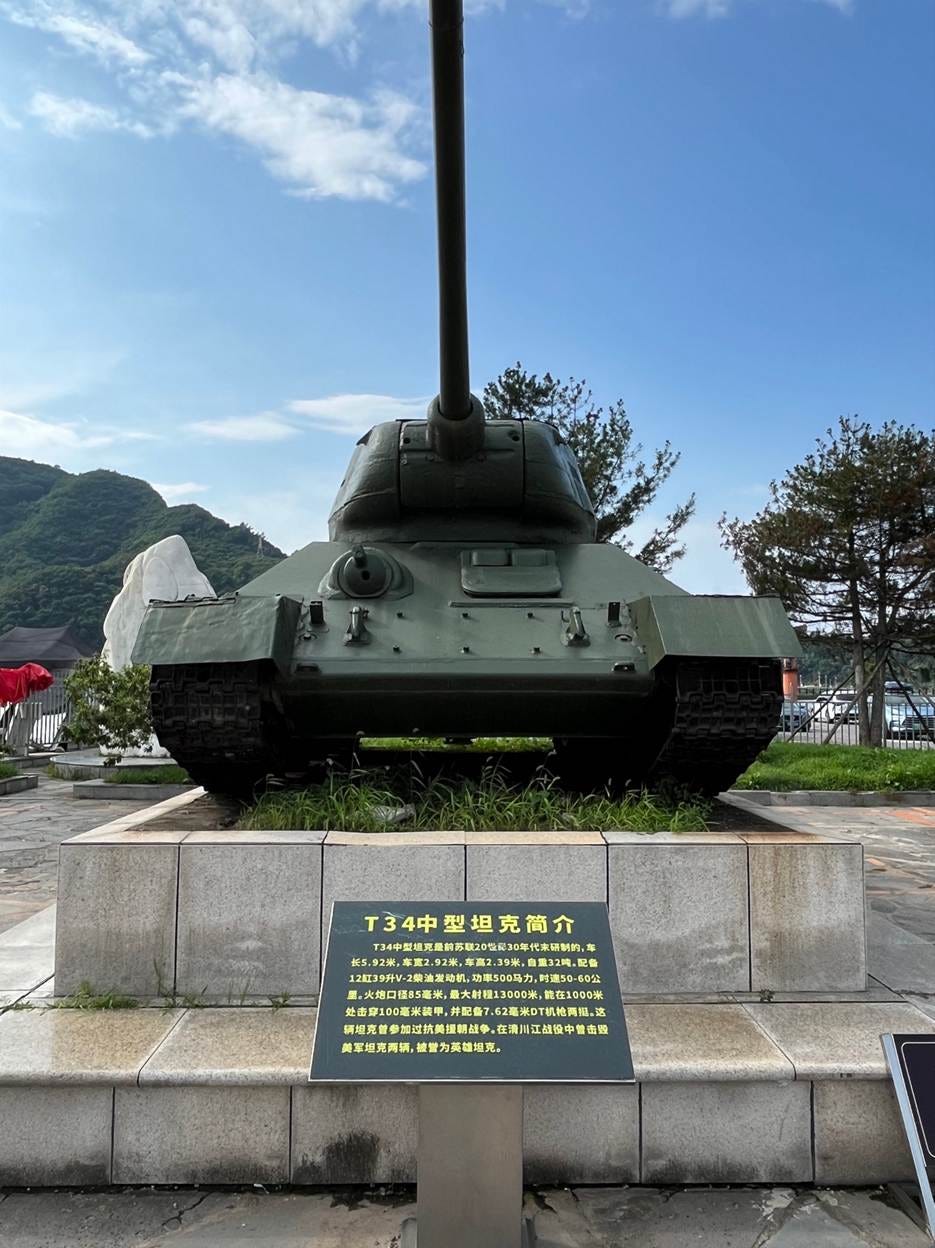
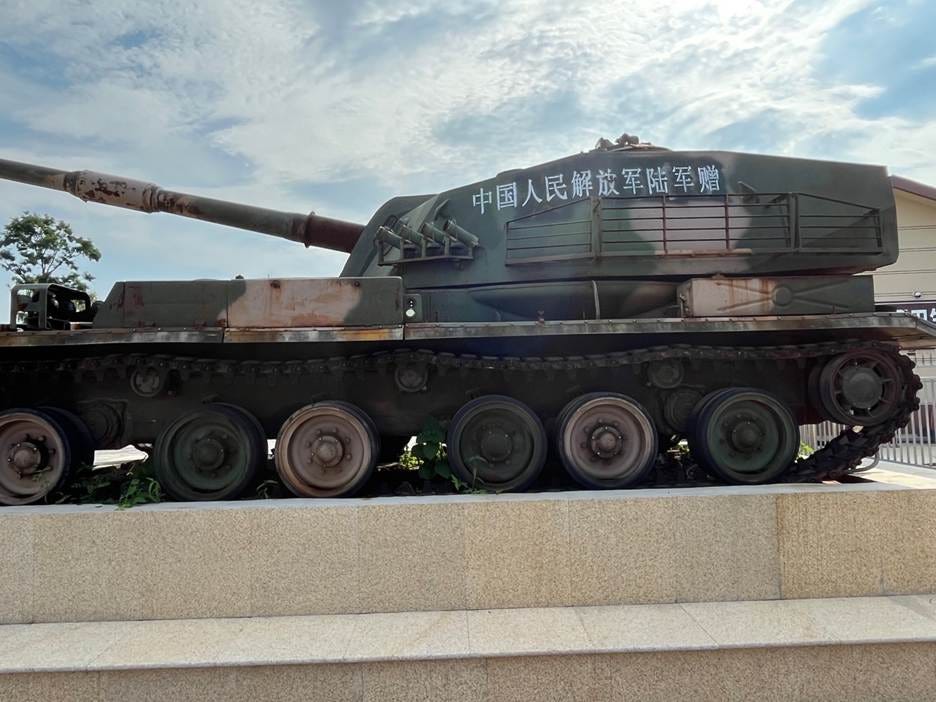
After the cruise, I walked through a Korean War memorial in Hekou, featuring some military equipment used by the Chinese People’s Volunteers (CPV) during and after the Korean War.
III. Memorial Hall of the War to Resist US Aggression and Aid Korea (抗美援朝纪念馆)
The final stop was the “Memorial Hall of the War to Resist U.S. Aggression and Aid Korea” (抗美援朝纪念馆), otherwise known as the Korean War Museum.
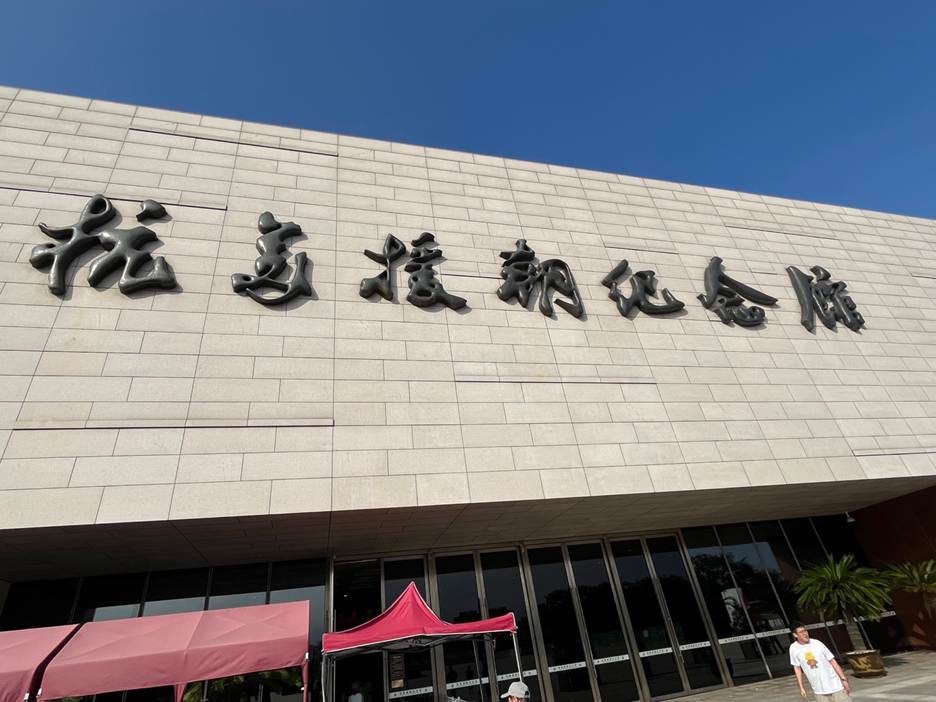
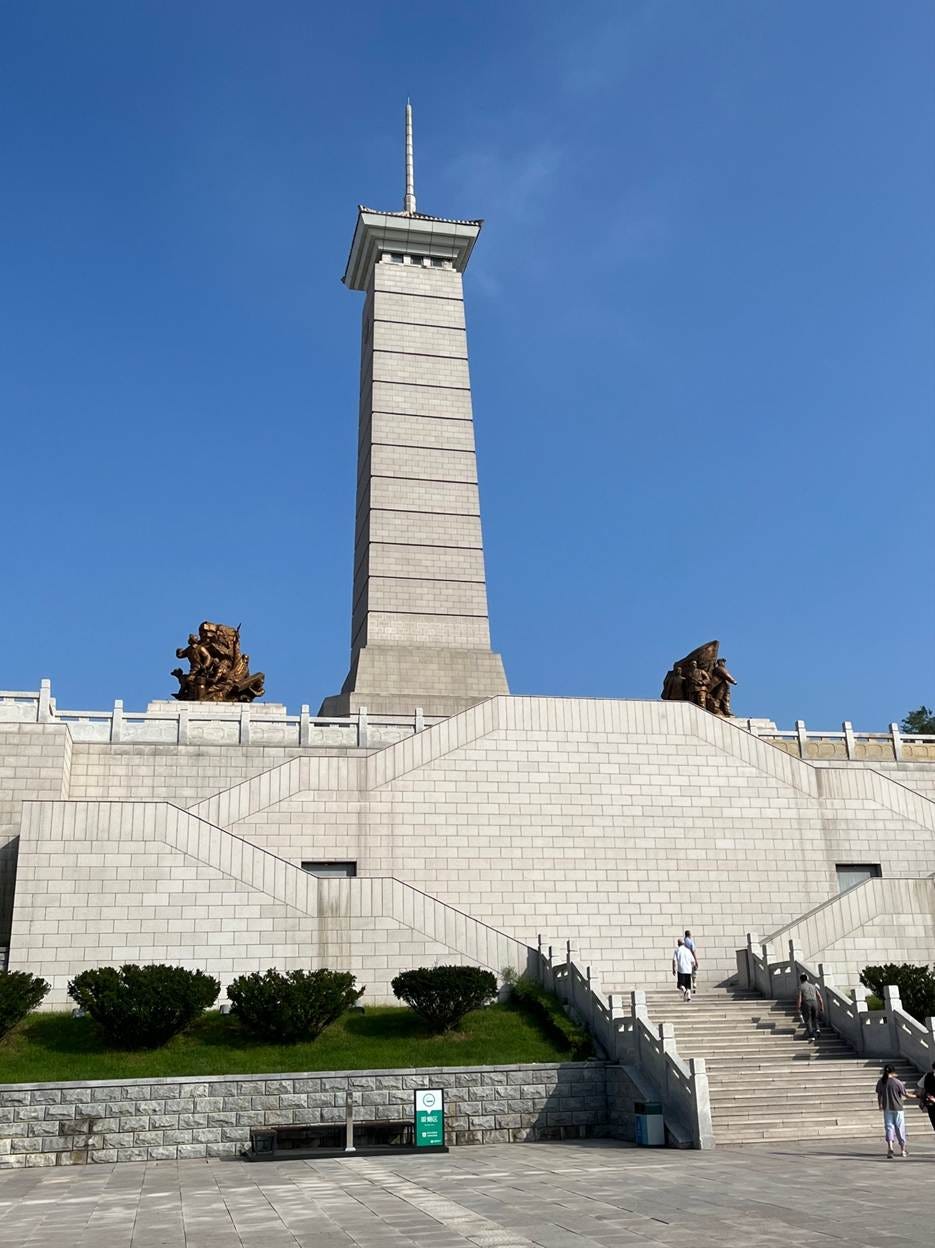
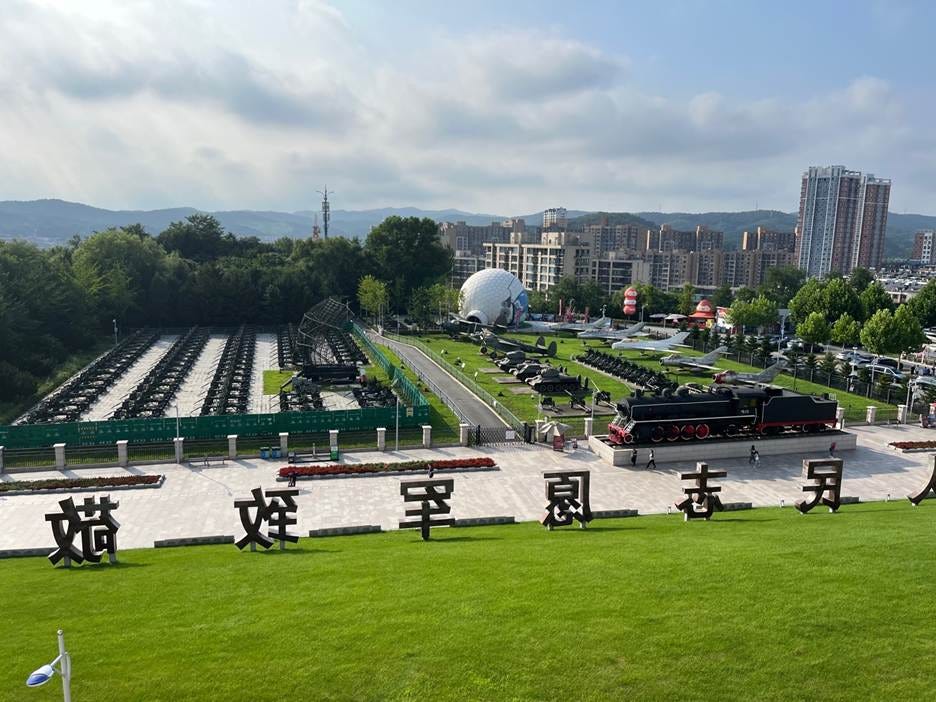
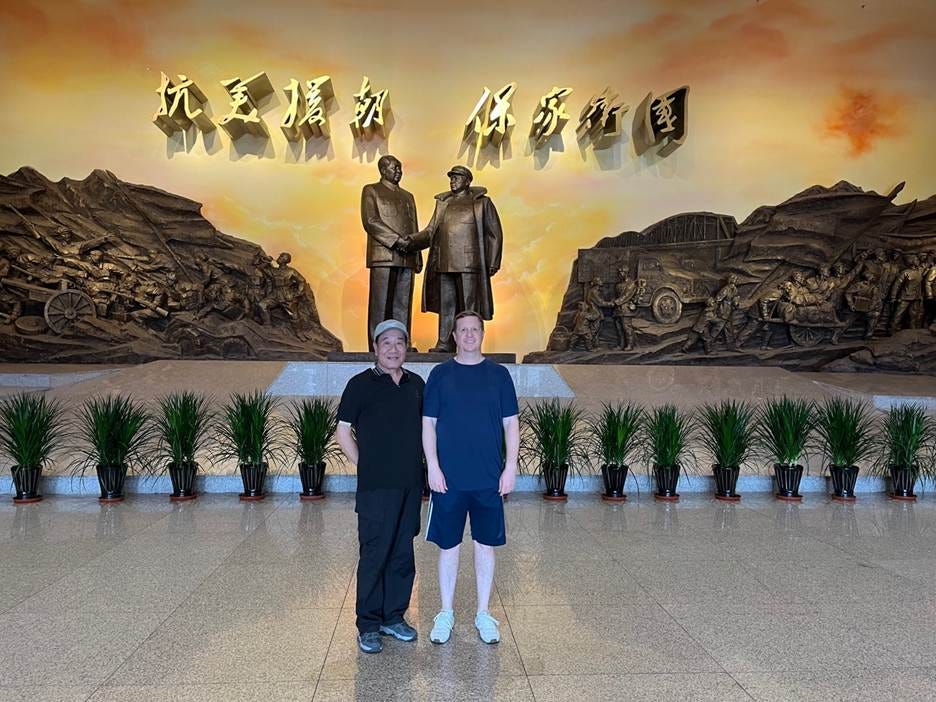
Built in 1958 and renovated in 1993, it is the only museum in China that memorializes the Korean War. This was my third visit, and first since the 2014 renovation. As an American who grew up reading textbooks about the war, it’s hard to overstate the cognitive dissonance I felt reading China’s version of the war. The “Foreward” upon entering the museum underscores this narrative:
“The War to Resist US Aggression and Aid Korea is a war against aggression in which the Chinese people had no choice but to engage during the early years after the founding of the People’s Republic of China (PRC) under the leadership of the Communist Party of China (CPC), in order to uphold justice, oppose hegemonism and safeguard China’s national security. In June 1950, the Korean civil war broke out, and the Truman Administration of the United States (US) immediately carried out an armed intervention, launched an all-out war against the Democratic People’s Republic of Korea (DPRK), crossed the 38th parallel blatantly and spread the war to the Yalu River, despite repeated warnings from the Chinese government. In October 1950, in response to the request of the Workers’ Party of Korea (WPK) and the DPRK government and the will of the Chinese People, the CPC Central Committee and Chairman Mao Zedong made the strategic decision to assist the DPRK against the US aggression and safeguard China’s national security. The CPV was set up and sent to the battlefield in the DPRK to resist the aggressors together with the DPRK army and people. After two years and nine months of bloody struggle, the CPV with inferior armament won the great victory of the War to Resist US Aggression and Aid Korea. The war stimulated the morale of China and its army who safeguarded the safety of both the DPRK and the PRC, changed the political landscape of Asia and even the world, helped establish an important position of China in Asian and international affairs.”
The exhibition emphasizes five interconnected themes: China’s defensive justification for intervention; the effectiveness of Chinese military operations against a technologically superior adversary; the importance of political mobilization and psychological warfare; the armistice as a Chinese strategic victory; and the war’s contribution to China’s subsequent diplomatic influence.
Although the exhibits contain important primary documents, battlefield photographs, maps, and artifacts, their presentation is explicitly political. They generally omit North Korea’s initial invasion of South Korea, minimize Soviet involvement except in selected military contexts, and present disputed claims, including allegations of American biological warfare, as established facts.
Historical Background and China’s Entry into the War (1949–1950)
The exhibition begins with the PRC’s establishment on October 1, 1949, emphasizing the country’s economic devastation after decades of warfare. Photographs of ruined factories and infrastructure illustrate the difficulties facing China’s new leadership.
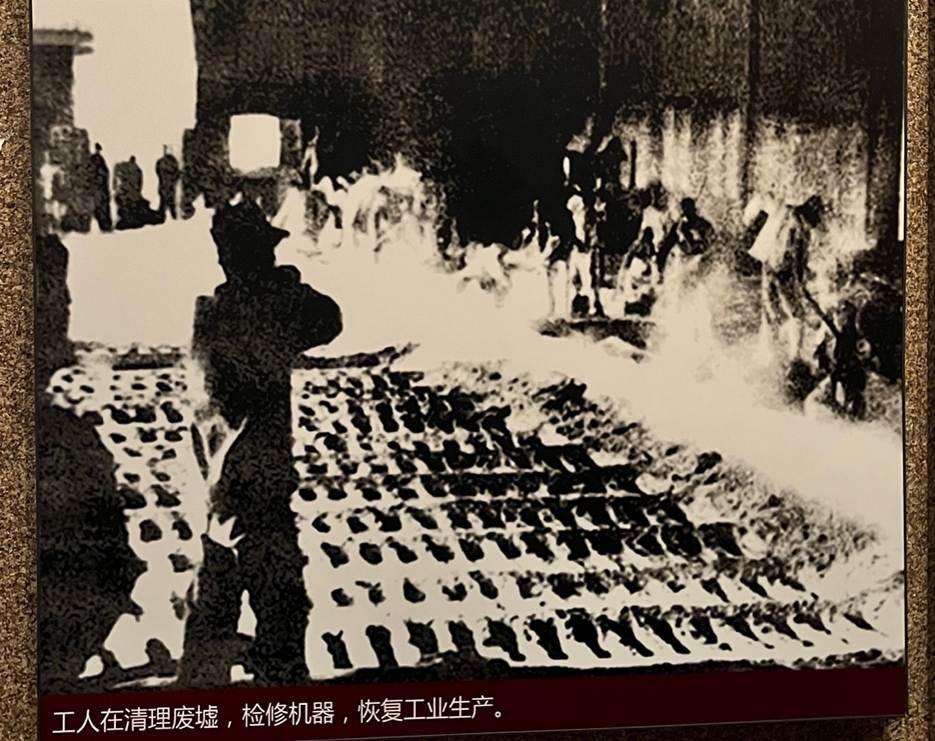
Following Korea’s division at the 38th parallel after World War II, competing governments emerged in North and South Korea in 1948. The museum describes the outbreak of war on June 25, 1950, without clearly identifying North Korea as the initiating aggressor.
Instead, the narrative focuses on American intervention, particularly President Harry Truman’s June 27 decision to deploy military forces to Korea and the U.S. Seventh Fleet to the Taiwan Strait. It portrays both developments as direct threats to Chinese sovereignty.
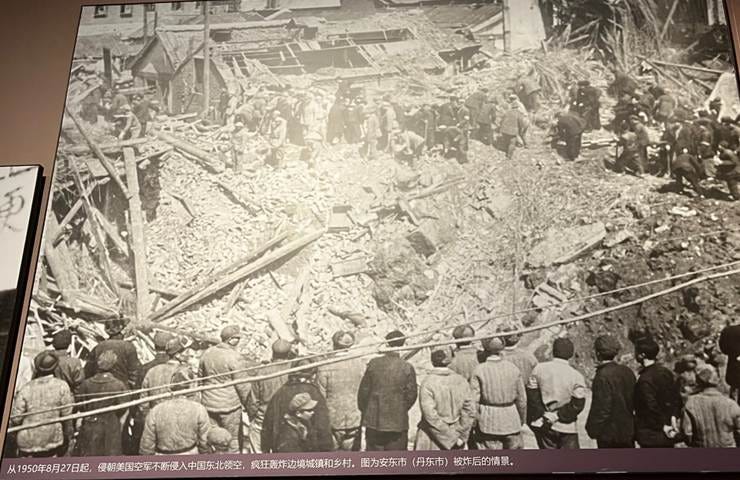
Additional exhibits document alleged American airstrikes on Chinese territory beginning August 27, 1950, particularly around Linjiang and Andong (present-day Dandong). Photographs of damaged buildings, destroyed infrastructure, and an American bomb are presented as evidence that the war was already threatening China’s homeland.
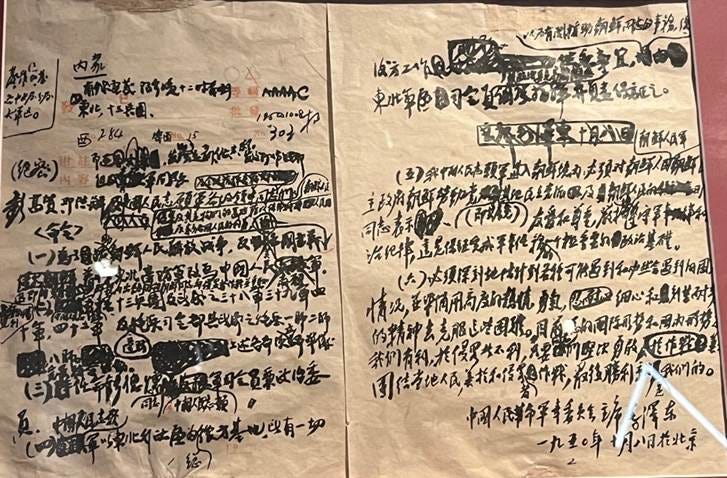
China’s intervention is framed as a reluctant but necessary decision. Documents include North Korean requests for military assistance, Zhou Enlai’s warnings against American advances, and Mao Zedong’s October 8 order establishing the Chinese People’s Volunteers (CPV). Chinese forces crossed the Yalu River on October 19, 1950.
Chinese Military Campaigns and Battlefield Strategy (1950–1953)
The exhibition celebrates China’s first five military campaigns, conducted between October 1950 and June 1951, as demonstrations of the CPV’s ability to overcome superior American firepower through mobility, surprise, manpower, and political determination.
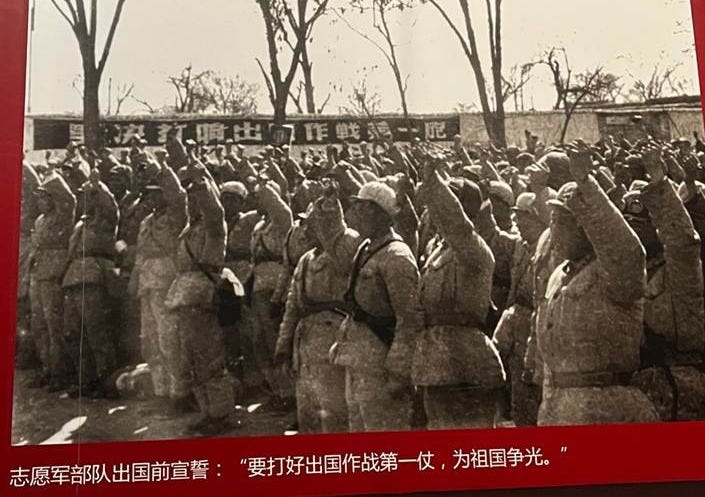
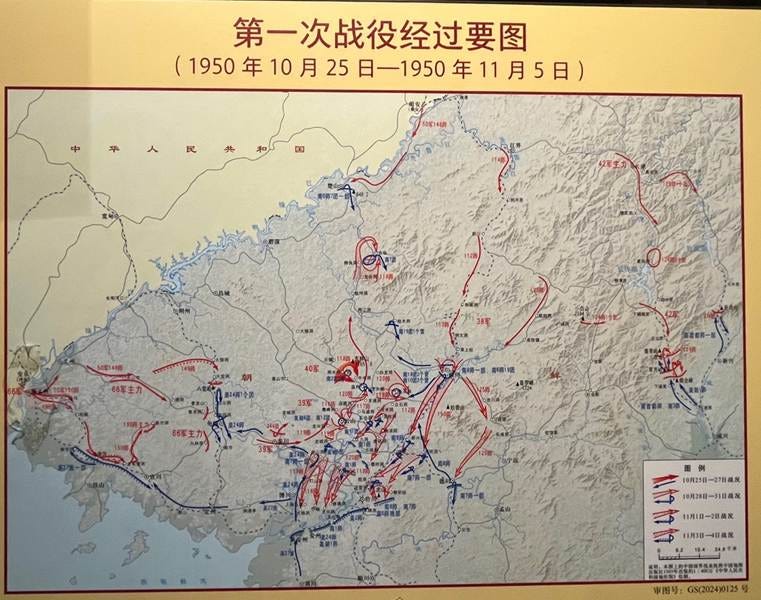
The First Campaign (October 25–November 5, 1950), including the Battle of Unsan, receives particular attention. The museum claims that Chinese forces inflicted more than 15,000 enemy casualties while sustaining approximately 10,700 casualties themselves.
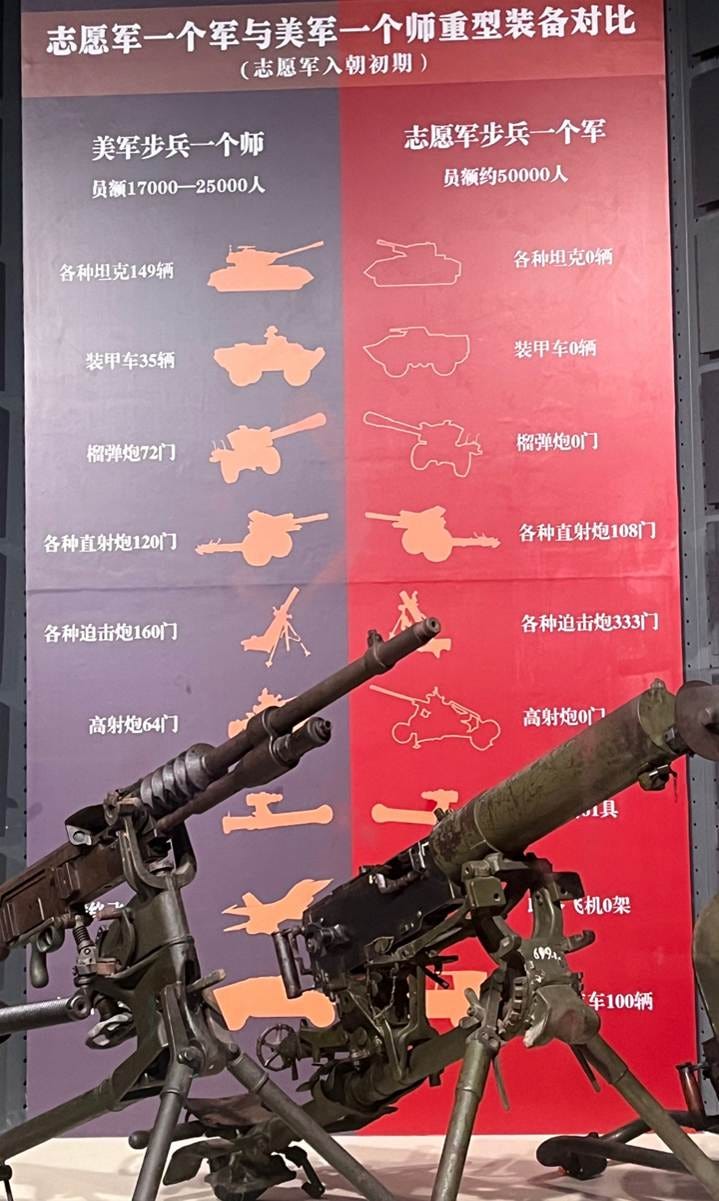
A comparison of U.S. and Chinese military equipment highlights the enormous technological disparity. The museum lists a U.S. infantry division as possessing 149 tanks and substantial artillery, while a Chinese army formation had virtually no comparable heavy equipment.
Captured American vehicles, flags, weapons, and military documents are displayed as evidence of Chinese battlefield success.
Transition to Positional Warfare
The Fourth Campaign (January–April 1951) is presented as a defensive struggle in which Chinese and North Korean forces delayed advancing United Nations Command (UNC) troops while reinforcements arrived.
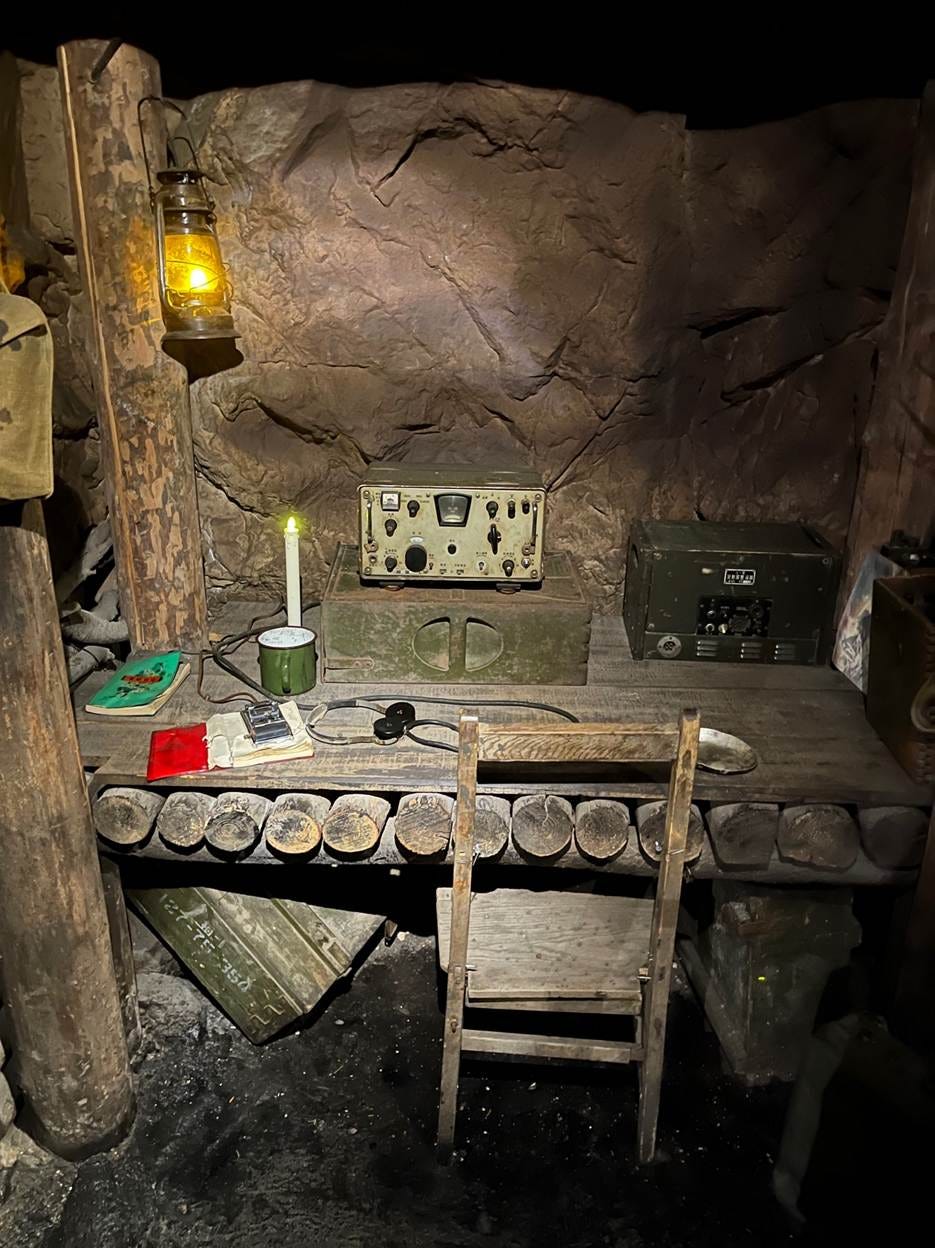
After the Fifth Campaign, the war shifted toward positional defense and prolonged negotiations. Beginning in mid-1951, Chinese forces constructed extensive underground fortifications along a roughly 250-kilometer front.
The museum emphasizes the importance of tunnel systems, which allowed Chinese troops to survive bombardment, maintain defensive positions, and conduct counterattacks despite inferior firepower.
The Battle of Shangganling (Triangle Hill), fought from October to November 1952, is portrayed as a defining example of Chinese endurance and tunnel warfare.
Final Offensives
The exhibition culminates in the July 1953 Battle of Kumsong, which targeted South Korean forces shortly before the armistice.
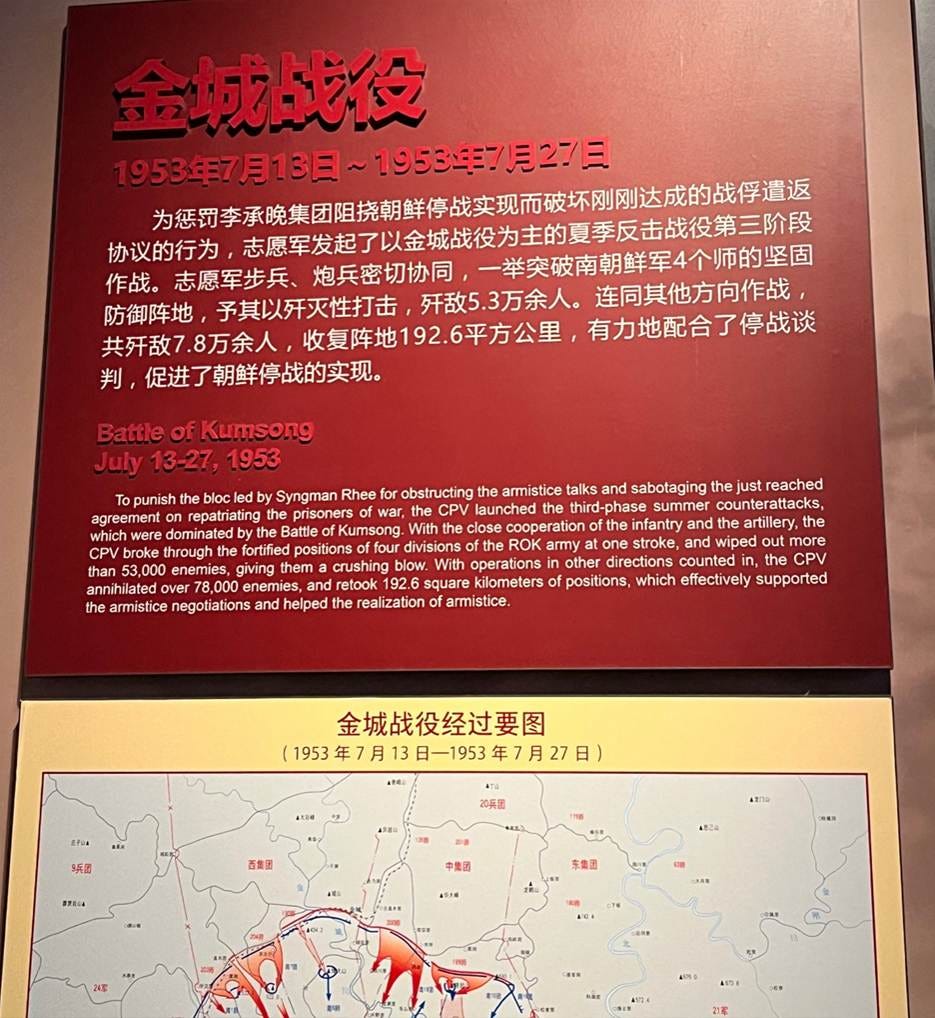
It highlights the capture of a South Korean regimental headquarters by a small Chinese reconnaissance team led by Yang Yucai (杨育才), emphasizing deception, infiltration, and operational surprise. Yang is famous in Chinese military history for the operation known as “Surprise Raid on the White Tiger Regiment” (奇袭白虎团), during which he reportedly disguised himself as an American military adviser, while his 12 accompanying soldiers dressed as South Korean troops, and infiltrated South Korean positions. The unit attacked the regiment’s headquarters at Ich’ong-dong, inflicting substantial South Korean casualties and prisoners.
The attackers captured a tiger-emblazoned banner associated with the South Korean unit, which is now displayed at China’s Military Museum in Beijing.
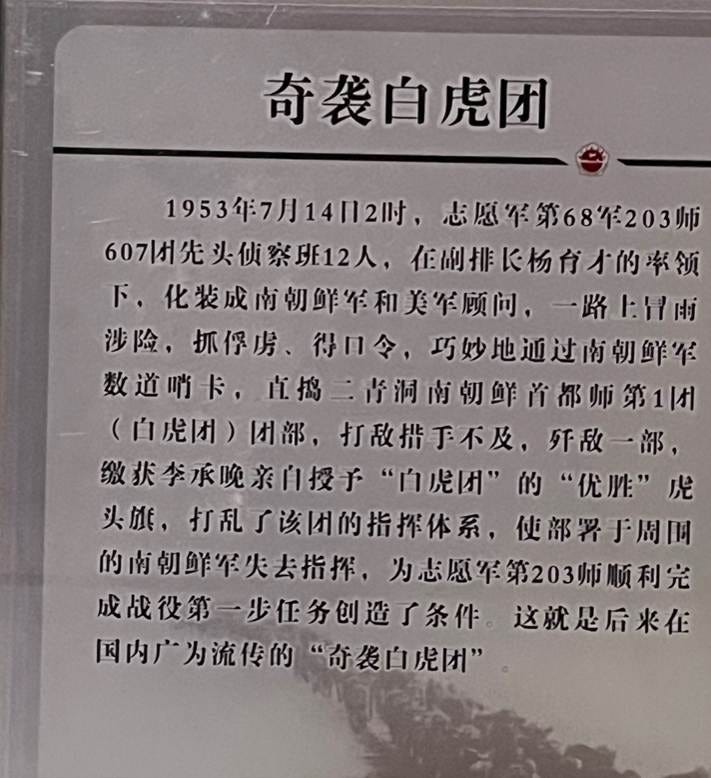
The White Tiger case is one of several examples in the museum of how Chinese and North Korean forces used tactical surprise, operational ingenuity, and organizational to offset U.S. technological superiority.
Psychological Warfare and Prisoners of War
The museum devotes substantial attention to Chinese political warfare against American and other UNC personnel. It includes English-language propaganda leaflets criticizing American troop rotation policies, appealing to soldiers’ homesickness, exploiting racial tensions, and encouraging surrender.
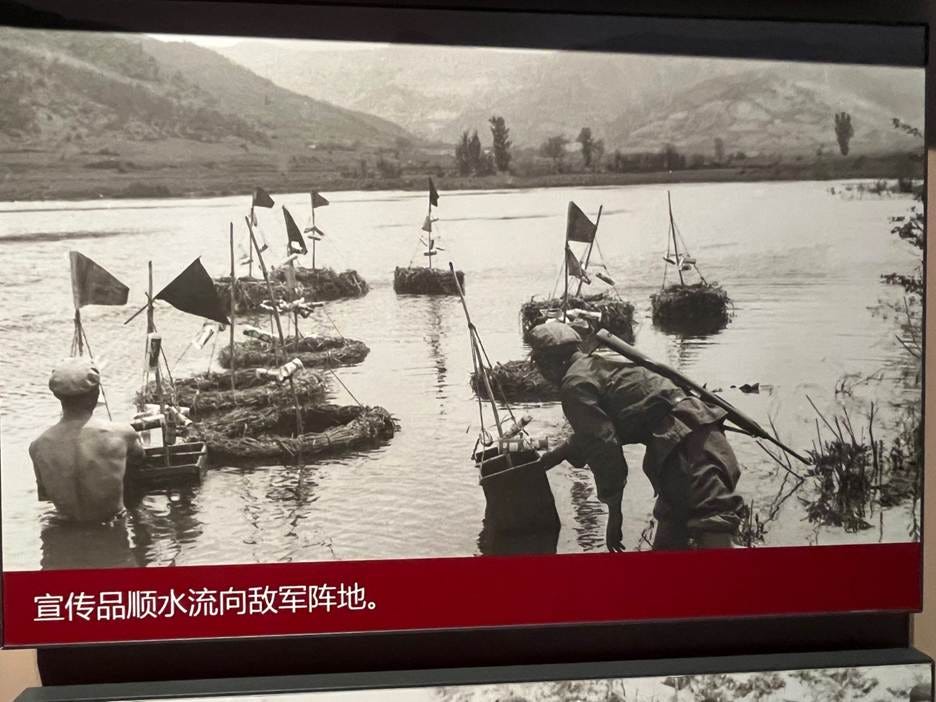
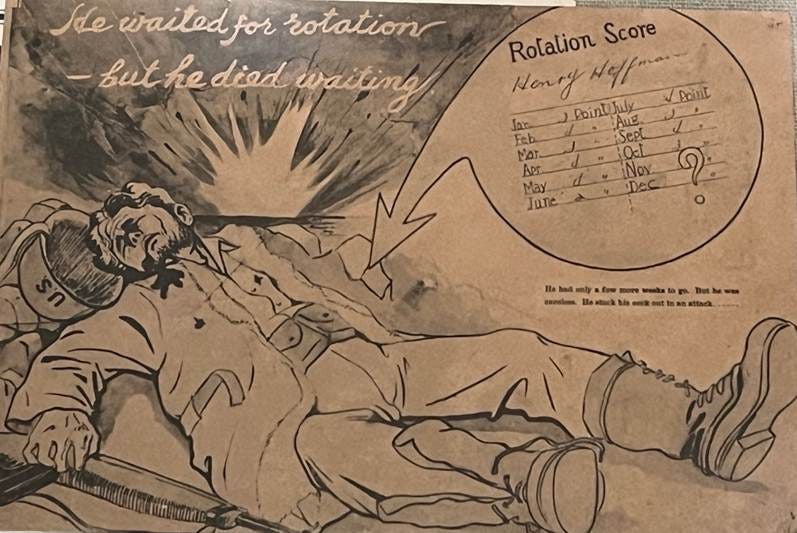
One photograph depicts African American soldiers whom the museum claims surrendered following Chinese battlefield appeals. Other exhibits show improvised rafts carrying propaganda leaflets downstream toward enemy positions.
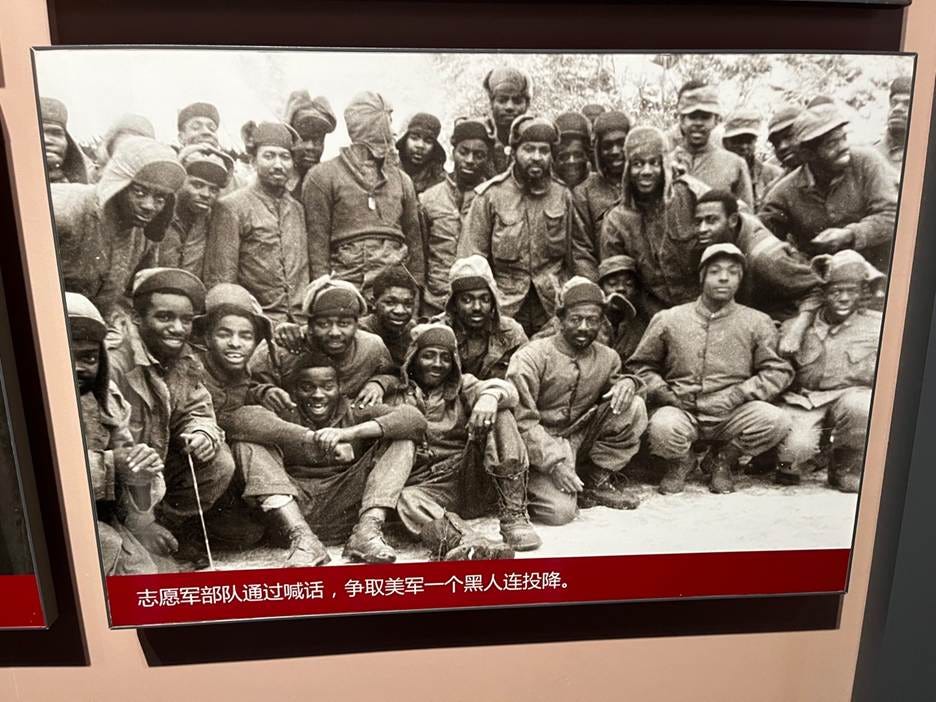
The exhibition also portrays the CPV as humane toward captured enemy soldiers while accusing the United States of mistreating Chinese and North Korean prisoners.
Prisoner repatriation became a major obstacle to the armistice. The UNC supported voluntary repatriation, whereas Beijing and Pyongyang initially demanded the return of all prisoners. Approximately 14,000 Chinese prisoners ultimately chose Taiwan rather than mainland China.
These exhibits reveal how the museum uses the prisoner-of-war issue to reinforce a moral contrast between Chinese and American conduct, while largely omitting abuses committed against UNC prisoners.
The Armistice, Chinese Withdrawal, and Postwar Diplomacy
The museum describes the July 27, 1953, armistice as a decisive Chinese victory because American-led forces failed to occupy North Korea or achieve a military settlement on their terms.
A map of the military demarcation line illustrates the territorial differences between American negotiating proposals and the final ceasefire boundary.
The exhibition also displays General Mark W. Clark’s memoir, From the Danube to the Yalu, highlighting his observation that he became the first American commander to sign an armistice without victory.
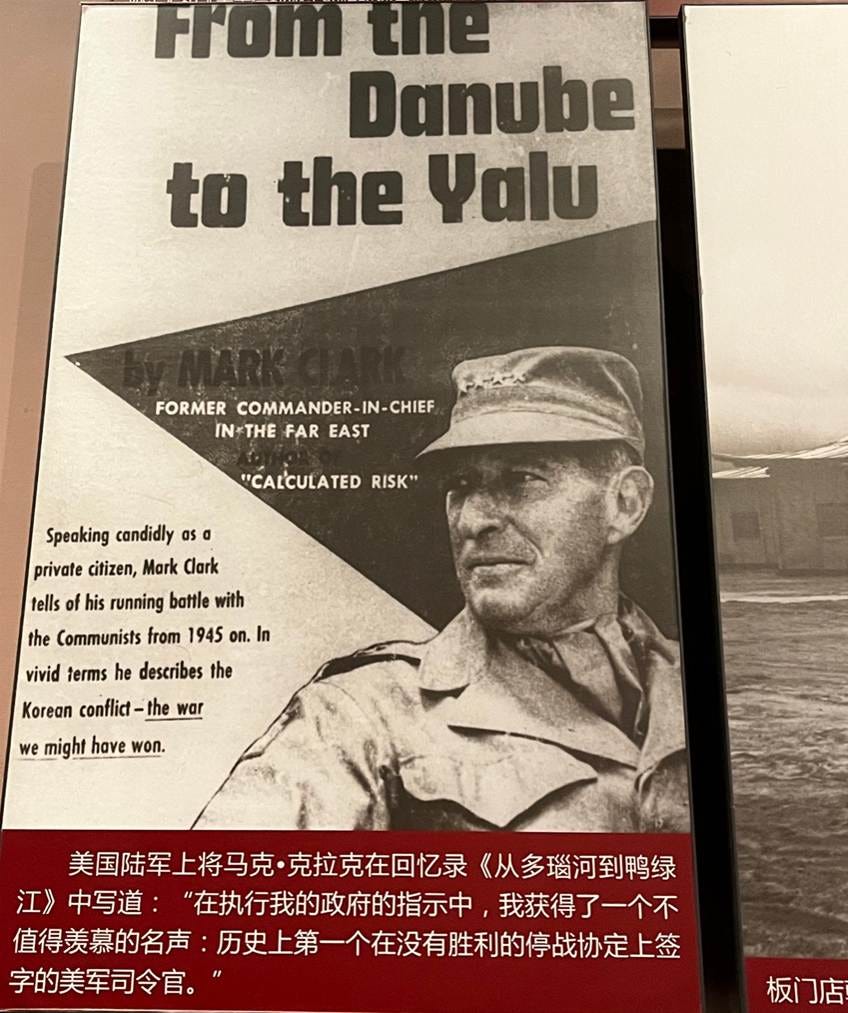
The museum interprets this statement as an acknowledgment of American defeat, although the armistice more accurately represented a military stalemate.
Chinese forces remained in North Korea after the armistice and completed their withdrawal on October 25, 1958.
Overall Takeaways
1. The Korean War occupies a foundational place in CCP historical legitimacy
The museum presents the war as the moment when the newly established PRC demonstrated its ability to resist a superpower. The conflict is portrayed as ending China’s historical vulnerability to foreign military pressure and restoring its international standing.
2. China frames military intervention as a defensive response to threats against national sovereignty
The exhibition repeatedly emphasizes American bombing of Chinese territory, the deployment of the Seventh Fleet to the Taiwan Strait, and the UNC advance toward the Yalu River. These developments establish the museum’s central argument that China’s intervention was a strategic necessity rather than an act of expansion.
3. Political resolve is portrayed as a force multiplier against technologically superior adversaries
The museum’s comparisons of American and Chinese military equipment reinforce the argument that superior weapons do not necessarily determine military outcomes. Political mobilization, organizational cohesion, sacrifice, surprise, and asymmetric tactics are presented as decisive Chinese advantages.
4. Political warfare is treated as an integral component of military operations
The extensive propaganda exhibits demonstrate Chinese efforts to exploit American domestic divisions, military grievances, and personal anxieties. This reflects a longstanding Chinese military tradition of integrating psychological operations with conventional warfare.
5. China’s interpretation of victory is primarily strategic rather than territorial
Although the war ended in an armistice near the original dividing line, Beijing considers the survival of North Korea, the prevention of a U.S.-aligned state on its border, and the failure of American forces to defeat the Communist coalition to constitute a major victory.
6. The exhibition selectively presents historical evidence
The museum highlights American statements, captured military equipment, and Chinese battlefield achievements while downplaying or omitting North Korea’s initial invasion, Soviet involvement in planning and supporting the war, the heavy costs of Chinese intervention, and competing interpretations of POW repatriation.
The exhibition also presents allegations of American biological warfare as established fact, although these claims remain historically disputed.
7. The war is presented as a catalyst for China’s military modernization and diplomatic emergence
The museum links battlefield performance to subsequent improvements in the PLA, China’s increased international prestige, and Zhou Enlai’s participation in the 1954 Geneva Conference. Military power and diplomatic influence are portrayed as mutually reinforcing.
8. The exhibition offers insights into contemporary Chinese strategic thinking
Perhaps the most important broader lesson is the museum’s portrayal of the Korean War as a successful example of confronting a militarily superior United States when Beijing perceives fundamental security interests to be at stake.
The narrative emphasizes deterrence through resolve, asymmetric military operations, national mobilization, and the willingness to accept substantial costs to prevent a negative regional security outcome.
The significance extends beyond the Korean War itself. The exhibition reinforces enduring CCP beliefs about the relationship between national sovereignty, military power, political legitimacy, and resistance to external pressure. But its selective treatment of the historical record underscores the importance of distinguishing the museum’s official narrative from a comprehensive historical assessment of the conflict.
To reinforce this point, as mentioned earlier, on October 24, 2026, General Secretary Kim made a rare visit to Dandong and devoted a large portion of the visit to the Korean War memorial. Kim paid tribute to CPV soldiers who fought alongside North Korea, reportedly thanking the “martyrs of the Chinese People’s Volunteer Army who supported North Korea with their lives and blood during a critical historical juncture, and expressed the North’s “sincere gratitude and eternal respect for the heroes of the War to Resist US Aggression and Aid Korea.”