


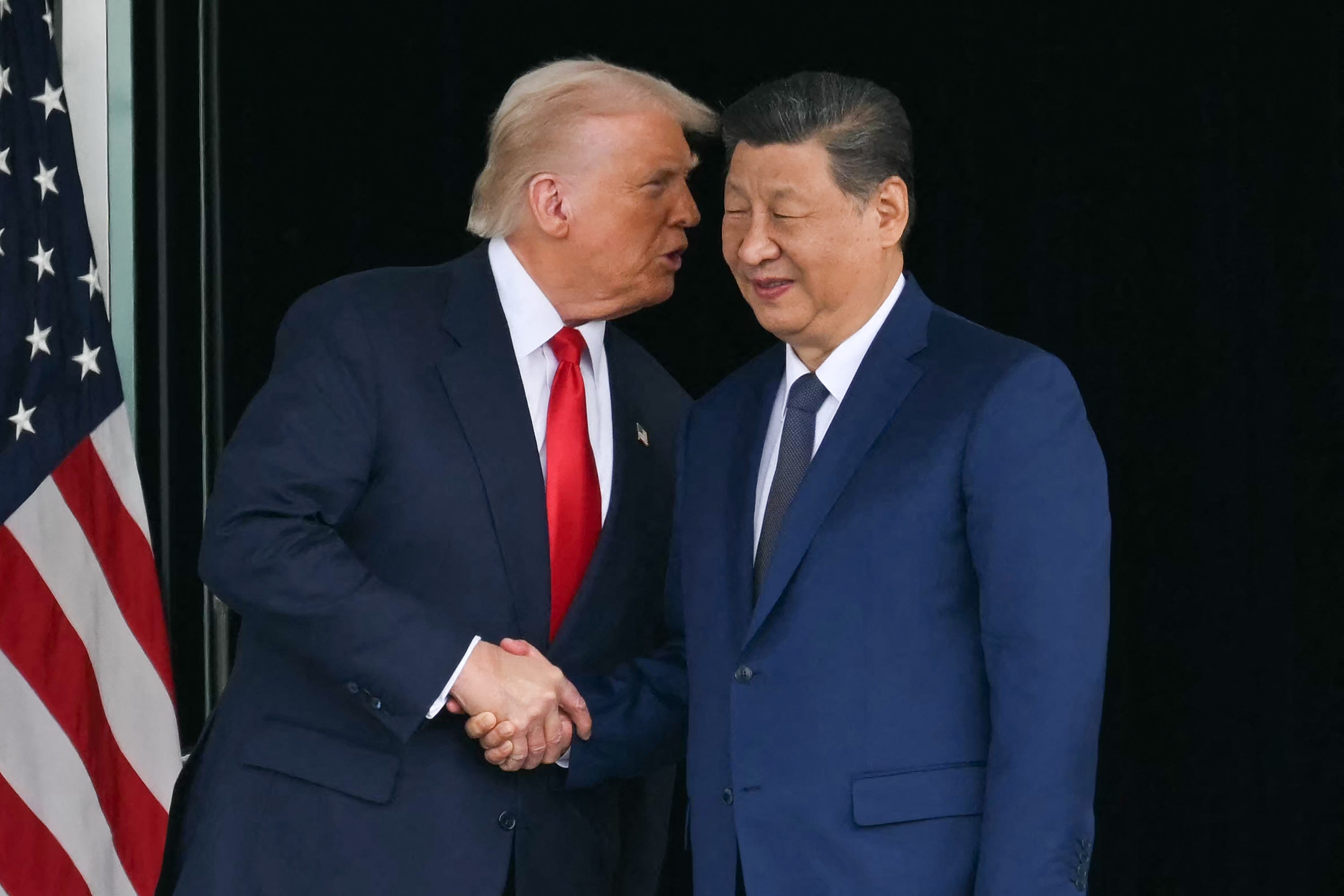
1. Trump-Xi Summit Rescheduled for May
What Happened: The White House announced on Wednesday that the delayed summit between President Trump and President Xi Jinping in Beijing would be rescheduled for May 14–15. The meeting, originally slated for mid-April, was postponed so Trump could remain in Washington to manage the ongoing war in Iran. White House press secretary Karoline Leavitt also announced plans for Trump and first lady Melania Trump to host Xi and Madame Peng Liyuan for a reciprocal trip in Washington, DC later this year, underscoring both sides’ desire to restore leader level exchanges.
Why It Matters: The long-anticipated summit will be the first time a U.S. president has visited China since Trump’s own 2017 trip, and the first in-person meeting between Trump and Xi since the APEC Leaders’ Summit in Busan last October. Trade will be a key watchpoint on the agenda, especially after the February Supreme Court ruling invalidated Trump’s IEEPA-based tariffs, reducing Washington’s trade leverage heading into the talks. The war in Iran also looms large over the meeting: China buys over 80% of Iran’s oil exports, giving Beijing an outsized economic stake in the conflict. The meeting, originally scheduled for three days, has been reduced to two, and the shortened format may limit how much ground the two sides can cover.
By Jamie Lui, Assistant Director of Research and Strategy, Center for China Analysis
Learn More: Read “U.S. Leaders Need to See What’s Happening in China” an opinion essay in the New York Times by CCA Co-Founder and Managing Director Jing Qian and CCA Fellow Neil Thomas.
2. Li Qiang Casts China as Global “Fitness Center” at China Development Forum
What Happened: Premier Li Qiang, in his keynote at the China Development Forum this week, outlined China’s shift toward “new quality productive forces” and technological upgrading. He described the domestic market as a “fitness center” for global firms, framing it as an environment that demands sustained effort and adaptation. The metaphor points to an evolving official narrative, with China placing less emphasis on its role as a low-cost manufacturing base for foreign capital and more on its position as a competitive, innovation-driven market where firms are expected to navigate structural changes and intensifying local competition.
Why It Matters: The choice of metaphor is notable. Foreign business leaders, including Jörg Wuttke, former president of the European Union Chamber of Commerce in China, have used the “fitness center” analogy to characterize the pace and intensity of innovation in China. By echoing this language, Beijing appears to reinforce a perspective already articulated by foreign investors and executives, while signaling its expectations to multinational firms about the new, dual reality of operating in China: conditions are more demanding, but continued participation can support long-term competitiveness.
By Shengyu Wang, Research Assistant, and Lizzi C. Lee, Fellow on Chinese Economy, Center for China Analysis (@wstv_lizzi)
Learn More: Watch “Can China Become an Innovation Superpower?” by CCA Honorary Senior Fellow Yasheng Huang and Lizzi.
3. China Leans on Tehran Ties to Protect Energy Flows in Hormuz
What Happened: On March 24, Chinese Foreign Minister Wang Yi urged Iranian Foreign Minister Abbas Araghchi to seize a “window for peace” during their second high-level call since the start of the Iranian crisis. The call came as the United States explored indirect ceasefire talks with Iran, but no breakthrough had emerged. As fighting continues, the Strait of Hormuz remains a volatile bottleneck for global energy flows, prompting President Trump to repeat calls for a multilateral naval escort, an effort Washington hopes key partners — potentially including China — will support.
Why It Matters: Rather than joining a U.S.-led multilateral naval escort, Beijing appears to prefer protecting its economic stakes in the region through direct engagement with Tehran. By prioritizing diplomacy, China leverages its unique relationship with Tehran to negotiate safe passage for its vessels, an advantage that would be compromised by joining a Western-led military operation. Beijing also seeks to preserve its global image as a neutral power, and Chinese strategists worry that adding more naval presence would trigger a “vicious cycle” of retaliation. The success of China’s diplomacy is already evident as major Chinese shipping firms like Cosco have resumed Gulf bookings, and some Chinese-owned ships have resumed transiting Hormuz under Iran’s proposed safe corridor for “non-hostile” vessels. China is banking on its mediator role to secure vital energy flows while avoiding the strategic risks and high costs associated with direct military entanglement.
By Jie Gao, Research Associate on Foreign Policy and National Security, Center for China Analysis
Learn More: Listen to “Jeffrey Feltman on the Israel-Hezbollah Conflict” with non-resident Distinguished Fellow Jeffrey Feltman and ASPI’s Managing Director Rorry Daniels on Asia Inside Out, a podcast by the Asia Society Policy Institute.
4. China Signs Declaration to Triple Nuclear Energy
What Happened: At the second Nuclear Energy Summit 2026 in Paris on March 10, China signed the Declaration to Triple Nuclear Energy. The Declaration, which first launched at the World Nuclear Symposium ahead of COP28, calls for a collective effort to triple global nuclear energy capacity by 2050 in order to help countries keep on track to meet their Paris Agreement climate goals. China’s endorsement of the Declaration reflects recent 15th Five-Year Plan goals to develop 110GW of nuclear capacity by 2030. At the end of 2025, China’s nuclear capacity totaled 62GW which fell short of its 70GW target. China had also missed its earlier 58GW target for 2020. These shortfalls are largely attributed to the suspension of construction after the Fukushima nuclear disaster.
Why It Matters: Amid a backdrop of geopolitical instability and volatile global energy markets, China’s approach to increasing its nuclear capacity reinforces its “all of the above” strategy to diversify its energy sources. Its efforts to scale up solar, wind, hydro, and nuclear energy have reflected a desire to reduce reliance on external markets and build resilience domestically.
By Taylah Bland, Fellow on Climate and the Environment, Center for China Analysis (@Taylahbland)
Learn More: Read “The Evolving Politics of Climate Change in China” by CCA Fellow Neil Thomas and Senior Fellow Guoguang Wu.
5. Xi Reaffirms Commitment to Xiong’an as Political Stakes Rise
What Happened: On March 23, Xi Jinping, during his fourth inspection tour of the Xiong’an New Area since its establishment, reaffirmed that Beijing’s decision to develop Xiong’an was “entirely correct.” He called for sustained “strategic resolve” and “long-term patience” in transforming the area into a model of high-quality development. Following his remarks, Premier Li Qiang and Vice Premier Ding Xuexiang urged officials to fully implement Xi’s instructions, with a focus on improving public services and accelerating the growth of emerging and future industries. Xinhua News Agency reiterated that the project is a national “millennium plan.”
Why It Matters: As one of the signature “millennium projects” of the Xi era, Xiong’an was launched in 2017 with the slogan: “The 1980s looked to Shenzhen, the 1990s to Pudong, and the 21st century to Xiong’an.” Total investment has now exceeded 1 trillion yuan. Yet persistent criticism over slow progress in supporting infrastructure and public services has led some observers to label the area an “unfinished” city, raising questions about the project’s effectiveness. Beyond Xi Jinping himself, Xiong’an’s trajectory is increasingly tied to the political fortunes of senior officials overseeing regional development — particularly Li Qiang, Ding Xuexiang, He Lifeng, Yin Li, and Chen Min’er.
By Lobsang Tsering, Senior Research Associate on Chinese Politics, Center for China Analysis
Learn More: Read “Xi’s Personal Priorities: What Matters Most to China’s Leader?” by CCA Fellow Neil Thomas and Lobsang.