


By Jing Qian, Co-Founder and Managing Director, Center for China Analysis
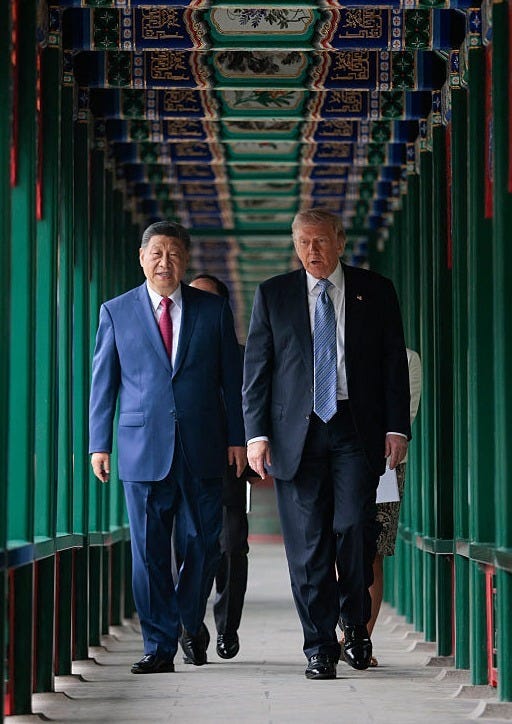
As we enter the final hours before Presidents Trump and Xi meet in Washington during Xi’s September 23–25 state visit, I think we may need to adjust how we watch U.S.–China summitry.
The era of searching for a “grand bargain” may be behind us. The more realistic question is whether both sides can establish a working equilibrium that makes their domestic political goals achievable.
That brings us back to the language agreed in Beijing in May: a “constructive relationship of strategic stability,” with the critical qualifiers, in Washington’s formulation, of “fairness and reciprocity.”
Beijing is now presenting this not simply as a framework for managing the next summit, but as a possible guide for the relationship for “the next three years and beyond.” Its May formulation described constructive strategic stability as cooperation remaining the mainstay, competition staying within proper limits, differences remaining manageable, and peace remaining the baseline.
The key question now is whether that concept can acquire enough operating substance to guide the relationship.
Where can the two countries identify arrangements that each regards as sufficiently fair and reciprocal, and that therefore make strategic stability more durable?
Against that standard, six things are worth watching.
1. Can Trump–Xi goodwill be translated into lasting mechanisms between the two nations?
Personal diplomacy is critical and matters enormously in both political systems. But personal relationships between leaders are not enough to sustain the world’s most consequential bilateral relationship.
Beijing itself is placing extraordinary weight on the leaders. Chinese official messaging now describes head-of-state diplomacy as both the “compass” and “anchor” of U.S.–China relations.
That makes the institutional question even more important: can strategic direction at the top travel downward through two very different political and bureaucratic systems?
The test is whether leader-level direction produces durable mechanisms: regular economic channels, AI and crisis-management systems, constructive areas of cooperation, implementation processes, and working relationships among the officials who actually manage the relationship.
Interestingly, Beijing is now describing precisely this objective in the economic relationship: moving from “crisis response” toward “institutionalized management.” Chinese official commentary has placed the trade and investment mechanism alongside military, AI, law-enforcement, local-government, business, and Track 1.5 channels as part of a denser network of bilateral mechanisms.
The goal should be to build enough standing machinery that every disagreement does not require leader-level rescue.
That matters as both countries approach major domestic political moments: China’s Fifth Plenum on October 26–29 and the U.S. midterm elections on November 3. The Fifth Plenum dates were formally set this week.
Domestic politics is driving diplomacy nowadays. So the question is whether the two governments can build mechanisms resilient enough to keep operating through domestic political cycles.
2. On economics, look for implementation rather than transformation
Trade will remain important.
Investment may become even more interesting.
But again, I would change the standard by which we judge progress.
Neither side is likely to transform the underlying economic relationship this week.
The more practical question is whether they can make it more predictable and more reciprocal.
And “implementation” itself may be contested: the Chinese readout of the latest Bessent-He talks emphasized “implementing the consensus reached in previous economic and trade consultations.” That raises an important question: not simply what does each side want next?, but what does each side believe the other has already committed to—and has it been implemented?
Can existing tariff arrangements actually be stabilized, now that both sides have more tariff instruments at their disposal?
Can disputes over tariffs and critical minerals be managed without repeatedly escalating into broader confrontation?
Can the emerging trade mechanism be institutionalized in a way that moves economic relations away from repeated crisis management and toward more predictable consultation?
And can the two sides eventually construct investment models in which Chinese capital or technology contributes to American production and employment while legitimate questions involving security, data, ownership, and governance are addressed transparently under U.S. law?
This is where fairness and reciprocity have to become more than diplomatic language.
They need institutional expression—and enough shared understanding of what has actually been agreed to make implementation, as well as measurement of implementation, possible.
3. On AI, can dialogue become a firewall—and quickly?
This may be one of the most consequential areas to watch.
The United States and China will continue competing intensely for technological leadership.
But the risks generated by increasingly powerful AI systems do not respect national borders.
The two sides have agreed to formalize an AI-risk dialogue, with another meeting expected in Shenzhen in roughly two months. The United States has also proposed an AI “incident line” through which the two governments could communicate when serious AI-related safety incidents occur. Beijing has confirmed the broader AI dialogue but has not yet publicly endorsed the specific incident-notification proposal.
That is modest but meaningful progress on building a working mechanism.
One key objective moving forward could be to build a defensive firewall for AI to deal with powerful models already in the hands of rogue actors, and to build mechanisms that help prevent accidents, miscalculations, or uncontrolled interactions between increasingly powerful systems from becoming wider crises.
Over time, that could mean mechanisms for incident notification, crisis communication, human control, and the management of shared risks involving cyber systems, critical infrastructure, biological misuse, and other potentially catastrophic applications.
It may be unrealistic to expect Washington and Beijing to agree to slow technological competition when both regard AI leadership as strategically consequential.
But perhaps this is precisely the point: the two countries do not have to resolve their competition over chips, compute, or technological leadership in order to build defensive mechanisms around risks neither side wants to materialize.
The latest discussions themselves suggest that kind of compartmentalization may be possible: risk communication on one track while competition over chips, compute, and market access continues on another.
Strategic competitors can still build a firewall around the most dangerous risks. And indeed, competition may make those defensive mechanisms more necessary—and more urgent.
4. Taiwan remains the hardest test of strategic stability
There will probably be no convergence on the fundamental political positions surrounding Taiwan.
Indeed, Beijing’s warmer pre-summit language has come alongside an equally explicit reiteration of its political red lines, with Taiwan identified as the most consequential issue in the bilateral relationship.
So this is perhaps the clearest test of what “strategic stability” actually means.
Can both sides maintain their positions and deterrence while reducing the risk of miscalculation, unintended escalation, and misreading of each other’s intentions?
In particular, can Washington maintain deterrence around Taiwan while simultaneously assuring Beijing that its one-China policy is not intended to embolden Taiwan to move toward independence?
Strategic stability does not require agreement—it requires enough understanding and predictability that disagreement does not automatically become crisis.
That requires more than political signaling. It requires defensive mechanisms: reliable military-to-military communication, crisis hotlines, advance notification where possible, clear procedures for managing encounters, and channels that remain open even when political relations deteriorate.
These mechanisms do not resolve the underlying dispute. They help prevent a dangerous incident, miscalculation, or misunderstanding from becoming a wider conflict.
5. Can strategic stability also become constructive?
A relationship organized entirely around managing threats will eventually become defined by threats.
Durable stability therefore needs at least some areas where the two countries can show that interaction can produce affirmative outcomes.
Health may be one of them.
Cancer, rare diseases, early detection, selected clinical and regulatory cooperation, responsible uses of AI in medicine, and AI-related biosecurity risks all offer potential areas for bounded cooperation.
A Chinese discovery that helps cure an American patient is not an American defeat.
An American medicine that saves a Chinese life is not a Chinese defeat.
None of this requires strategic trust.
It requires boundaries, safeguards, and predictability—and, again, fairness and reciprocity.
Perhaps that is also how we begin moving, carefully, beyond unreasonable suspicion.
6. Strategic stability also needs human infrastructure
Government mechanisms are only one layer.
The relationship also needs connective tissue between the two societies: scientists, doctors, students, businesses, scholars, universities, and civil society.
These relationships are not merely the “soft” side of diplomacy. They are part of the hard infrastructure of stability.
Interestingly, people-to-people relations have figured unusually prominently in Beijing’s pre-summit messaging—from Xi’s outreach to students at ten American universities to repeated references to youth, local relationships, the Flying Tigers, and his own long history of engagement with American society. Chinese messaging has emphasized that the relationship’s “hope lies in the people, foundation in society, future in youth, and vitality in localities.”
The fewer legitimate connections that remain between two societies, the greater the danger that each understands the other mainly through security institutions, political rhetoric, and worst-case assumptions.
Not every exchange should be preserved regardless of risk.
But strategic competition without human infrastructure becomes increasingly brittle and dangerous.
Resilience requires both government-to-government mechanisms and society-to-society connections.
That is why bridge builders still matter.
In an era of strategic competition, bridge-building can sometimes sound naïve. But the harder the relationship becomes, the more important serious bridge builders become: people and institutions capable of understanding both societies without romanticizing either, explaining disagreement without amplifying it, and preserving channels through which problems can still be solved.
So my test for the summit is not a grand bargain, but a working stabilization that creates room for constructive strategic stability.
That means:
Fairness and reciprocity where priorities diverge;
Mechanisms that translate leader-level direction into mutually agreed, measurable implementation;
Trade and investment arrangements that create greater predictability and reciprocity;
An AI firewall and joint defensive mechanisms against shared AI risks;
Guardrails around the hardest strategic disagreements;
A positive agenda where cooperation can produce mutual benefit, such as cancer and health collaboration;
And human infrastructure that keeps the relationship grounded in people—a constant and sober reminder of what all of this is ultimately about.