


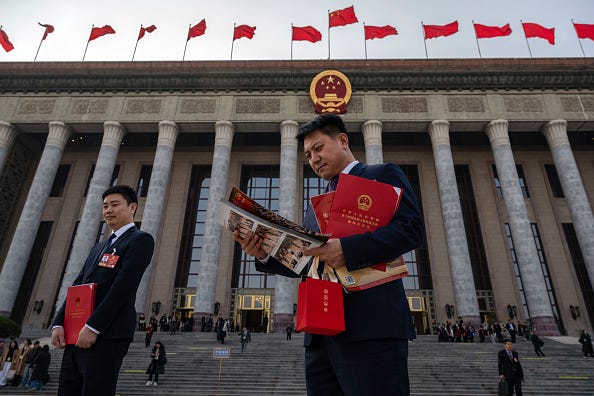
Last week, Beijing wrapped up its annual Two Sessions — the parallel meetings of China’s legislature, the National People’s Congress (NPC), and its top political advisory body, the Chinese People’s Political Consultative Conference (CPPCC). Highlights of this year’s gathering included Premier Li Qiang’s Government Work Report, several closely watched appearances by President Xi Jinping, the removal of several officials from civilian posts and the People’s Liberation Army (PLA) ahead of the meeting, and the release of China’s 15th Five-Year Plan (FYP), a blueprint for the country’s development from 2026 to 2030. Below, experts from the Center for China Analysis (CCA) assess the key takeaways across several issue areas. Last week, CCA also co-hosted a webinar on the Two Sessions with the South China Morning Post featuring Lizzi C. Lee, Lyle Morris, and Neil Thomas.
The Three Cs: Continuity, Consistency, and Conservatism
This year’s Two Sessions can be summed up in three Cs: continuity in politics, consistency in policy, and conservatism in approach.
The political story was continuity. The meetings again showed how completely the system revolves around Xi Jinping. His three main appearances during the sessions — with the Jiangsu provincial delegation, with CPPCC members from the medical and social welfare sectors, and with PLA delegates — all pointed in the same direction. China is beginning the 15th FYP period under Xi’s leadership and on Xi’s terms. The removals of civilian and military leaders in the run-up to the meetings reinforced the message. So did Xi’s remarks to PLA delegates, where he returned to the familiar themes of loyalty and anti-corruption. Political discipline remains at the core of how he governs.
The policy signal was just as consistent. In his March 5 remarks to the Jiangsu delegation, Xi emphasized new quality productive forces, technological upgrading, and industrial self-reliance. Those longstanding priorities aligned with the Government Work Report and the newly approved FYP, both of which place innovation, industrial modernization, artificial intelligence, and resilience at the heart of China’s development strategy. The direction of travel was familiar. What the Two Sessions showed was a firmer official embrace of a shift Xi has been advancing for years: away from the old growth model of property, debt, and experimentation and toward a more security-minded, state-steered, technology-heavy model.
The broader governing style on display was conservative. Xi’s March 6 speech on the Healthy China initiative continued attention to welfare and social policy, but within a framework shaped by stability, state capacity, and population quality rather than bold redistribution or structural liberalization. That same caution could be seen in the lower growth target, the lack of major stimulus, and the FYP’s incremental language on rebalancing toward consumption. Taken together, this year’s Two Sessions projected control, discipline, and strategic focus, but little appetite for bold policy change.
Xi Gets His Way at Last
At first glance, the politics of this year’s Two Sessions seemed almost dull. As with last fall’s Fourth Plenum, the numerous empty chairs in the cavernous hall where delegates meet were a stark reminder that Xi Jinping’s withering anti-corruption drive remains white hot. But there were no political earthquakes like January’s purge of military supremo Zhang Youxia, and nothing as dramatic as Xi’s abolishment of presidential term limits at the 2018 meeting occurred either.
And yet, after nearly a decade and a half in power, Xi’s signal political accomplishment at this year’s meeting was to finally force the system to loudly endorse his grand project of transforming China’s economic development model. That he did so through a FYP, the regime’s most formal and authoritative vehicle for conveying its long-term economic strategy, lent additional gravity to the achievement. Of course, the broad outlines of Xi’s economic program — jargon-laden theories such as the new development concept, dual circulation, and new quality productive forces — have been around for years. But the Two Sessions’ key documents marked the government’s most thorough embrace yet of Xi’s economic vision.
That it took so long for Xi to get his way in formally embedding all those ideas in one FYP seems incongruous with what is accurately described as his unmatched power. But the vast size and scope of the bureaucracy, along with local officials’ stubborn adherence to the notion that “the mountains are high and the emperor is far away,” make it less so. Even so, Xi has made far more progress in flattening those mountains and keeping provincial barons within arm’s reach than any of his predecessors except Mao Zedong.
The new 15th FYP represents the ultimate triumph of Xi’s quest for resilience, self-sufficiency, and security over growth, openness, and reform. A useful analogy for the course of this campaign might be the seven stages of grief. Throughout Xi’s tenure, the elite and the bureaucracy have worked their way through all of them — shock and disbelief, denial, anger, bargaining, depression, and testing — and may now finally be arriving at acceptance.
The Purges Behind the Pageantry
This year’s Two Sessions focused on the making of the 15th FYP, and personnel issues were not formally on the agenda. The NPC Standing Committee, which meets roughly every two months, has authority over government personnel appointments that now extends up to and including the rank of vice premier. As a result, it now often appears unnecessary to discuss or decide State Council personnel changes at the NPC’s annual full session.
The NPC and the CPPCC, however, still have their own personnel issues to manage, especially regarding the qualification of NPC deputies and CPPCC members. Before the Two Sessions formally opened, the NPC Standing Committee revoked the qualifications of 19 NPC deputies on February 26. In a similar move, the CPPCC Standing Committee revoked the memberships of 15 CPPCC members on March 2.
Among those affected were 13 senior generals of the PLA; two of them — Li Wei and Li Qiaoming — are incumbent members of the CCP’s Central Committee, though they have retained those memberships for now. This may suggest that the military purge is moving so quickly that established procedures have not yet fully caught up. Also removed were the top leader of China’s state agency overseeing military industries and eight leaders from major state-owned enterprises, most of them in the defense sector. Together these developments suggest that the purge within the PLA and military-industrial system may be taking place on a much larger scale than outside observers had assumed.
A leading nanoscientist, Wang Chunru, was also among those stripped of CPPCC membership. In addition, Politburo member Ma Xingrui was omitted from the presidium of the NPC session and accordingly was absent from public view during the Two Sessions. That absence strongly suggests that after months of circulating rumors, he too has been purged, even if no formal announcement has yet been made.
Rooting Out Corruption in the PLA
The main outcomes and messaging on Chinese foreign and security policy during this year’s Two Sessions were largely consistent with previous meetings, though this year they came with a stern warning about corruption in the PLA.
On defense, China announced a 7% increase in its defense budget, continuing a long-standing pattern of steady, single-digit growth. The increase suggests Beijing remains committed to sustained military modernization despite economic headwinds. At the same time, it marks a modest slowdown from the 7.2% annual increases announced in 2023, 2024, and 2025.
The most noteworthy message from Xi regarding the PLA concerned corruption and political loyalty. And here the message was both direct and dire.
On March 7, Xi chaired a plenary meeting of senior PLA delegates, where he said: “There must be no one in the military who harbors disloyalty to the Party, and there must be no hiding place for corrupt elements.”
A similar message was echoed by Defense Minister Dong Jun and Central Military Commission (CMC) Vice Chairman Zhang Shengmin during subsequent meetings.
For observers, the emphasis was unmistakable: Xi is adopting a zero-tolerance approach to corruption within the military, and any PLA officer who fails to heed the warning will be held to account. Given Xi’s move to remove his top general, Zhang Youxia, months earlier, Xi’s message at this year’s meeting suggested that his anti-corruption campaign has reached new and unprecedented heights.
Finally, on Taiwan, Premier Li Qiang said Beijing would “resolutely crack down on separatist activities” — a shift from last year’s pledge to “oppose” such activities. The wording fits a broader pattern in recent years of senior Chinese officials signaling a firmer line on “independence forces” under Taiwanese President Lai Ching-te.
Devil in the Details of the Government Work Report
The most striking thing about this year’s Government Work Report is how many analysts seem surprised by how unsurprising it is. Commentary still laments the headline GDP target and fiscal numbers as disappointing. That is true, but it also misses the point. Beijing has been steadily lowering the temperature of growth expectations and signaling that it will not resort to another massive stimulus cycle anytime soon.
And the work report confirms that. The new growth target range of 4.5 to 5%, down from the 5% target of the past three years, comes alongside a fiscal deficit ratio that remains around 4% of GDP. The quotas for RMB 4.4 trillion in local government special-purpose bonds and RMB 1.3 trillion in ultra-long special treasury bonds are unchanged. There is no major new stimulus push, as the emphasis has shifted toward structural adjustment, including managing local government debt and improving fiscal sustainability. And if growth undershoots later in the year, Beijing can still step in with additional fiscal support.
The more interesting signals sit in the fine print. Fiscal priorities clearly tilt toward science and technology, with central government spending in that category rising 10% year-on-year to RMB 426.4 billion. As expected, the report highlights the AI+ strategy, a broad effort to deploy AI across sectors to lift productivity. But it also repeatedly stresses breakthroughs in basic research and foundational technologies, with ambitions spanning chips, quantum computing, robotics, and nuclear fusion. This suggests growing confidence in Beijing that China can move toward genuine “zero-to-one” innovation, rather than merely scaling and diffusing existing technologies from “one to 100.”
Another notable shift is the more forceful language on prices. China’s GDP deflator has been negative since early 2023, and producer prices have been falling for more than three years. The pledge to “steer general price levels back into positive territory” signals clear recognition of fragile demand and squeezed profit margins driven by domestic oversupply and price-war dynamics.
Finally, the most critical watchpoint lies beyond the report itself. Beijing has been promoting a “correct view of political performance,” urging officials not to obsess over GDP growth alone. But replacing hard growth targets with softer goals such as business confidence or social welfare is easier said than done. The real challenge will be aligning incentives across China’s vast bureaucratic system.
Five-Year Plan Charts an Ambitious Tech Course but a Gradual Rebalancing Path
A critical question surrounding China’s 15th FYP, both for China’s population and for the rest of the world, is the extent to which it charts a course toward “economic rebalancing.” The FYP elevates the rhetorical importance of that goal, which calls for boosting the contribution of household consumption to China’s economy while reducing reliance on investment and exports to drive demand. However, the details suggest that progress will be gradual.
The fact that the Plan does not set a quantitative target for raising consumption as a share of GDP makes this an aspirational goal rather than one for which China’s leadership will hold itself — and the rest of the government — to account.
The FYP also outlines a menu of reforms that would structurally support rebalancing. These include accelerating urbanization, strengthening the social safety net, liberalizing the service sector, and redesigning China’s fiscal system to give local governments more resources to spend on such initiatives. However, the language — “explore,” “improve,” “promote” — suggests an incremental pace, especially on fiscal reform.
The FYP’s three highest priorities relate not to demand but to the supply side of the economy: industrial modernization, technological breakthroughs, and artificial intelligence. Beijing believes progress in these areas is vital to China’s economic future as well as its geopolitical resilience. Many of the action words, such as achieving “decisive breakthroughs” in core technologies, convey a sense of urgency that is still missing from consumption policy.
The incremental approach to rebalancing implied by the FYP means that China’s current pattern of growth is likely to persist for some time, with consequences both at home and abroad. That pattern includes a very large Chinese trade surplus in goods, which is driving growing friction with trade partners, and relatively weak consumption, which is contributing to deflationary pressures and subdued confidence domestically.
Climate Goals Quietly Recalibrated
Compared with priorities such as technological self-sufficiency, economic upgrading, and military strength, climate and sustainable development were never expected to dominate the FYP. The clearest signal of Beijing’s climate ambition lies in its carbon-intensity target — the reduction of emissions per unit of GDP. The plan calls for a 17% cut in carbon intensity by 2030, a level that would leave China short of its 2020 pledge under the Paris Agreement to reduce carbon intensity by more than 65% from 2005 levels by the end of the decade, as set out in its first round of Nationally Determined Contributions.
That 65% target was intended to span two planning cycles: the 14th Five-Year Plan (2021-2025) and the 15th (2026-2030). Pandemic-era economic disruptions, slower-than-expected growth, and continued reliance on heavy industry complicated progress in the first half, leaving a daunting gap for the second. The new target suggests a quiet recalibration, effectively acknowledging how difficult the original 2030 goal has become.
Beyond these headline figures, two dynamics deserve closer scrutiny. First, China’s emissions may be structurally plateauing. The Centre for Research on Energy and Clean Air estimates energy-related carbon dioxide emissions likely declined slightly in 2025, extending a flat or falling trend that began in early 2024. This reflects deeper forces — economic slowdown, weaker demand for steel and cement, and rapid renewable integration — rather than temporary shocks. While officials remain cautious about declaring an early peak, domestic debate is shifting from when emissions will peak to how quickly they should decline. Faster deployment of wind, solar, and especially batteries could further reduce coal dependence over the next five years.
Second, China’s clean-technology development — rather than traditional administrative climate controls — is increasingly becoming the primary driver of emissions reductions. The country now accounts for roughly 80% of global solar photovoltaic manufacturing and more than 70% of global production of wind turbines and electric vehicle batteries. As deployment of these technologies accelerates at home, they will play an ever more prominent role in bending China’s emissions curve downward, bringing Beijing’s economic ambitions into closer alignment with its climate objectives.