


By Neil Thomas and Lobsang Tsering
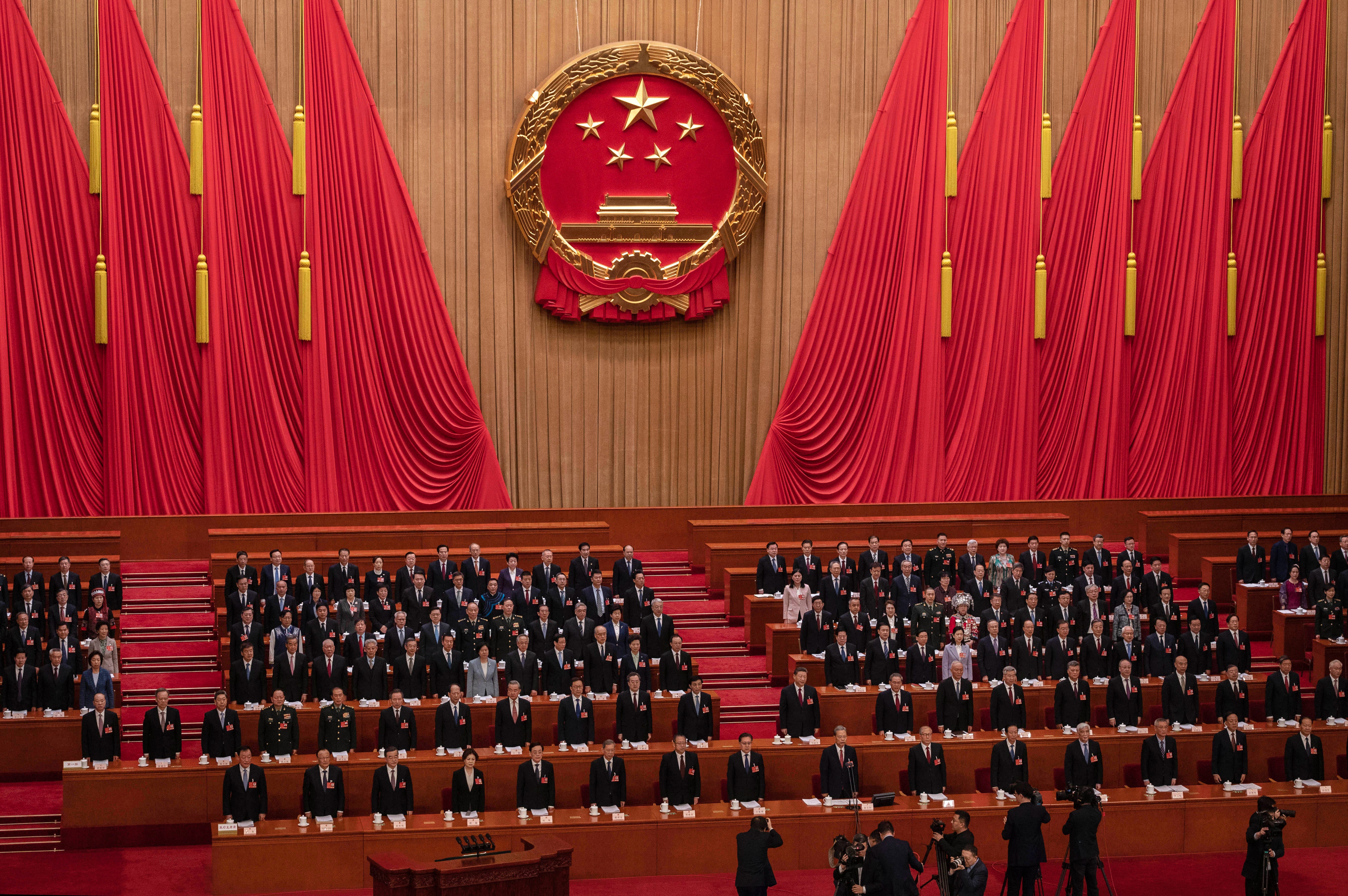
China’s annual “Two Sessions” convene from March 4 to approximately March 11. Thousands of delegates from across the nation will gather in Beijing for one of the most important events on the Chinese political calendar. This year is especially significant because the government will not only announce its annual economic targets but will also publish the 15th Five-Year Plan (FYP), outlining policy objectives for 2026–2030.
Key watchpoints include: How fast does Beijing want the economy to grow this year? How quickly can it shift from old to new growth drivers? Which strategic emerging industries will receive policy support? Is China prioritizing high-tech competition with the United States at the expense of rebalancing toward consumption and services? What signals will Xi Jinping, General Secretary of the Chinese Communist Party, send about his personal priorities? Could there be personnel shakeups?
What Are the Two Sessions, and Why Are They Important?
The Two Sessions are the annual meetings of the National People’s Congress (NPC), China’s roughly 2,900-delegate legislature, and the Chinese People’s Political Consultative Conference (CPPCC), a political advisory body with about 2,170 representatives. Held annually since 1978, they serve as a platform for communicating macroeconomic policy and socio-economic goals. Several landmark laws — including the 1979 Sino-Foreign Equity Joint Venture Law, the 1986 Foreign-Capital Enterprise Law, and the 1988 Sino-Foreign Contractual Joint Venture Law — were adopted during Two Sessions meetings.
The gatherings are also a media spectacle, offering a high-profile forum for political elites to discuss headline policy issues. For example, at the 2009 Two Sessions, Premier Wen Jiabao formally highlighted a 4 trillion RMB stimulus package to respond to the Global Financial Crisis. Still, both the NPC and CPPCC operate under Party leadership, and space for internal debate has narrowed considerably since Xi took office in 2012 and centralized decision-making within Party institutions.
The main event is usually the annual Government Work Report (GWR), delivered by the Premier to the NPC. It reviews the previous year’s performance and sets policy tasks and economic targets — including GDP growth, fiscal spending, employment, and inflation — for the year ahead. The report operationalizes decisions and priorities established at the CCP’s Central Economic Work Conference (CEWC) the previous December.
The NPC also reviews reports from the National Development and Reform Commission on economic and social development and from the Ministry of Finance on central and local budgets, as well as work reports from the NPC Standing Committee, the Supreme People’s Court, and the Supreme People’s Procuratorate. The CPPCC hears an annual work report from its Standing Committee, discusses policy proposals submitted by its members, and adopts a political resolution. Several ministers, including the foreign minister, also hold press conferences to discuss their priorities for the year.
What to Expect in This Year’s Government Work Report?
Premier Li Qiang will deliver this year’s GWR on March 5, the opening day of the NPC session; the CPPCC opens one day earlier. For 2026, he is expected to announce:
GDP growth target: down to 4.5%–5%.
Fiscal deficit ratio: steady at 4% of GDP.
CPI target: steady at around 2%.
Urban unemployment rate ceiling: steady at about 5.5%.
China is likely to drop its headline growth target to a record low. The target has been set at “around 5%” for the past three years, but signals from Beijing policy circles suggest a shift to “between 4.5% and 5%.” At this year’s provincial-level Two Sessions, held in recent weeks, 21 of 31 local governments lowered their growth targets. Such a move would represent another incremental step in the leadership’s long-term shift from high-speed to high-quality growth and its growing emphasis on balancing development with security in a more uncertain world. It would also align with IMF and World Bank growth projections and remain consistent with Xi’s goal of raising per capita GDP to about $20,000 by 2035.
A lower growth target reduces pressure for large-scale stimulus. Many economists expect the official fiscal deficit ratio to remain around 4% of GDP, signaling a preference for targeted support and fiscal discipline over broad expansion. Authorities are likely to rely on special government bonds, which sit outside the official deficit, and more selective budget allocations, to inject money into priority sectors while containing headline fiscal expansion and preserving room for future policy maneuver. Funds are expected to flow toward innovation, social services, and consumption support, reflecting an effort to balance near-term stabilization with long-term economic transformation.
The December CEWC outlined eight priorities for 2026, including expanding domestic demand, fostering innovation, deepening reform and opening, promoting more balanced regional development, accelerating the green transition, improving social welfare, and preventing risks in key sectors. Policymakers are expected to continue prioritizing industrial manufacturing and technological innovation while trying to gradually rebalance toward consumption through coordinated fiscal and monetary measures. Trade-in and voucher programs will reportedly expand into services, elderly care, and childcare, with a goal of lifting related consumption by approximately 5%.
Constraints remain significant. Investment still depends heavily on infrastructure, and private investment — which fell 6.4% year-on-year in 2025 — may not rebound quickly. Consumption faces headwinds from high household savings (around 34%), weak income expectations, and falling property prices. Structural reforms and income-distribution improvements will be necessary to unlock sustained consumption growth, with at least a decade-long horizon. Tight local government finances, with explicit debt ratios of up to 120%, also limit fiscal space, while weak confidence is feeding deflationary pressure, as liquidity circulates within the financial system rather than flowing into real economic activity.
Against a backdrop of strategic competition and global uncertainty, Beijing will continue emphasizing domestic self-reliance alongside external resilience. This requires strengthening domestic demand, accelerating indigenous innovation, and diversifying export markets. Recently published Xi speeches also point to renewed pressure on the financial sector to serve the real economy and channel capital into future industries. Beijing aims to strike a balance between sustaining growth, managing risks, and preserving openness to beneficial trade and high-tech foreign investment.
What Is a Five-Year Plan and Why Does it Matter?
It is difficult to overstate the scale of the Five-Year Plan. Central and local governments together oversaw roughly $20 trillion in public budget expenditure over the past five years. The next plan will outline Beijing’s objectives for an even larger sum.
Every half-decade, the NPC reviews and approves a new FYP at the end of a Two Sessions. Since 1953, FYPs have served as China’s central framework for medium-term economic and social strategy. They set phased development goals and identify priority sectors and policy tasks.
In the 11th FYP (2006-2010), the official term shifted from “Plan” (jihua) to “Outline” (guihua), signaling more strategic guidance and less Soviet-style resource allocation. Targets became more flexible, with greater emphasis on innovation, social welfare, and macroeconomic stability.
Under Xi, who has overseen the 13th FYP (2016-2020) and 14th FYP (2021-2025), these documents have shifted further away from high-speed growth toward technological self-reliance, national security, and state guidance of the economy. While the market is still described as playing a “decisive role,” policy increasingly stresses government steering and risk control. Macroeconomic management has correspondingly moved from broad stimulus toward more targeted, conditional support.
The FYP process is highly institutionalized. Preparations typically begin in the third year of the current plan, following its midterm evaluation. First, the Party leadership drafts the “Proposals” for the next FYP, setting its overall direction and priorities. Second, a Central Committee plenum in the fifth year reviews and approves these Proposals. Third, the State Council translates them into a detailed FYP draft. Finally, the draft plan is submitted to the NPC for approval at the Two Sessions in the first year of the new cycle.
What to Expect in the 15th Five-Year Plan?
Xi emphasizes that the 15th FYP will play an “important bridging role” between the 20th Party Congress and his goal of “basically realizing socialist modernization” by 2035. It is expected to further institutionalize a state-guided growth model centered on technological sovereignty, strategic security, and gradual economic rebalancing.
The Proposals approved by the Fourth Plenum last October highlight priorities including high-quality development anchored in indigenous innovation; strengthening the real economy and building a modern industrial system; expanding domestic demand; and deepening institutional reform. These goals are paired with a stronger emphasis on people-centered social development, closer integration of growth with national and economic security objectives, and the promotion of green technologies to combat climate change.
Advancing industrial self-reliance will be a central objective. The plan is expected to outline science and technology initiatives across fields including next-generation artificial intelligence, high-end manufacturing and industrial upgrading, energy and resource security (including renewables and nuclear fusion), and core infrastructure such as transport, logistics, and national security systems. According to a report by the Xinhua National Research Institute of Economics, affiliated with the national economic planning agency, the plan should prioritize breakthroughs in six technological chokepoints:
Overcoming semiconductor manufacturing constraints in equipment, materials, and software, especially related to advanced lithography.
Localizing at least 90% of core components and computer numerical control systems in industrial mother machines.
Closing gaps in high-end scientific instruments, including cryo-electron microscopy and nuclear magnetic resonance spectrometers.
Raising the domestic share of foundational industrial software to at least 50%.
Achieving breakthroughs in advanced materials, including extreme ultraviolet semiconductor materials and high-performance fibers.
Reducing bio-manufacturing bottlenecks by localizing at least 50% of core microbial strains and advanced bioreactor equipment.
On consumption, close attention should be paid to how the FYP helps operationalize two existing central policies: the Strategic Plan for Expanding Domestic Demand (2022–2035) and the Action Plan for Boosting Consumption. Beijing could target an increase in household consumption to around 42–47% of GDP. Expected measures include expanded trade-in programs for durable goods — especially automobiles, home appliances, and renovation materials — alongside stronger support for elderly care through age-friendly home upgrades and for childcare through expanded community-based provision. New consumption categories, including AI-enabled services and the low-altitude economy, are also likely to receive policy support.
Investment policy is expected to tilt further toward sectors that directly support consumption upgrading and public welfare, including consumer infrastructure, culture, tourism, sports, elderly care, and childcare services. However, trillions of yuan per year in special treasury bonds and local government bonds will still be directed primarily toward infrastructure investment, strategic reserves, purchases of unsold housing inventory, urban renewal projects, and local debt resolution.
Beijing is also expected to pursue a dual-track approach to raise household income and reduce household burdens: improving minimum-wage adjustment mechanisms and expanding non-salary income channels, while increasing basic pensions, raising medical insurance subsidies, boosting childcare allowances, and extending interest-free student loans. Together, these measures aim to expand the middle-income group and reinforce a virtuous cycle between consumption and investment.
The 15th FYP period is also expected to bring reforms aimed at building a unified national market and curbing “involution-style” competition in established industries. Likely measures include clarifying government-market boundaries through regulations, expanding negative lists to reduce local protectionism, and encouraging firms to invest and produce abroad. Revisions to the Anti-Unfair Competition Law and stricter fair-competition reviews will target predatory pricing and monopolistic behavior. Standards harmonization initiatives and “same line, same standard, same quality” programs are intended to shift competition away from price wars and toward innovation. The broader objective is a governance framework that better integrates an “effective market” with a “capable government.”
Climate and environmental policy under the plan will likely emphasize technological innovation and industrialization in green sectors to support a progressive transition toward higher–value, lower-emissions growth. Priorities include faster iteration of clean energy technologies — such as green hydrogen and next-generation storage — greener industrial processes, including hydrogen-based metallurgy and carbon capture, improved digital environmental monitoring, and advances in circular-economy technologies such as advanced materials recycling. Policy tools will likely include stronger government–industry–academia coordination, expanded green finance and procurement mechanisms, and more active participation in international standards-setting.
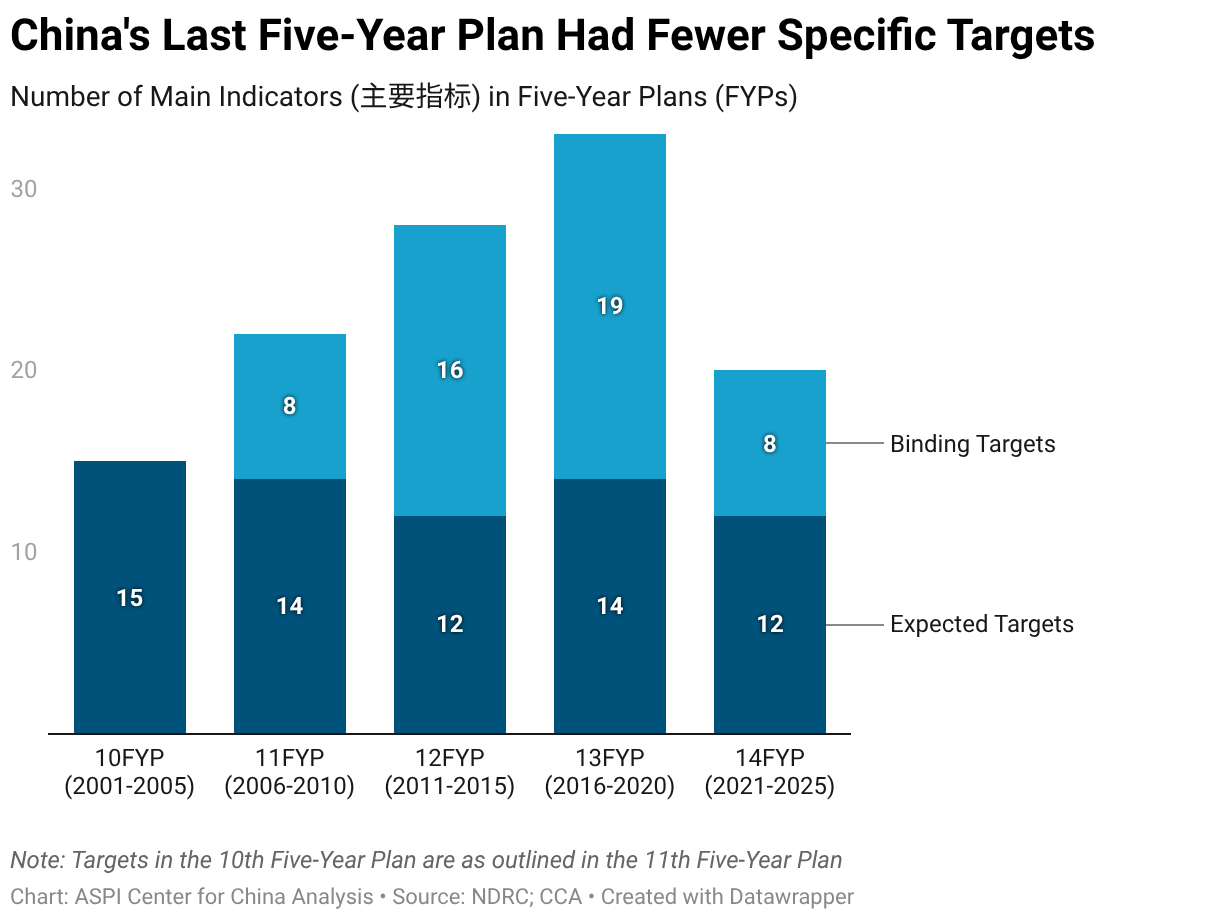
The FYP document will list hundreds of policy objectives, so a major watchpoint is the set of “main indicators” (zhuyao zhibiao), published in table form since the 11th FYP (2006-2010), which serve as the plan’s core performance metrics. Since then, indicators have been classified as either “expected” (yuqi xing) or “binding” (yueshu xing), with binding targets carrying greater policy weight. The number of indicators rose from 15 in the 10th FYP to 33 in the 13th, then fell to 20 in the 14th FYP — likely reflecting Xi’s preference for flexibility amid trade-war and pandemic shocks (see chart below). A further reduction would signal greater policy discretion, while an expansion would suggest tighter central steering and even less local flexibility.
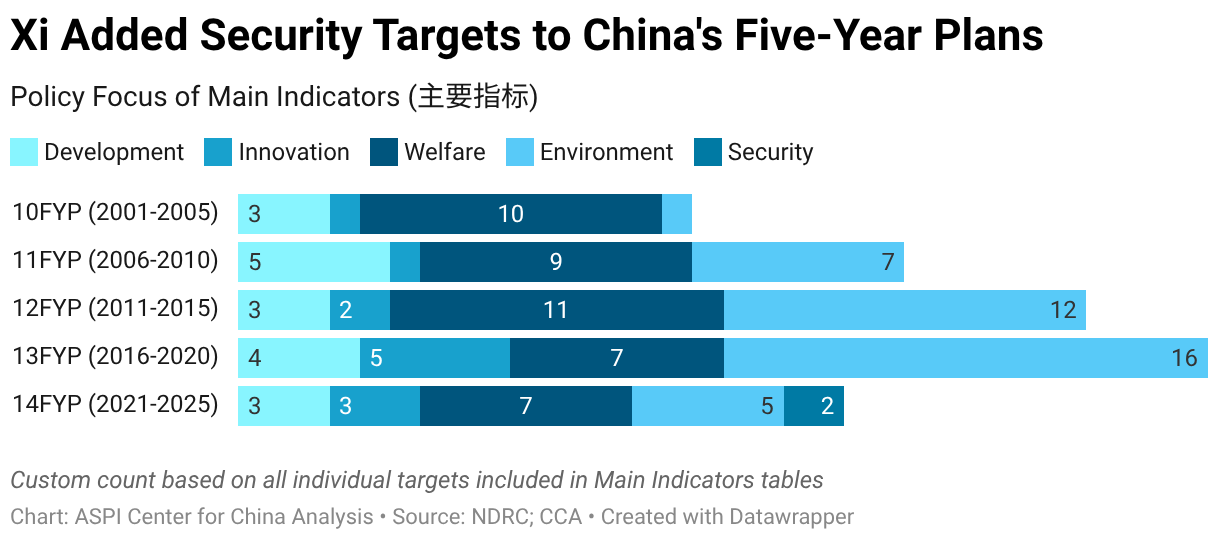
The composition of these targets will also offer clues to Xi’s priorities (see chart below). The 14th FYP reduced the number of environmental targets (all of which were binding), increased the share focused on social welfare, and added new targets related to agricultural and energy security. This shift reflected the elevation of national security alongside development, the importance of social stability, and earlier environmental gains. Last year’s Proposals suggests that Xi’s emphasis on social welfare will continue, but with 15th FYP targets potentially tilting further toward innovation and security. Xi may also restore specific targets for economic growth — which was left vague during the Covid-hit current plan — as well as for productivity growth, a central element of his “new quality productive forces” agenda, and for the services sector, which will be essential to replacing manufacturing as a primary engine of employment.
Following adoption of the 15th FYP at the Two Sessions, implementation will proceed in three stages: national, local, and sectoral. Central ministries and commissions will translate the framework into sector-specific plans and annual task lists in the year ahead. Provincial governments have already released draft outlines during their local Two Sessions, with prefectural- and county-level plans to follow in the months ahead. These documents will include more granular policy guidance for firms and investors.
What Political Signals to Expect at the Two Sessions?
Watch what Xi says
During the Two Sessions, Xi meets with NPC delegates, CPPCC members, and the People’s Liberation Army (PLA) delegation to the NPC to underscore his priorities for the year ahead. After these meetings, ministries and provincial governments usually launch nationwide study and implementation campaigns to translate Xi’s directives into concrete policy action.
Last year, Xi emphasized three core priorities: advancing new quality productive forces, deepening market-based factor allocation reforms, and curbing “involution.” These themes quickly translated into policy initiatives. China’s R&D intensity reached 2.8 % of GDP, exceeding the OECD average for the first time; the country entered the top ten of the Global Innovation Index; and it ranked first globally in PCT international patent filings. On market reform, Beijing approved ten regions for two-year pilot programs on market-based factor allocation. To curb involutionary competition, the NPC revised the Anti-Unfair Competition Law, issued new rules on fair-competition reviews and platform pricing, and began urging production restraint in high-capacity sectors where Chinese firms already dominate the global market.
Watch for new laws likely to be passed
The Law on National Development Plans represents China’s first effort to formalize medium- and long-term development strategy through statute. It will regulate the content, drafting, implementation, and supervision of five-year plans and related sectoral and regional plans. Because China already has a mature planning system, the law is less about introducing new policy tools than about Xi’s ongoing political campaign to formalize and institutionalize central authority.
Beijing says the Law on Promoting Ethnic Unity and Progress will provide safeguards for the integration of ethnic minorities into mainstream Chinese culture. In practice, it will expand the legal basis for restricting religious, cultural, and political activities among minority groups by creating legal scaffolding to prosecute behavior that Beijing deems “separatist” or “extremist.”
An Ecological and Environmental Code will elevate ecological protection within the national legal framework while also supporting green-industry development and international ESG competitiveness. The Code is expected to cover three pillars: pollution prevention and control, ecological conservation, and green and low-carbon development.
Watch for possible but unlikely promotions and purges
Major personnel announcements are uncommon at the Two Sessions, but attendance patterns can reveal which officials are in political trouble. At last October’s Fourth Plenum, only 315 of the 376 original Central Committee members attended, an unusually low 83.8% attendance rate that confirmed multiple purges. Unexplained absences by NPC delegates or CPPCC members can signal disciplinary investigations, though illness and travel conflicts do occur. Ma Xingrui, the former Party Secretary of Xinjiang, is expected to continue his months-long disappearance from public view, all but confirming him as the third Politburo member purged during Xi’s third term.
The PLA delegation could be noticeably smaller this year. On January 24, Beijing announced disciplinary investigations into Zhang Youxia, first vice chairman of the Central Military Commission (CMC), and Liu Zhenli, a CMC member and chief of staff of the Joint Operations Command. Xi has taken a blowtorch to the PLA leadership amid a sweeping corruption probe and rumors of political infighting. Zhang, Liu, and several other missing officers still technically hold NPC seats, which confer immunity from criminal prosecution, but they will not attend the Two Sessions and will have their positions revoked once their investigations conclude.
Across NPC delegations, the PLA has seen the most removals and resignations this term, both in absolute and proportional terms (see chart below). Guizhou ranks next, following corruption scandals tied to government spending, vanity projects, and big data centers. Henan follows, after multiple investigations into banking-sector corruption. By contrast, provinces where Xi has deep personal ties — such as Fujian, Shaanxi, and Zhejiang — have been relatively less affected.
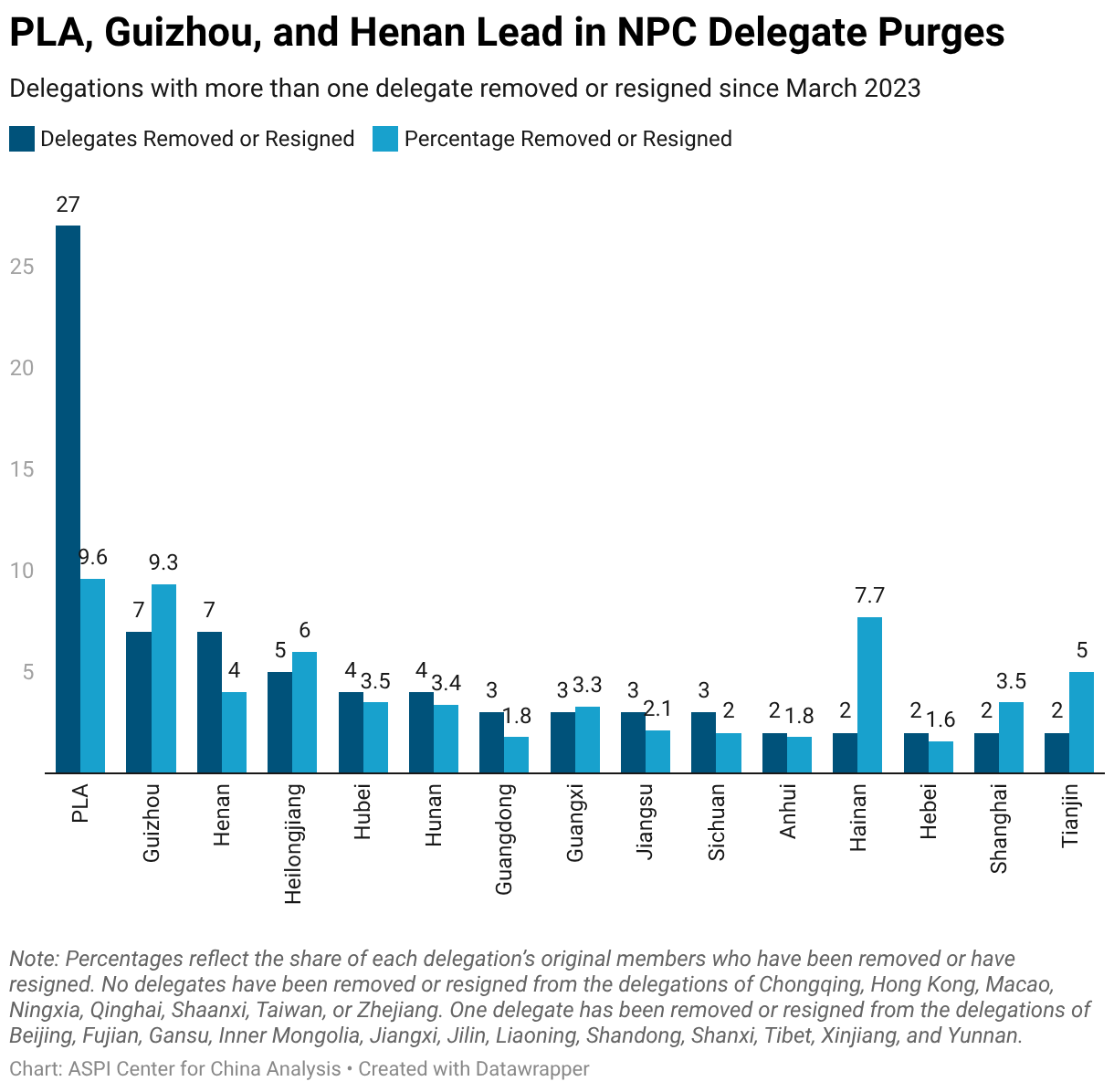
The NPC and CPPCC have experienced far fewer purges than the Central Committee. Of the NPC’s original 2,977 delegates, 78 have been removed and ten have resigned — about 3.0%. Of the CPPCC’s original 2,169 members, 38 have been removed and nine have resigned (some for procedural reasons) — approximately 2.2%. By comparison, 48 of the Central Committee’s 205 original full members — 23.4% — are now purged or missing. This gap likely reflects the PLA’s heavier representation in the Central Committee and the fact that most NPC and CPPCC members are not senior enough to become players in elite political struggles. With a boss like Xi, promotion can be hazardous.
Key Dates
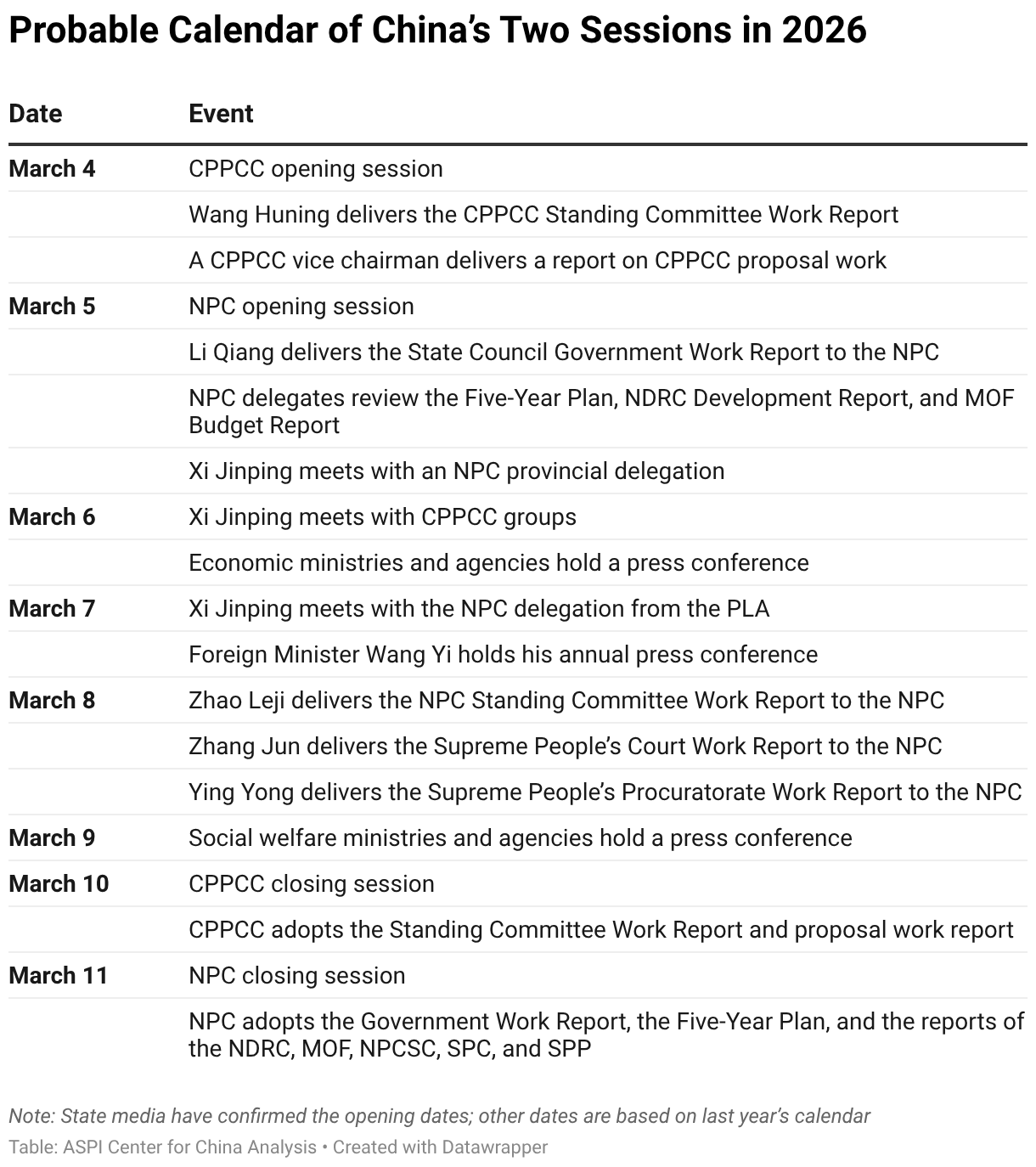
Beijing will not release the agendas for the CPPCC and NPC meetings until the day before they begin. However, based on past practice, the dates in the table below are reasonable estimates. Observers can also monitor the Beijing Municipal Public Security Bureau’s forthcoming annual notice on low-altitude airspace restrictions during the Two Sessions to confirm the likely closing date. Much of the time will be devoted to CPPCC members and NPC delegates deliberating draft reports — though meaningful revisions are rarely made before their final adoption at the conclusion of the meetings.
Probable Calendar of China’s Two Sessions in 2026
The authors thank Bert Hofman, Lizzi C. Lee, Zhuoran Li, Jing Qian, Shengyu Wang, and Yifan Zhang for their thoughtful comments and suggestions.

This is a remarkable piece to provide a framework in the upcoming Two Sessions and 15th FYP. Thanks for your work.