


By Li Shuo
The Stakes: Prospects for Global Decarbonization
As the world’s largest carbon emitter and a clean technology industrial powerhouse, China’s climate ambition in 2026 will critically influence both global emissions and the viability of the Paris Agreement’s targets to limit global warming to well below 2°C. The year 2026 marks an inflection point shaping Beijing’s choices. On one hand, China’s emissions plateauing several years ahead of its 2030 target, coupled with unprecedented clean energy development, creates fertile ground for China’s greater climate ambition. On the other hand, persistent economic headwinds and an altered geopolitical landscape could restrain China at the very moment it is preparing its 15th Five-Year Plan.
Against the backdrop of a rapid U.S. retreat under the Donald Trump administration — marked by withdrawing from the Paris Agreement, dismantling clean energy incentives, undermining the legal foundation for regulating carbon emissions, and defunding key federal agencies — the central question is whether China will assume greater climate leadership or maintain a more cautious stance shaped by domestic and international constraints.
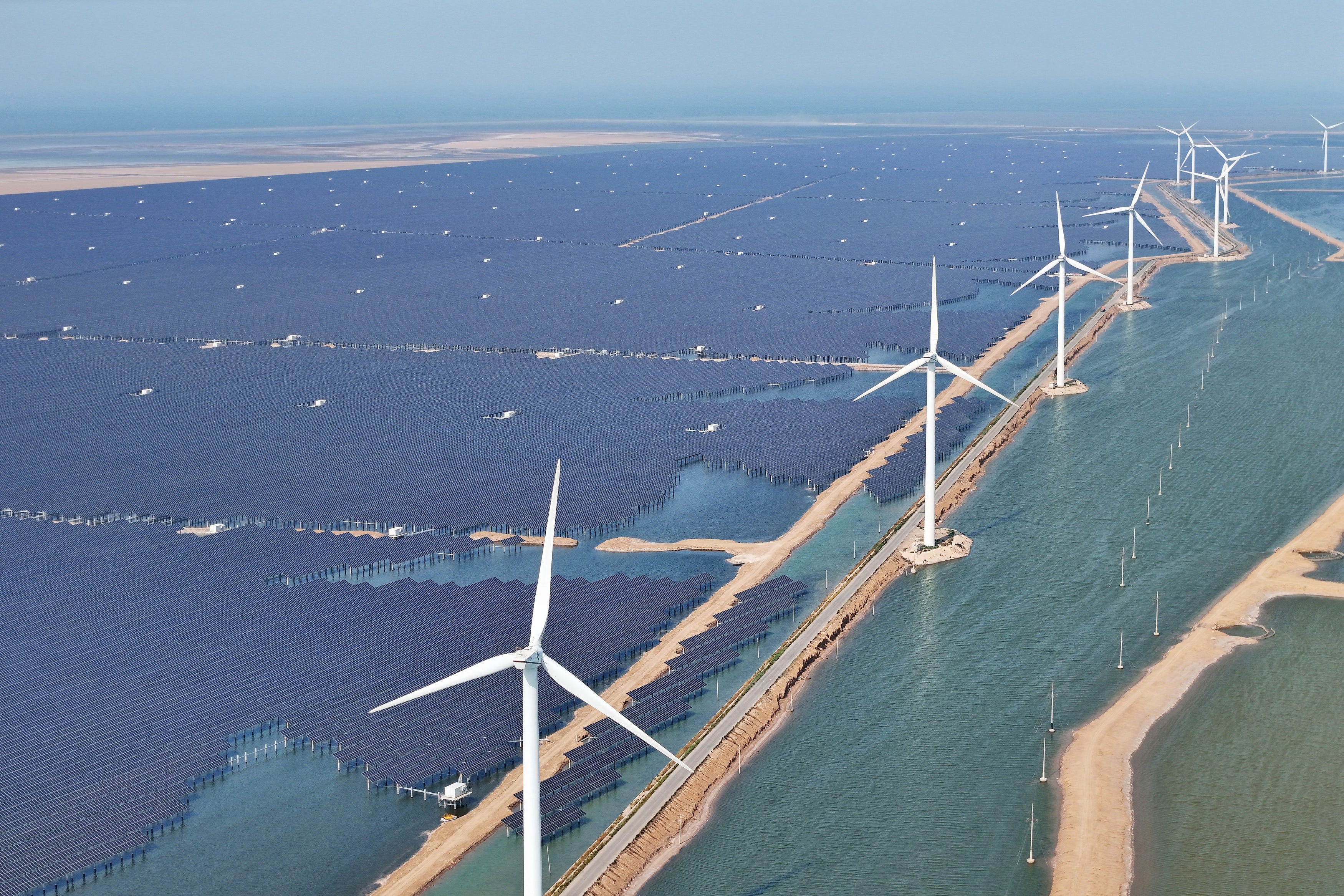
China’s climate calculus has always been inherently complex, shaped by a mix of competing interests, historical narratives, and geopolitical considerations. China has rapidly emerged as a global leader in renewable-energy technology and deployment: The country now produces more than 80% of the world’s solar panels, 75% of electric vehicle batteries, and 60% of wind turbines, installing more solar capacity than the rest of the world combined. Environmental protection and climate action are now clear political priorities for Beijing, tied to broader goals of ecological civilization and sustainable development.
Yet even as China’s industrial capacity surges, its climate diplomacy remains cautious, hesitant to lead from the forefront at global climate forums. Constrained by economic headwinds and geopolitical tensions, the country continues to rely heavily on coal, expanding its fleet of coal-fired power plants and putting its carbon-intensity pledges in jeopardy. How Beijing balances these competing pressures in 2026 will shape not only China’s development path but also the prospects for global decarbonization.
Core Dilemma: Balancing Caution with Growing Power
China’s reluctance to assume overt climate leadership reflects a convergence of domestic economic concerns, long-standing diplomatic traditions, and deep skepticism about the reliability of Western partners. Domestically, economic uncertainties continue to fuel anxiety among heavy industries and the regions that depend on them, tempering Beijing’s appetite for aggressive climate policies that could threaten economic and political stability. Internationally, Beijing approaches climate leadership with considerable caution. Shaped by a strong sense of fairness, an emphasis on collective action, and a tradition of reserved climate diplomacy, Chinese officials have long argued that climate change is a problem created primarily by Western historical emissions, and therefore it requires leadership first and foremost from industrialized countries.
This outlook is reinforced by wavering commitments from key Western capitals — most dramatically Washington and, to a lesser extent, Brussels — that undermine Beijing’s willingness to act boldly. China also resents the cyclical nature of Western climate politics, especially the periodic “lectures” it receives when conditions favor climate ambition in the West. By contrast, Beijing argues that its steady, incremental approach, without claiming moral high ground, offers a more credible and sustainable path. The return of Donald Trump and his destructive climate policies, widely seen in Beijing as causing lasting damage to the future U.S. and global climate discourse, has only deepened Chinese elites’ doubts about the long-term viability of the collective climate action if the world’s most powerful country remains unwilling or unable to commit.
This paradox — China’s industrial dominance in clean technology versus its political caution — will be a defining and persistent feature of China’s trajectory. Rapid advances in China’s cleantech production have outstripped political decision-making, leaving Beijing struggling to reconcile its status as a cleantech superpower with its reluctance to assume rhetorical leadership.
Outlook for 2026
In 2026, China is likely to pursue a “talk less, do more” strategy on climate. China will deepen its role as the world’s leading industrial power of clean technologies, but it will be cautious in taking up the diplomatic mantle of climate leadership in the international arena. Rather than engage in symbolic contests for climate leadership, Beijing is expected to double down on industrial and commercial achievements — such as large-scale deployment of renewables, electric vehicles, and energy storage — that translate into steady and gradual emissions reductions and increased economic competitiveness.
Domestically, the Chinese government will maintain steady climate policies embedded in its forth-coming Five-Year Plan, emphasizing incremental progress while avoiding overly ambitious targets that could threaten economic growth or social stability. Supported by rapid renewable-energy deployment, China’s emissions are expected to peak in the mid-2020s — about five years earlier than initially committed. This will spark new debates in 2026 about the pace and ambition of China’s post-peak emissions reductions.
Internationally, Chinese companies will continue their aggressive expansion of clean energy exports, targeting emerging markets in Africa, Southeast Asia, Latin America, and the Middle East — regions with significant infrastructure needs and climate vulnerabilities. This outreach aligns with China’s broader diplomatic ambition, using clean energy projects as tools of soft power and economic integration.
Conditions and Contingencies
Realizing this forecast will depend on a convergence of enabling conditions across domestic policy, technological capacity, and geopolitical dynamics.
Politically, China’s leadership will prioritize economic stability, energy security, and industrial competitiveness over symbolic climate gestures and rapid emissions reduction. The government’s cautious stance reflects its need to manage complex domestic challenges that aggressive climate measures might destabilize.
Economically, China’s clean energy sector must continue innovating and profitably penetrating global markets.
Geopolitically, tensions with the United States and its allies will remain, but be contained enough for China to pursue pragmatic climate action.
Finally, a slowdown in Western climate ambition — manifested through continued and dramatic backslides in Washington, and subtler but still consequential distractions in Brussels — will make China’s incremental but steady approach more credible by comparison.
What to Watch
If the baseline scenario unfolds, 2026 will see Chinese leaders using climate policy tactically to project responsibility and reliability, contrasting their steadiness with perceived Western unpredictability.
The government will embed moderate but achievable climate targets into its 15th Five-Year Plan, steering clear of headline-grabbing pledges. State support for domestic cleantech industries will intensify, with a strong focus on ensuring the long-term health of this strategic and hypercompetitive sector.
Internationally, China will engage constructively in multilateral forums such as the United Nations’ climate COP process, and will foster bilateral cooperation, especially with Europe, while avoiding taking on unfair burdens or being seen as capitulating from these engagements.
Domestically at the commercial level, competitive pressure on Chinese cleantech firms will persist, driving innovation, entrepreneurship, and cost reductions that benefit global decarbonization. However, the sector’s cutthroat competition will see inevitable bankruptcies and consolidation. This will also prompt government efforts to prevent destructive rivalry.
Overall, Beijing’s industrial interventions will remain pragmatic but dynamic: deepening corporate strengths, nurturing innovation, and expanding the global presence of “China, Inc.” quietly but effectively.
Alternative Scenarios
Baseline (most likely): China continues a pragmatic “results over rhetoric” strategy. Industrial leadership deepens, emissions peak in the mid-2020s, and global cleantech exports accelerate — but Beijing avoids symbolic contests over climate leadership.
Alternative 1: In a bold move, China sees the strategic value of climate action in contrasting itself with the United States, and decides to build on President Xi Jinping’s surprising 2020 carbon neutrality announcement by making further high-profile commitments — potentially in the direction of confirming the early emissions peak, doubling down on renewable energy support to climate-vulnerable countries, or specifying strong sectorial emissions targets. By doing so, Beijing will want to align with other high-ambition countries to reshape global climate governance in the context of prolonged U.S. absence, accelerating a shift in global climate power.
Alternative 2 (least likely): Persistent, severe domestic economic crises or geopolitical upheaval force China to further delay its coal phasedown and reduce its climate commitments, thereby undermining global efforts and creating a leadership vacuum.
Strategic Implications
China’s climate posture in 2026 will have wide-reaching implications for global decarbonization. The most likely scenario will see China remain a cautious political actor on the world stage. Yet beneath its measured diplomatic approach lies a steadily growing economic power — one that even China’s traditionally slow-moving leadership increasingly recognizes. While this dynamic is unlikely to catalyze bold climate diplomacy in 2026 or meaningfully reshape U.S.-China relations given Washington’s disinterest, its effects will accumulate over time, propelled by the firm economic foundations that Chinese policymakers have carefully built over the past two decades.
Crucially, China’s pathway to climate leadership will not mirror Western models. Instead, it will blend commercial pragmatism with reserved diplomacy, reflecting its own political system, strategic priorities, and economic strengths. This divergence presents international counterparts with two interrelated challenges: how to engage productively with China’s model of climate leadership, and how to adapt their own strategies in a more multipolar climate landscape.
Policy Shaping and Conclusion
Addressing these challenges requires first recognizing that alternative leadership models exist — and that, in some respects, China’s steady, pragmatic approach may prove more effective over the long run than Western approaches. A key question is which model offers a stronger foundation for sustained global climate action: the predictable, if slow, “baseload” support provided by China, or the more volatile, boom-and-bust, and increasingly rhetorical political cycles that characterize U.S. climate engagement.
The second challenge is to tailor an engagement strategy that works with China’s unique mix of strengths and constraints. Entry points do exist, even in today’s difficult geopolitical environment — for example, facilitating multilateral trade and investment frameworks that establish transparent and fair rules for expanding Chinese clean-energy technologies into the Global South. This could deliver dual benefits, spurring economic growth in developing countries while accelerating global emissions reductions. Likewise, dialogue platforms between China and Western countries centered on technology transfer and investment cooperation may prove far more productive than politicized, high-profile summits.
At the same time, Western policymakers must confront an urgent and uncomfortable “China question” — the matter of whether, when, and how they might need to work with and even rely on China when it comes to deploying low-carbon technologies critical for reducing emissions. The stakes are high. With China’s dominance in the cleantech sector, recent reversals of industrial support in the United States, and rising protectionism in other key economies, the absence of a well-articulated and intellectually coherent answer to this question — or, alternatively, an answer that consists merely of a simplistic and politically charged “no,” without convincing alternatives — could become one of the biggest obstacles to cutting emissions in the West.
In the end, China’s climate trajectory in 2026 will likely be defined by a careful balance between industrial leadership and political caution. Recognizing this duality is essential for crafting realistic diplomatic and policy strategies that aim for constructive engagement. The coming year will be a test of whether China can reconcile its internal contradictions and emerge as a stronger driver of climate action in a world urgently searching for stable, credible leadership.