


Dear readers,
Welcome to the first issue of PLA Watch in 2026! Thank you to everyone who shared feedback through our readers survey.
To meet the insatiable appetite for PLA updates, we’re excited to shift the PLA News section to a bi-weekly schedule starting now.
As always, we’ll continue to cover PLA strategy and modernization, and we’ll share the latest PLA Observer list at the end of the month. Keep an eye out for Special Issues landing in your inbox as well. Lyle will also be sharing his takeaways from the PLA’s “Justice Mission – 2025” exercises around Taiwan very soon. Stay tuned!
Cheers,
Jie
China Announces Senior Military Promotions Amid Ongoing High-Level Personnel Adjustments
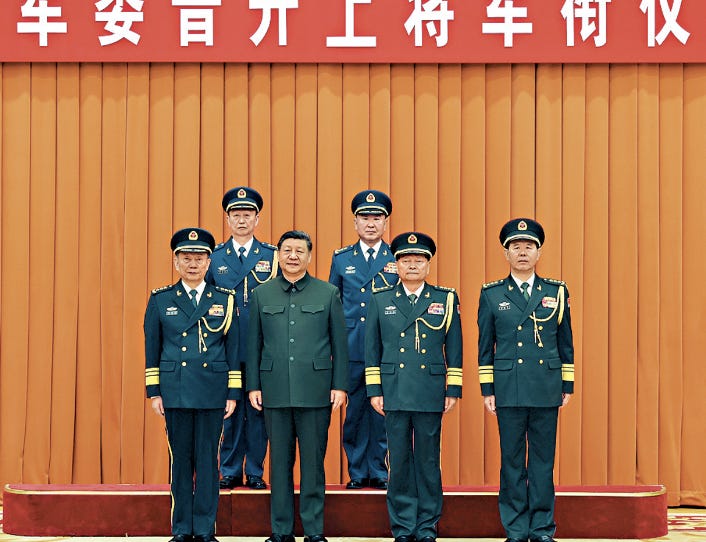
On December 22, 2025, China’s Central Military Commission (CMC) held a promotion ceremony for the rank of general (上将) in Beijing. Eastern Theater Command commander Yang Zhibin (杨志斌) and Central Theater Command commander Han Shengyan (韩胜延) were promoted. Both officers are PLA Air Force-origin and were born in 1963.
Before his current assignment, Yang transferred in March 2023 from deputy commander of the Southern Theater Command to deputy commander of the Western Theater Command. Han, then a lieutenant general, was moved in late 2018 from deputy commander of the Western Theater Command to commander of the Central Theater Command Air Force.
The ceremony’s optics were notable: only four generals, Zhang Youxia (张又侠), Zhang Shengmin (张升民), Liu Zhenli (刘振立), and Dong Jun (董军) ,were present, a sharp contrast with the December 23, 2024, promotion ceremony, which reportedly had around 20 generals in attendance. The promotion cadence also appears compressed. Since late 2019, the CMC General Office has pushed to rationalize rank-to-billet correspondence, and China has generally held at least two full general promotion ceremonies annually. While the frequency rose to four ceremonies in 2023 and three in 2024, 2025 had only this single event.
Days after the promotion ceremony, the Standing Committee of the National People’s Congress (NPCSC) announced the termination of the deputy credentials of several military-affiliated representatives to the 14th National People’s Congress (NPC). Those removed included former CMC Vice Chairman He Weidong (何卫东); He Hongjun (何宏军), formerly the Executive Deputy Director of the CMC Political Work Department and expelled from the PLA in October 2025 alongside He Weidong; lieutenant general Wang Peng (王鹏), previously the director of the CMC Training and Administration Department; Wang Renhua (王仁华), previously in charge of the CMC Political and Legal Affairs Commission; and Zhang Hongbing (张红兵), the political commissar of the People’s Armed Police (PAP). The NPCSC notice did not provide investigative details, but it formalized outcomes that had been widely speculated amid these officials’ noticeable absences from major public events in recent months.
CCA Analysis: Yang and Han’s promotion is a rapid backfilling in sensitive theaters amid continued turbulence. The Eastern Theater Command has cycled through four commanders since 2016; two of the first three, He Weidong and Lin Xiangyang (林向阳), have reportedly fallen, with Lin officially expelled from the CCP and PLA in October 2025, and transferred to military prosecutors. The Central Theater Command has seen even higher churn: seven commanders in roughly a decade. The previous commander, Wang Qiang (王强), appointed in summer 2024, was widely viewed as purged in 2025 after missing major public appearances.
Both promotions were signaled in advance. Han served as commander of the PLA military parade on September 3, 2025, an assignment normally held by the Central Theater Command commander, given Beijing’s jurisdiction. Wang Qiang’s absence from the late-July PLA anniversary reception in Beijing followed by his non-appearance in the parade reinforced succession speculation. Yang likewise gained visibility ahead of his promotion: At the December 13, 2025, annual Nanjing Massacre memorial ceremony, which the Eastern Theater Command’s top commanders typically attend, state media showed Yang and his current political commissar standing prominently in the front row. With the latest promotion, Yan and Han have now positioned themselves as top candidates for CMC promotions in the years ahead.
Meanwhile, despite the sharply reduced attendance of generals at the December 22 promotion ceremony, the PLA is keen to signal that this episode of elite turbulence remains insulated from combat readiness. Only a week after Yang Zhibin’s promotion, the Eastern Theater Command announced the large-scale “Justice Mission-2025 (正义使命-2025)” exercises around Taiwan. This could suggest that, despite leadership turnover, the theater-level command chain remains intact and operational tempo has not been disrupted. Alternatively, it may indicate that such major exercises are centrally scripted in advance, leaving limited room for individual commanders to shape execution beyond adhering to pre-set directives. Finally, another theory suggests that such exercises are orchestrated to counter a public perception that PLA readiness has eroded.
China-Pakistan Co-Produced JF-17 Fighter Emerges as Centerpiece of Pakistan’s Expanding Arms Export Push
Recent reporting suggests new appeal for the JF-17 “Thunder” fighter from Muslim countries looking to upgrade their fleets. The aircraft is a Pakistan–China co-developed platform and may prove to be a success story of one of China’s first co-produced fighter aircraft on the international arms market.
Islamabad is reportedly engaged in discussions with the Libyan National Army and with Sudan over broader weapons packages that may include JF-17 fighters, though details and timelines remain unclear. Saudi Arabia is also reported to be in exploratory talks over a potential arms-for-debt arrangement valued at roughly US$2–4 billion, in which the JF-17 has been described as a primary option rather than a confirmed purchase. At the same time, Indonesia is reported to be in more advanced discussions over a large defense package that could involve more than 40 JF-17s, alongside drones, air-defense systems, and training support. Separate reports suggest that Bangladesh and Iraq are in preliminary discussions for the fighters. Beyond new prospective customers, Azerbaijan has expanded an existing order, while the JF-17 is already in operation in Pakistan, Myanmar, and Nigeria.
CCA Analysis: Expanding markets for the JF-17 serve several Chinese objectives. While Pakistan manages production and marketing, key components of the aircraft such as radars, engines, and datalinks are manufactured by China. Adoption of the platform integrates Chinese components and standards into foreign air forces, signaling a degree of trust in Chinese military technology. This could potentially open the door for future purchases of other Chinese-made platforms.
Skeptics say some buyers may ultimately favor Western aircraft for performance and interoperability. Yet the aircraft fills a mid-range niche that Western suppliers often neglect, complementing, rather than directly displacing, top-tier systems. Over time, a larger customer base could generate revenues and production volumes that support economies of scale across China’s defense industry.
For prospective buyers, the aircraft offers a cost-effective, combat-tested option that sits between aging legacy jets and expensive Western high-end platforms. JF-17’s combat deployment during the May 2025 India–Pakistan air clashes has featured prominently in Pakistani public messaging, even as specific battlefield claims remain contested. Interest from multiple countries reflects broader efforts to diversify defense suppliers away from Western nations.
China Led Joint Naval Exercises with BRICS Countries
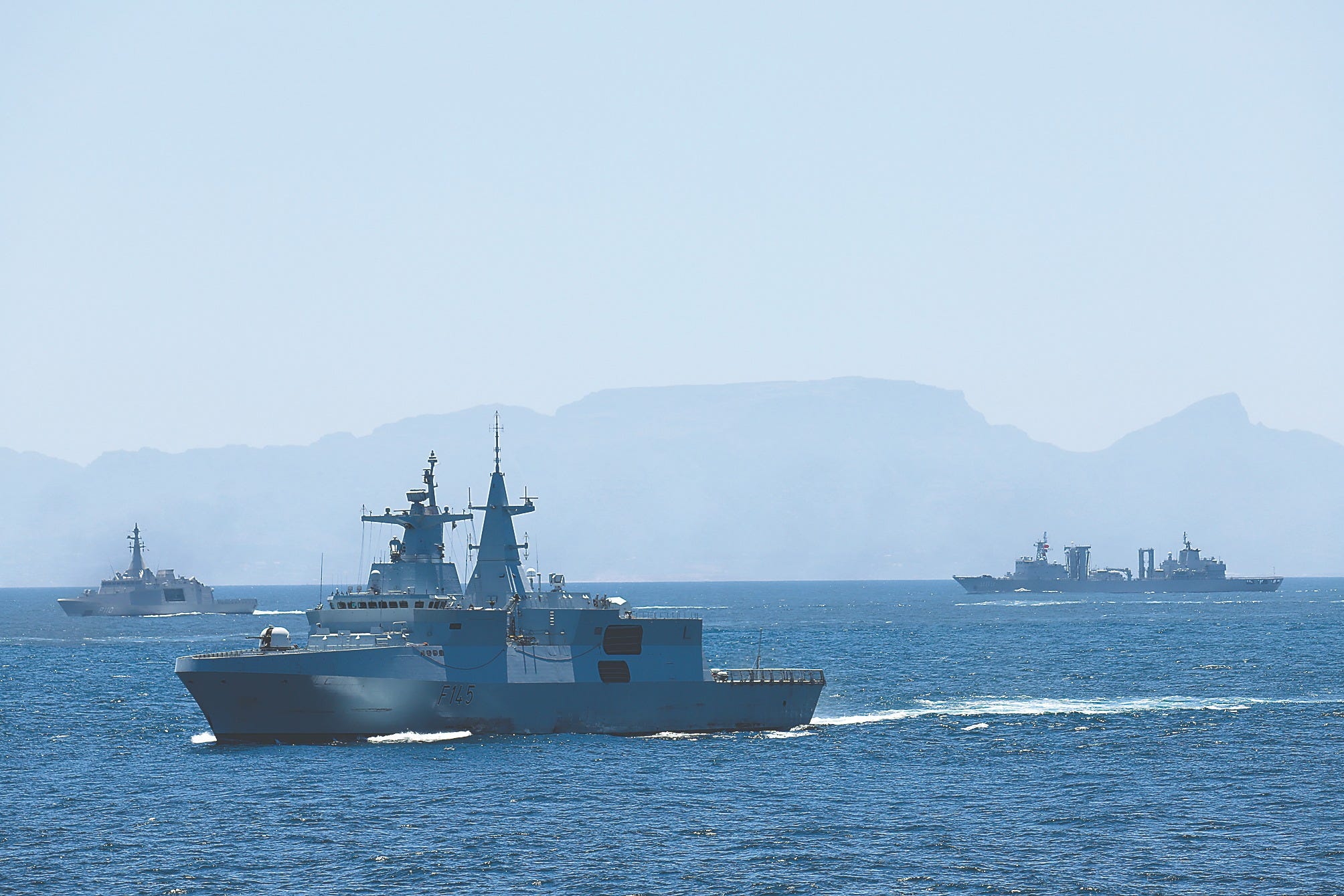
On January 10, the opening ceremony for the “Peace Will-2026” joint maritime exercise was held at Simon’s Town port in Cape Town. PLA reporting described China as the host and listed China, Russia, and South Africa as participating BRICS members. Additional reporting suggested that Iran, Indonesia, Ethiopia, and the UAE may also have participated. The exercise took place from January 9–16.
The theme of the exercise was “joint actions to safeguard the security of important shipping lanes and economic activities.” China deployed the PLAN 48th Gulf of Aden escort task force’s Type 052DL destroyer Tangshan and replenishment ship Taihu, an embarked helicopter, and dozens of special operations personnel. The exercises featured communications drills, formation maneuvers, anti-surface strikes, and a hostage ship rescue scenario.
The drills build on earlier China–Russia–South Africa exercises in November 2019 and February 2023 (previously known as Exercise Mosi), which also centered on protecting shipping and maritime economic activity. The latest iteration was reportedly postponed from November 2025 to avoid overlapping with the G20 summit in Johannesburg.
CCA Analysis: Chinese commentary frames these drills as serving three overlapping purposes. First, to build confidence with partner navies along busy sea lines of communication where piracy and other maritime security risks persist. Second, expanding PLA familiarity with distant sea operations and honing practical experience in port calls, maintenance, crew rotation, and resupply for future PLAN escort missions. And third, mutual learning with other navies by comparing command processes, threat assessments, communications procedures, and approaches to international law at sea—while exchanging practices in counter-piracy, counterterrorism, maritime rescue, and limited strike scenarios.
Participation and conducting drills with partners such as Russia and Iran, who face international opprobrium and sanctions, serves China’s broader goals of aligning with states in the crosshairs of Western criticism and scrutiny.
Hypersonic Anti-Ship Missile Finalization Test from Type 055 Destroyer
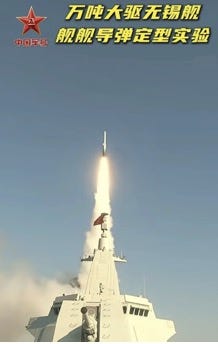
Official military media recently released footage showing a PLA Navy Type 055 destroyer, Wuxi (无锡), conducting a ship-to-ship missile “finalization test.” The video shows a missile launching from the ship’s vertical launch system (VLS) using a cold-launch method, in which the missile is ejected from the cell before its motor ignites and then climbs away. Official messaging stated the missile successfully hit and destroyed its target but did not disclose the specific time or location of the test.
The footage is also the first official public release to identify the missile as the YJ-20 hypersonic anti-ship missile and shows it being fired live from a surface combatant. Related reporting noted that the missile’s terminal phase appeared to feature a near-vertical impact angle and high-speed penetration characteristics. The footage marks the first time official channels have released “finalization test” imagery for the system following its earlier public appearance.
CCA Analysis: Publicly framing the event as a “finalization test” suggests the YJ-20 has cleared key design-validation milestones and is close to operational fielding. More importantly, the footage confirms integration with the Type 055’s common shipboard VLS architecture, enabling the PLA Navy to employ an anti-ship strike option from frontline surface combatants.
In terms of weapon characteristics, official and semi-official narratives emphasize three core features: hypersonic flight, terminal maneuverability, and high-angle terminal attack – resembling aspects of a ballistic missile trajectory. The design both extends range and stresses air-defense and missile-defense systems of larger surface ships. Compared with defenses oriented around sea-skimming, horizontal approaches, a steep terminal profile can compress reaction time and stress traditional adversary naval defense architectures.
Operationally, this implies the YJ-20’s potential target set extends beyond general surface combatants to include high-value platforms such as aircraft carriers and amphibious assault ships. Coupled with the Type 055’s far-seas operating capacity, sensors, and command-and-control systems, this pairing expands the PLAN’s options for holding at risk carrier strike groups at greater distances.
Photos Suggest Modular Military Systems Tested on Civilian Container Ship
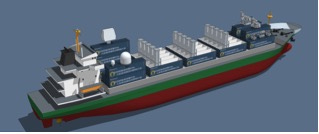
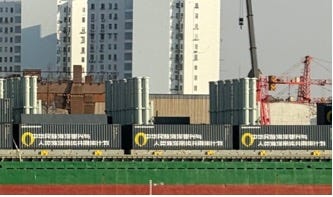
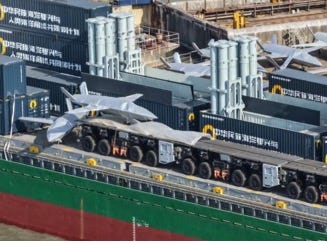
Multiple sets of photos circulating online appear to show the container ship Zhong Da 79 (中达79) berthed in Shanghai with containerized military systems on its deck.[1] Most noteworthy was the deployment on the ship of a modular, road-mobile, electromagnetic aircraft launch system (EMALS) catapult capable of launching advanced fixed-wing combat drones. The same cargo vessel was seen days before configured as an improvised surface combatant, with roughly 60 vertical launch system (VLS) containerized cells, radars, and close-in defenses.
The images indicate the ship carried different modular configurations at different times rather than a single fixed fit. Some containers are marked “containerized weapon module development suite (货柜化武器模组研发套件),” while others display slogans referencing “maritime rejuvenation (海洋强国復兴)” and a “maritime community with a shared future for mankind (海洋人类命运共同体规划).”
Open-source geolocation has placed them at Hudong-Zhonghua Shipbuilding in Shanghai, where the Type 076 amphibious assault ship Sichuan is being built. In at least one configuration, Zhong Da 79 appears near the Type 076 within the same yard. Later images tied to the same ship show a new deck configuration featuring a modular system assembled from multiple low-bed trucks, consistent with a rapidly deployable, reconfigurable setup. All this suggests that Zhong Da 79 may be serving as an experimental test platform for integrating modular military systems on a civilian hull.
CCA Analysis: Equipping civilian merchant cargo ships with containerized VLS cells and UAVs is not a new concept in naval warfare. But the fact that China openly displayed the layout for open-source analysis suggests a level of comfort in this technology.
These photos raise more questions than answers. Whether or not a catapult system composed of multiple segmented components would be stable enough for use on a cargo ship with less stability on the high seas than a traditional warship is unclear. It’s also unclear if this was purely a public reveal campaign by the PLA and civilian shipping industry, with no near-term practical use.
Nonetheless, this development fits a broader PRC trajectory of exploring how civilian shipping can be incorporated for wartime use. Recent PLA exercises and reporting have repeatedly surfaced signals of civilian-vessel participation with different conversion concepts tailored to specific missions. Tom Shugart, a defense analyst, has been at the forefront of highlighting China’s strategy of integrating its massive civilian fleet (ferries, cargo ships) for military purposes, especially for a potential Taiwan contingency, by retrofitting them to carry troops and equipment In that context, Zhong Da 79’s modular configurations can be interpreted as introducing reconfigurable, scalable military platforms on civilian cargo ships in new and innovative ways.
The effort points to an attempt to package “scalable VLS firepower” and “distributed fixed-wing UAV launch capacity” into standardized modules that can be fielded at relatively low-cost. The value of the former is its ability to generate mass quickly and impose stress on an adversary’s air-defense and anti-access systems early in a conflict. The latter would externalize fixed-wing UAV launch capabilities from high-value military decks into a dispersible, modular options using civilian decks.
From a U.S. perspective, China’s use of civilian assets for military purposes complicates considerations of use of force equations, especially for rules-of-engagement against quasi-civilian assets.
Written by:
Lyle Morris, Senior Fellow, Center for China Analysis
Jie Gao, Research Associate, Center for China Analysis
Sheng-Wen Cheng, Intern, Center for China Analysis
[1] These include https://www.scmp.com/news/china/military/article/3337842/china-quietly-preparing-cargo-ships-transform-military-vessels-case-war#selection-899.89-906.0; https://www.scmp.com/news/china/military/article/3338331/chinas-truck-mounted-catapult-system-enabling-merchant-aircraft-carriers; https://militarnyi.com/en/news/china-converted-a-container-ship-into-an-arsenal-ship-with-a-salvo-of-60-missiles/; https://news.usni.org/2026/01/07/chinese-merchant-ship-sports-electromagnetic-drone-launcher-vertical-launching-systems.