


In this issue of PLA Watch, we explore personnel changes within China’s defense industry and military research organizations, in particular in the Chinese Academy of Engineering. We also analyze the debut of two newly-commissioned PLA Navy destroyers, the Type 055, which were recently assigned to the Eastern Theater Command (ETC) Navy and implications for the PLAN.
Next, we examine the recently-concluded China-Vietnam Border Defense Friendship Exchange, including the 40th joint patrol in the Beibu Gulf. Finally, we highlight an uptick in PLA commentary on U.S. wartime use of artificial intelligence (AI) and how the PLA is framing AI in the military.
Written by:
Lyle Morris, Senior Fellow
Jie Gao, Research Associate
Sheng-wen Cheng, Intern
More Defense Industry Purges Tied to the PLA
In mid-March, China’s defense-industrial and military research organizations saw a series of high-profile personnel changes. Three academicians with defense backgrounds—Wu Manqing (吴曼青), Zhao Xiangeng (赵宪庚), and Wei Yiyin (魏毅寅)—were removed from the official roster of the Chinese Academy of Engineering (中国工程院), with their names and profiles no longer publicly listed. The academicians—an elite honorific awarded to elected fellows of China’s top scientific institutions—were associated with radar and electronic information systems, nuclear engineering, and missile guidance and aerospace technology, respectively.
Two days after the event, the profile of Yang Wei (杨伟), the chief designer of the J-20 fighter, also disappeared from the Chinese Academy of Sciences website, and he had reportedly not appeared in public for over a year. Yang previously led development work on both the J-10 and J-20 and held a senior executive role at Aviation Industry Corporation of China (AVIC, 中国航空工业集团有限公司).
At the same time, the corruption case against Tan Ruisong (谭瑞松), former AVIC Chairman, concluded on March 25. Tan was sentenced to death with a two-year reprieve, along with full confiscation of personal assets. Charges against Tan include bribery, embezzlement, insider trading involving more than US$89 million, and the disclosure of confidential information over a long period. Official statements reported that he used restructuring, project contracting, and personnel or resource arrangements in the defense sector for private gain.
CCA Analysis: The current wave of scrutiny reflects a continued expansion of investigations into Chinese academics involved in the research and engineering of PLA weapons systems. Earlier rounds have already swept through the Rocket Force and major defense-industrial firms, with multiple senior figures removed and at least nine academicians stripped of their titles in recent years.
The Tan Ruisong case further illustrates the deep integration of China’s defense sector with capital markets and resource allocation. These enterprises could become financial hubs for senior officials, who can leverage their political authority to engage in rent-seeking during R&D, procurement, and export. However, extending state discipline to elite scientists and chief designers introduces a risky trade-off between political control and technical autonomy. This tension embodies economist Barry Naughton’s “impossible trinity,” which suggests the state cannot simultaneously achieve firm autonomy, strict oversight, and policy-driven goals. Therefore, the future of PLA modernization depends on the nature of this scrutiny. More targeted interventions may improve institutional coordination without stalling progress. Conversely, broad or sustained crackdowns risk destabilizing the concentrated expertise and long-term leadership required for defense innovation, weakening the very program execution and system integration China seeks to perfect.
Type 055 Destroyers Debut in the Eastern Theater Command
Recently, two newly commissioned PLA Navy Type 055 destroyers assigned to the Eastern Theater Command (ETC) Navy—the Dongguan (东莞) and Anqing (安庆)—began their first public round of post-commissioning training in the East China Sea.
Their disclosed training included air defense, anti-surface strike, anti-submarine warfare, and multi-domain coordination. Reporting also emphasized operations under complex electromagnetic conditions, including target detection, data-link sharing, and fire control coordination. Anti-submarine drills involved towed sonar, unmanned shipborne helicopters, and sonobuoys to hone undersea warfare capabilities. Later releases showed live-fire activity involving countermeasure deployment and formation maneuvering, though the locations of the drills, the munitions used, and detailed performance results were not disclosed.
Beyond the operational details, official coverage framed the exercises within a broader political narrative. References to deterring “Taiwan independence” and safeguarding maritime security were presented alongside the training, linking capability development to cross-strait signaling.
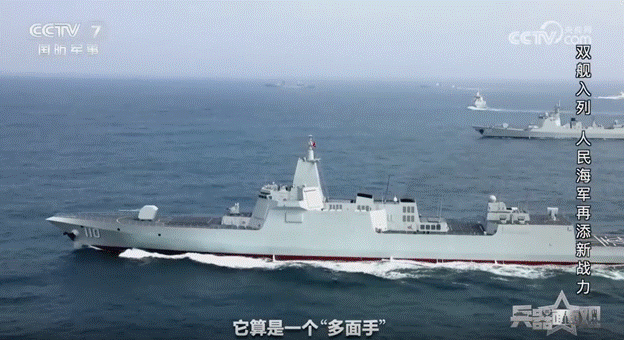
Since 2020, including the two newly commissioned vessels, a total of 10 Type 055 destroyers have entered service. As a key surface combatant in the PLA Navy, the platform continues to undergo incremental upgrades and weapons testing. A recent example was the finalization test of a hypersonic anti-ship missile, which we covered earlier this January.
CCA Analysis: The speed with which Dongguan and Anqing have been integrated into the theater commands is noteworthy. Their assignment to the Eastern Theater Command is particularly notable given its focus on the Taiwan Strait and East China Sea contingencies. Deploying advanced surface combatants to the ETC strengthens air defense, anti-submarine warfare, and command capabilities in scenarios most directly tied to cross-strait operations.
Official coverage also emphasized the Type 055’s role as a high-end operational node capable of operating in contested electromagnetic environments, sharing targeting data across platforms, and integrating unmanned systems into anti-submarine operations. Together, these elements point to a “system-of-systems” combat approach featured prominently in PLA discussions of modern warfare.
Meanwhile, the political framing is equally notable. By pairing the ships’ commission and training with messaging directed at Taipei, official narratives connect naval modernization more directly to Taiwan-related deterrence, reinforcing that capability development is not only a signal of military modernization but of sustained day-to-day cross-strait deterrence.
China–Vietnam Joint Patrol and South China Sea Contrast
From March 16 to 20, China and Vietnam conducted their 10th Border Defense Friendship Exchange, including the 40th joint patrol in the Beibu Gulf (北部湾). The naval component took place on March 19 and 20, with both sides sending two vessels to patrol along the China–Vietnam maritime boundary.
The exercise included alternating command responsibilities and the sharing of maritime domain awareness (MDA) during the patrol. Training focused on joint escort missions, anti-piracy, search and rescue, formation maneuvering, and command and control coordination. Public reporting also highlighted live-fire drills with light weapons, marking a modest expansion in the scope of training from previous years.
The maritime engagement took place in tandem with higher-level political coordination, including the first China–Vietnam “3+3” strategic dialogue covering foreign affairs, defense, and public security. Wang Yi, the Chinese minister of foreign affairs, mentioned that both sides should “enhance cooperation through multilateral platforms and properly manage maritime issues.”
During the same period, friction between China and the Philippines continued in the South China Sea. Chinese authorities reported “warning off” Philippine aircraft near disputed features by the China coast guard (CCG). The Philippines, on the other hand, continued to publicize footage and statements tied to resupply operations and maritime encounters, claiming that the CCG conducted unsafe maneuvers towards Philippe vessels.
CCA Analysis: The Beibu Gulf patrol reflects a continuing pattern of relatively low-profile military cooperation between two countries with disputed maritime territory. By concentrating on escort, anti-piracy, and search and rescue, both sides can sustain military interaction without directly engaging the more politically sensitive parts of their maritime disputes. All of these efforts are enabled by a cooperative institutional framework of joint fisheries patrols in the Beibu Gulf.
This is juxtaposed with China’s interactions with the Philippines in the South China Sea, in which tension and clashes are the norm. These operations are closely intertwined with a public narrative battle over moral authority. The Philippines has continued to use transparency measures to shape external perceptions, while China frames Philippine actions as unilateral provocations that exacerbate the disputes.
China’s approach to Vietnam and the Philippines offers a useful test case for cooperation and coercion: institutionalized cooperation in areas where operating rules are relatively clear, and persistent gray zone pressure in more contested waters. This dual-track approach has become a more recognizable feature of Beijing’s regional behavior.
China Criticizes U.S. Battlefield AI Use While Advancing Its Own Intelligentized Warfare Framework
On March 11, China’s Ministry of National Defense cautioned against the use of artificial intelligence (AI) in battlefield decisions involving lethal force, warning that excessive reliance could weaken accountability and ethics in war. The statement stressed that AI applications should remain under human control and called for greater international coordination on governance frameworks. The remarks were made in response to a question about reported tensions between the Pentagon and U.S. domestic technology companies over expanding military access to AI systems, as well as reports that such tools had been used in operations related to Venezuela and Iran. In contrast, recent PLA commentary continues to frame AI as central to “intelligentized” (智能化) warfare, highlighting its role in multi-domain sensing, data processing, manned-unmanned coordination, and system-level integration across platforms.
CCA Analysis: There has been a marked increase in attention to AI-enabled or “intelligentized” warfare within the PLA. The PLA is highly attuned to how data, algorithms, and computing power can reshape decision-making, compress command timelines, and enhance overall combat effectiveness. U.S. military operations in Iran have likely heightened this awareness. Across multiple articles, AI is framed not merely as a supporting tool, but as a core enabler of military operations, particularly in real-time battlefield situational awareness. In several cases, this is explicitly linked to faster OODA (Observe–Orient–Decide–Act, 观察—判断—决策—行动) loops, with the aim of enabling commanders to process information and act more quickly than an adversary.
At the same time, these discussions consistently emphasize the need to maintain human control over AI-enabled systems. Some writings explicitly warn against the risks of overreliance on automated decision-making, including what has been described as a “Tacitus Trap,” where repeated system errors or lack of transparency could erode trust in AI-assisted decisions and undermine command authority. References to human supervision, responsibility boundaries, and alignment between human intent and machine behavior appear alongside calls for greater autonomy and deeper operational integration.
Beijing’s criticism of U.S. battlefield AI use is ultimately hypocritical, however, as it belies the PLA’s own efforts to advance AI-enabled warfare capabilities, which the PLA will almost certainly employ in future scenarios. The fact of the matter is both the U.S. and China are grappling with how AI should be incorporated into military operations, particularly in defining the boundary between machine autonomy and human judgment in future warfare.