


In this issue of PLA Watch, we cover the dramatic downfall of Wei Fenghe and Li Shangfu, who were sentenced to death with reprieve by a military court on charges of corruption. We also examine the unveiling of a new fifth-generation fighter jet, the “J-35AE,” and its potential appeal on the global arms market. Finally, we delve into the PLA’s recent training of counter-drone capabilities and what it might mean for future battlefield scenarios.
China Sentences Two Former Ministers of Defense to Death with Reprieve
On May 7, Xinhua News reported that a PRC military court sentenced the last two disgraced PRC Ministers of Defense, Wei Fenghe (魏凤和) and Li Shangfu (李尚福), to death with a two-year reprieve for corruption. Below is a rough translation of the article:
“On May 7, 2026, the military court lawfully pronounced judgment on the bribery case of Wei Fenghe, former member of the Central Military Commission, former State Councilor and Minister of National Defense. Wei Fenghe was found guilty of bribery and sentenced to death with a two-year reprieve, deprivation of political rights for life, and confiscation of all personal property. After the two-year reprieve period expires, his sentence will be commuted to life imprisonment in accordance with the law, and he will be imprisoned for life without the possibility of commutation or parole. On May 7, 2026, the military court lawfully pronounced judgment on the bribery case of Li Shangfu, former member of the Central Military Commission, former State Councilor and Minister of National Defense. The court found Li Shangfu guilty of bribery and offering of bribes, and sentenced him to death with a two-year reprieve, deprivation of political rights for life, and confiscation of all personal property. After the two-year reprieve period expires, his sentence will be commuted to life imprisonment in accordance with the law, and he will be imprisoned for life without the possibility of commutation or parole.”
CCA Analysis: The swift sentencing of Wei and Li marks a dramatic downfall for the two former CMC members. China rarely sentences CMC members — let alone former ministers of defense — to death. They are the first known cases of Chinese ministers of defense receiving death sentences with reprieve.
In 2023, Air Force General Liu Yazhou (刘亚洲) was given a suspended death sentence for corruption. Liu was formerly the Political Commissar of the PLA National Defence University and Political Commissar of the Chengdu Military Region Air Force. The last corruption-related scandal of a former CMC member was for former CMC Chief of the General Staff Fang Fenghui (房峰辉), who was purged in 2017 and received a life sentence in 2019. Before Fang, the last PLA general sentenced to death was former lieutenant general Gu Junshan (谷俊山), who received a suspended death sentence in August 2015 for corruption-related crimes. Gu served as the deputy director of the PLA General Logistics Department (GLD) from December 2009 to February 2012.
One also recalls the recent cases of former CMC Vice Chairs Guo Boxiong (郭伯雄), who received life imprisonment in 2016 for corruption, and Xu Caihou (徐才厚), who died of cancer in 2015 before trial proceedings concluded on charges of corruption.
The last major upheaval of this proportion occurred in the wake of the Lin Biao (林彪) purge in the 1970s. General Huang Yongsheng (黄永胜) reportedly received a death sentence with reprieve during the “Lin Biao clique” purge by Mao, later commuted; and Lieutenant General Wu Faxian (吴法宪), also reportedly sentenced to death with reprieve after the Lin Biao affair, later commuted.
For Xi to hand out suspended death sentences, Wei and Li likely engaged in other serious crimes beyond corruption, like leaking secrets or harming national security.
China Discloses Fifth-Generation Fighter Export Variant
During a May 1 Labor Day special program aired on China Central Television (CCTV), footage showed a J-35 stealth fighter with the serial number “0001” and Aviation Industry Corporation of China (AVIC) markings emerging from a hangar. The aircraft appeared without PLA Air Force insignia and was presented in an unpainted light grey finish, suggesting it may be an export variant of the J-35, called “J-35AE.”
Chinese military commentator Fu Qianshao said that the configuration — specifically a single-wheel nose landing gear rather than the reinforced dual-wheel system typically associated with carrier operations — indicates a land-based variant rather than a naval carrier-based model. The serial number “0001,” together with AVIC branding on the fuselage, further suggests a distinct production line separate from PLA operational inventory. In fact, months ago, the AVIC had already displayed a scale model of the J-35A at the 2026 Singapore Airshow, signaling export positioning in advance of the CCTV appearance.
So far, Pakistan has been widely assessed as a likely customer. In earlier days, Pakistani officials publicly stated that China had offered to sell 40 J-35 aircraft alongside KJ-500 airborne early warning platforms and HQ-19 air defense systems. On May 7, 2026, a senior Pakistan Air Force official further confirmed that an initial collaborative mechanism for the J-35AE had been signed, though contract details were not disclosed.
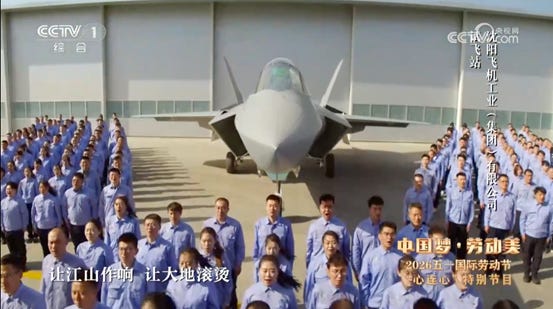
CCA Analysis: The emergence of the J-35AE in public signals that China is moving forward with a fifth-generation fighter export market. If confirmed at scale, this would represent a notable shift in the global stealth fighter landscape, where the United States has cornered the operational export market for fifth-generation fighters (The Russian SU-57 is excluded as there is no verified information or public disclosure of buyers so far).
It should be noted that the picture of the J-35AE was embedded within a broader state enterprise showcase, rather than a formal export announcement. Thus, some ambiguity remains over whether the disclosure was primarily informational, promotional, or deliberate signaling. Even so, the parallel confirmation from Pakistani officials of an initial collaborative agreement, combined with design features consistent with export configuration, indicates an institutionalized pathway toward foreign acquisition, with Pakistan as the most likely recipient.
More broadly, the development reflects how China’s defense export model is increasingly evolving beyond platform delivery toward integrated support arrangements. The reported presence of AVIC technical personnel in Pakistan during the May 2025 India-Pakistan crisis suggests a model in which Chinese systems are accompanied by embedded operational and technical support under real conflict conditions. Arms sales to Pakistan, including the recent delivery of the Hangor-class attack submarine, provide China with opportunities to expand influence and test its operational and support capabilities on the battlefield.
At the same time, it remains uncertain whether such an export program can scale in a manner comparable to the U.S. F-35 ecosystem. The U.S. model is anchored in alliance structures, long-term interoperability frameworks, and security guarantees that China currently does not yet replicate. While China may be entering the stealth fighter export space, its ability to turn this into a durable global network remains unproven.
The PLA Showcases Counter-Drone Air Defense Capabilities
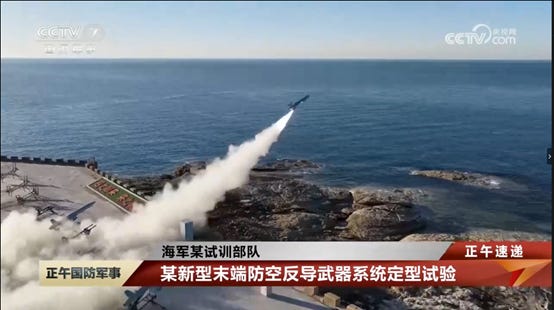
China continues to publicly showcase its counter–unmanned aerial system (C-UAS) capabilities. According to CCTV in early May, the PLA Navy recently completed a “finalization test” (定型试验) of a new terminal air defense and anti-missile weapon system in the Bohai Sea. The test involved multiple drone targets simulating ultra-low-altitude sea-skimming profiles and low-observable penetration tactics under complex electromagnetic conditions. The test was designed to stress the system’s interception performance in realistic threat environments. The term “finalization test” indicates that a late-stage verification process in which a system that has largely completed development is moving toward production and deployment.
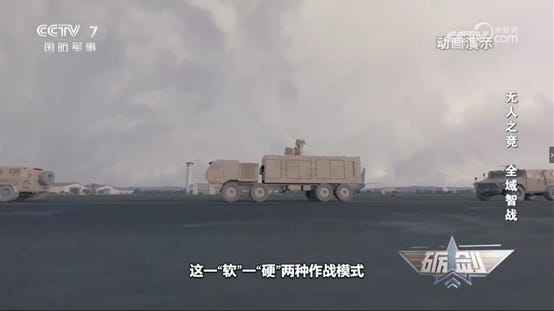
Chinese state media also publicized directed-energy counter-UAS systems. A recent CCTV program presented simulated engagements involving the “Guangjian-11E” (光箭-11E) and “Guangjian-21A” (光箭-21A) laser systems. The Guangjian-11E was shown in a “soft-kill” (软杀伤) role, disrupting drone sensors and communication links through pulsed laser effects, while the Guangjian-21A was demonstrated in a hard-kill (硬杀伤) role, physically damaging airframes and internal electronic components. The demonstrations included engagements against low-altitude targets and fiber-linked drones.
CCA Analysis: The development reflects a broader shift in which counter-UAS capability is increasingly treated as a core requirement of modern force design rather than auxiliary air defense. Operational experience from Ukraine and the Middle East has demonstrated that small, low-cost drones can generate disproportionate battlefield effects through reconnaissance, targeting support, saturation attacks, and one-way strike missions against high-value platforms. This has prompted the PLA to adapt layered air defense systems utilizing counter-UAS, particularly in maritime and littoral environments.
The PLA’s emphasis on ultra-low-altitude sea-skimming (超低空掠海), concealed penetration (隐蔽突防), and complex electromagnetic environments (复杂电磁环境) reflects concern over drone employment concepts designed to exploit radar coverage gaps. These characteristics are particularly relevant in a Taiwan contingency environment, where U.S. and Taiwan defense discussions increasingly emphasize a drone-enabled “hellscape” concept in the Taiwan Strait, intended to increase operational cost and delay PLA maneuver and landing operations.
From a capability development perspective, the PLA systems being demonstrated suggest an emerging layered counter-UAS structure combining soft-kill and hard-kill directed-energy options, typified by the Guangjian platforms. China’s development of high-power microwave (HPM) systems, including the “Hurricane-3000” (飓风-3000) we previously covered, offer another example of the PLA’s interest in counter-swarm applications. Compared to lasers, HPM systems are generally better suited to area effects, with the potential to disrupt multiple drone systems simultaneously through electromagnetic interference.
However, compared to laser-based systems, publicly observable evidence of operational HPM field employment remains limited. This may indicate that while the capability is being developed and tested, it has not yet reached the same level of operational maturity in the PLA. U.S. development programs such as the Tactical High-power Operational Responder (THOR) and its follow-on Mjölnir similarly suggest that HPM systems face persistent constraints in power generation, thermal management, beam control, and system integration under operational conditions.