


By Lyle Morris, Angelo M’Ba and Leon Ho
This edition of PLA Watch examines three major developments in the People’s Liberation Army (PLA): 1) continued leadership purges and tightening political control; 2) expanding naval operations beyond the First Island Chain; and 3) sustained military diplomacy and overseas deployments. Internally, the Fifth Plenum formalized the removal of 16 senior military officers, while elevating Zhang Shengmin to the Politburo, highlighting Xi Jinping’s prioritization of political loyalty and discipline amid concerns about the impact of leadership disruptions on military readiness. Operationally, the PLA launched one of its largest exercises in the Indo-Pacific. This included the deployment of the Liaoning aircraft carrier around the Philippines and coordinated surface combatant and replenishment vessel movements near Taiwan and the South China Sea. The PLA Navy (PLAN) also concluded its 48th Gulf of Aden task force, covering 150,000 nautical miles and spanning 378 days, representing the longest such deployment in PLAN history. Finally, the PLA engaged with military counterparts from Russia, Europe, and regional partners, and conducted overseas naval and humanitarian missions. Taken together, these developments reveal a PLA navigating significant internal political upheaval while continuing to modernize, expand its operational reach, and strengthen its international military presence.
I. More Purges and Political Control Signaling Coming out of Fifth Plenum
The Fifth Plenary Session of the 20th CCP Central Committee formally ratified the expulsions of 16 senior military officers, including former CMC Vice Chairman Zhang Youxia, former Joint Staff Department chief Liu Zhenli, former CMC General Office directors Zhong Shaojun and Fang Yongxiang, and several senior theater command and service officers. These actions were part of the broader expulsion of 33 Party officials.
The plenum also elevated CMC Vice Chairman Zhang Shengmin to the Politburo. Zhang is now the only serving PLA general on the Politburo.
The CCP delivered a resolution on the Politburo’s work in which the Party called for “comprehensive and rigorous Party governance.” The resolution emphasizes stronger political loyalty, improved personnel selection, tighter discipline, anti-corruption enforcement, and more centralized leadership.
Although these directives apply to the Party as a whole, they are particularly relevant to the PLA following the latest leadership removals.
Finally, on October 29, the PRC Ministry of National Defense announced the restructuring of several military educational institutions, including the establishment and reorganization of colleges specializing in unmanned and intelligent engineering, operational support, and military discipline and legal affairs. The two principal institutions explicitly identified were the PLA Army Engineering University and the PLA National Defense University. Other military universities were also reportedly affected (Table 1).
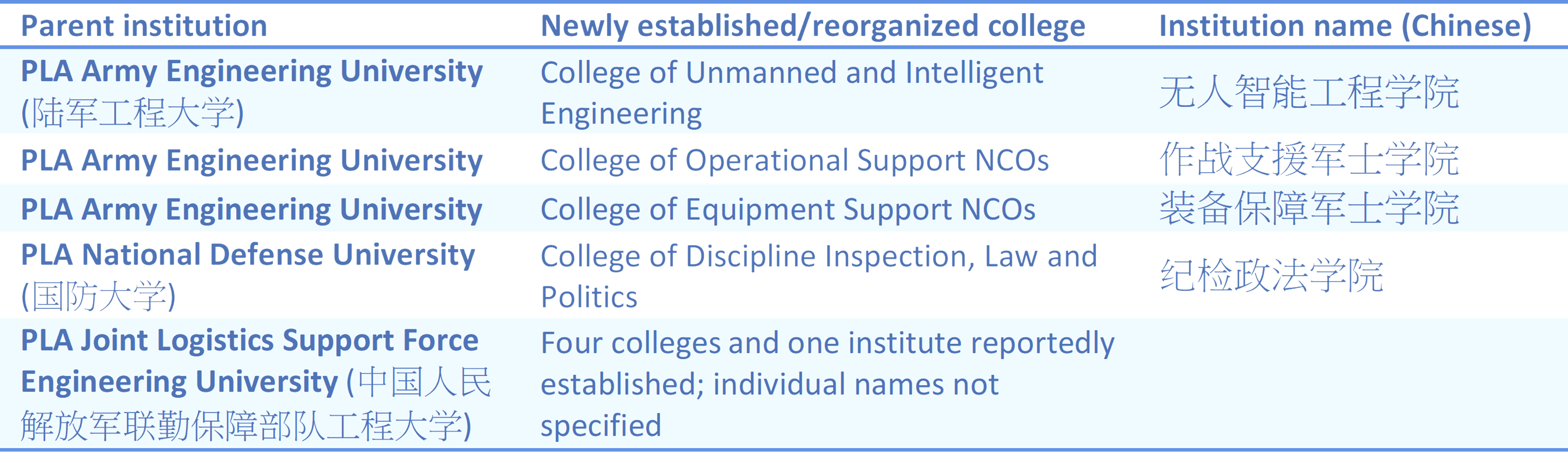
The ministry also confirmed the renaming of noncommissioned officer schools to reflect changes in the PLA’s enlisted personnel system, underscoring a broader change in nomenclature:
Former Noncommissioned Officer Schools (士官学校) will be redesignated NCO Colleges (军士学院).
The corresponding People’s Armed Police institutions will adopt the designation Police Sergeant Colleges (警士学院).
This reflects the PLA’s transition from the term 士官 (shiguan) to 军士 (junshi) for its NCO personnel system. The ministry did not provide an exhaustive list of affected schools.
CCA Analysis: The removals eliminate substantial operational experience from the PLA’s senior leadership just as the PLA approaches the 2027 military modernization milestone. The scale of the purges also raises questions about Xi’s confidence in his senior commanders and the institutional consequences of prolonged political investigations.
Actions at the plenum suggest that Xi continues to prioritize political reliability and organizational discipline alongside military modernization. They also indicate that the anticorruption campaign is unlikely to end with the latest round of dismissals. These educational reforms highlight continued investment in military talent in the operation of unmanned systems and in skills in emerging technologies. They also demonstrate that the PLA’s institutional modernization efforts are proceeding alongside its political rectification campaign.
II. PLA Navy Operations Beyond the First Island Chain: Liaoning’s Extended Deployment and an Emerging Maritime Logistics Model
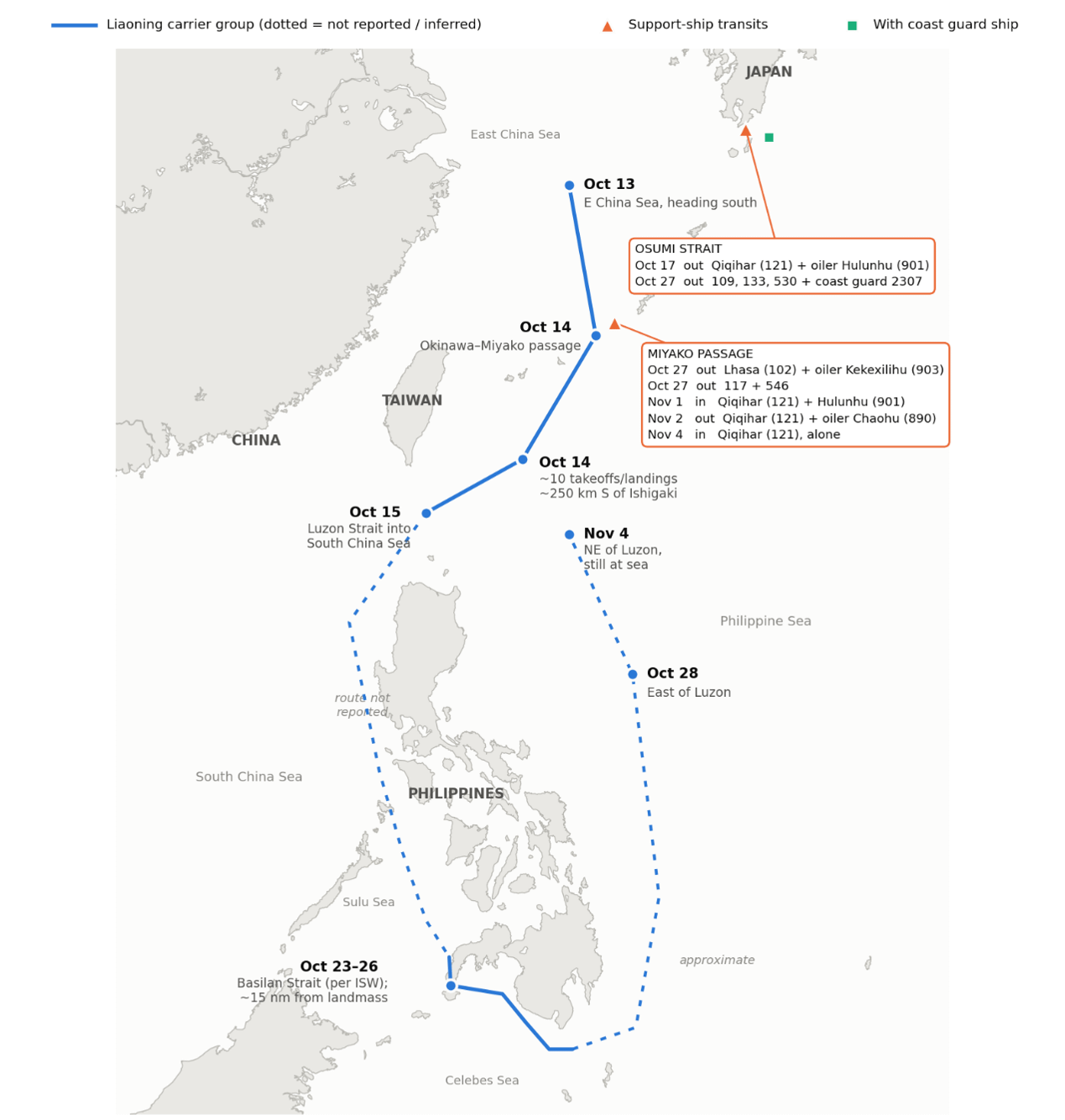
On October 14, the PLAN announced that the Liaoning aircraft carrier strike group had entered the Western Pacific for “routine training,” emphasizing that the deployment was “not directed at any specific country or target.” Japan’s Joint Staff Office reported that it first detected the carrier group on October 13, accompanied by the Type 055 cruisers Anshan (103) and Wuxi (104), and the Type 052D destroyer Huainan (123). The four vessels passed between Okinawa and Miyako Island on October 14, after which Japanese authorities observed approximately ten carrier-based aircraft takeoffs and landings roughly 250 kilometers south of Ishigaki Island. On October 15, the group reportedly entered the South China Sea through the Luzon Strait.
The Philippines’ Western Mindanao Command tracked the carrier group off Zamboanga del Norte. According to an assessment by the Institute for the Study of War (ISW), the group transited the Basilan Strait between October 23 and 26, passing within approximately 15 nautical miles of Philippine territory. A Philippine military spokesperson characterized the transit as a “periodic activity” and maintained that there was “no cause for alarm.”
The group subsequently proceeded eastward through waters south of Mindanao before moving northward into the Philippine Sea. On October 28, Taiwan’s National Security Council placed the carrier group east of the Philippines, and by November 4, Liaoning was reportedly observed northeast of Luzon.
These movements suggest that the carrier group had effectively circumnavigated the Philippine archipelago, although portions of its route remain inferred rather than independently documented.
Image 1: PLA Navy, oil tanker and China Coast Guard Movements, October 13–November 4, 2026
Notably, no replenishment ship was identified accompanying the Liaoning carrier group during its initial deployment.
However, several PLAN replenishment vessels conducted separate transits of the First Island Chain during the same period, accompanied by surface combatants. On October 17, the Type 052D destroyer Qiqihar (121) and fast combat support ship Hulunhu (901) sailed eastward through the Osumi Strait. On October 27, the Type 055 cruiser Lhasa (102) and replenishment ship Kekexilihu (903) transited eastward through the Okinawa–Miyako passage. On November 1, Qiqihar and Hulunhu returned westward through the same passage. The following day, Qiqihar accompanied another replenishment ship, Chaohu (890), eastward into the Pacific before returning alone on November 4.
Although these movements demonstrate sustained logistical activity beyond the First Island Chain, available reporting does not establish whether the replenishment vessels directly supported Liaoning or operated independently of the carrier group.
Separately, on October 27, the Type 055 cruiser Dongguan (109), Type 052D destroyer Baotou (133), and Type 054A frigate Xuzhou (530) transited eastward through the Osumi Strait alongside China Coast Guard (CCG) vessel 2307. The reported transit marked an important development in visible PLAN–CCG coordination beyond the First Island Chain. Japanese authorities reportedly assessed that the two services were strengthening their operational coordination, although the precise command arrangements and mission of the mixed formation remain unclear.
Meanwhile, the overall scale of Chinese maritime activities continued to expand. According to Taiwan’s National Security Council, 53 Chinese naval and other government vessels, including 34 naval warships, were operating across a broad area extending from southern Japan to waters around Taiwan and the Philippines on October 28. By November 3, Taiwanese reporting indicated that the number had exceeded 100 vessels, although differences in geographic coverage and vessel classifications complicate direct comparisons. On November 10, Taiwan’s Minister of National Defense, Wellington Koo, reportedly characterized the activities as “area-denial drills.”
CCA Analysis: The significance of the October–November deployments is the concurrent presence of the Liaoning, multiple PLAN surface combatant groups, replenishment vessels, and a mixed PLAN–CCG formation across the First Island Chain.
According to an assessment by the Institute for the Study of War (ISW), China “may be conducting a major, unannounced military exercise simulating surrounding and isolating Taiwan,” even as a second aircraft carrier, the Fujian, headed eastward from Sanya. ISW further assessed that “the number of vessels involved and the geographic range of their deployment are greater than the PLA’s most recent exercise around Taiwan — Justice Mission 2025.”
For this recent series of exercises, it’s important to not draw parallels with Justice Mission 2025, which was a Taiwan-centered exercise. Its announced drill zones were in the Taiwan Strait and immediately around Taiwan, and its stated objectives included blockading key ports and deterring outside intervention.
These recent activities cover a wider regional deployment spanning waters off Taiwan, the South China Sea, and the Western Pacific. In other words, these activities appear to have focused not only on Taiwan, but on testing broader Indo-Pacific power projection capabilities.
Beijing typically assigns official names to major military exercises directed at Taiwan. In this instance, designating the maneuvers as “routine training” allowed China to maintain a relatively low-profile public posture for an operation that involved a substantial maritime force. Such an approach could shorten the warning time available to other countries before the onset of an actual blockade.
More revealing, however, was how Beijing organized and deployed the participating forces.
For a navy seeking to deny U.S. and allied forces access to waters east of Taiwan, three operational capabilities are essential: moving warships through the strategic passages of the First Island Chain, sustaining naval forces at sea for extended periods, and maintaining replenishment operations through maritime chokepoints that Japan and the Philippines can monitor and potentially target during wartime.
The latest deployment appears to have tested all three capabilities.
By sailing a circuit around the Philippine archipelago, the Liaoning demonstrated an alternative southern route into the Philippine Sea in an apparent bid to reduce China’s reliance on the Ryukyu passages that Japan monitors most closely. As Chinese military analyst Wang Yunfei told the Global Times, the route marks “a new entry channel,” making it “more challenging for the outside world to predict the direction of operations.”
The reason for an additional development may lie in the changing deployment patterns of PLAN replenishment vessels. During the Liaoning’s deployments in December 2025 and May–June 2026, the Hulunhu accompanied the carrier strike group, as PLA Watch #24 noted for the latter deployment.
The latest deployment departed from this pattern. Rather than remaining with the carrier group, replenishment vessels operated on separate schedules, transited the First Island Chain under destroyer escort, and rotated in and out of the Western Pacific. This arrangement marks a shift away from a model in which replenishment ships remain continuously attached to individual carrier groups.
A key question for future observation is whether PLAN carrier operations continue this new pattern of operating independently from replenishment vessels. Such a shift would have substantial implications for the PLAN’s ability to sustain prolonged naval operations beyond the First Island Chain.
III. External developments: Military diplomacy and overseas missions
Despite internal turmoil and political reshuffling, the PLA conducted numerous military-diplomacy overtures and overseas missions.
From October 21 to 28, a PLA delegation visited France and Germany for defense strategy consultations. These are high-level, institutionalized dialogues through which strategy, risk, and confidence-building mechanisms are discussed. Paris, and Berlin agreed to strengthen communication, enhance mutual trust, and deepen defense exchanges.
On November 3, CMC Vice Chairman Zhang Shengmin met with Russian Defense Minister Andrei Belousov in Beijing, marking Zhang’s first reported meeting with a foreign minister since his elevation to the Politburo.
In addition to these developments, the Chinese Ministry of National Defense announced several international military exchange programs at a press conference on October 29. These programs included:
The International Army Cadets Week in Nanjing, with participants from 11 foreign countries, between November 2 and 6;
A visit from nearly 90 foreign defense attachés from more than 50 countries to military and historical sites in Guizhou and Sichuan between November 2 and 7;
Several China–ASEAN junior and mid-career officer exchanges in Hangzhou, Kunshan, Nanjing, and Shanghai between November 2 and 8;
A visit by approximately 50 officers from more than 20 African countries, focusing on defense science and technology, between November 5 and 11.
Parallel to these diplomatic advances, the PLA pursued overseas deployments, including two notable naval developments on October 23.
First, the PLAN’s 48th Gulf of Aden escort task force concluded its 378-day deployment, covering 150,000 nautical miles. Over the course of the operation, the longest and most extensive in PLAN history, it reportedly escorted 423 Chinese and foreign vessels and participated in international exercises.
Second, the PLAN hospital ship Auspicious Ark (Hull 868) arrived in Ghana for its first medical mission to the country, part of the broader Mission Harmony 2026 deployment, the 12th iteration of China’s overseas humanitarian medical service program. The 10,000-ton vessel was greeted by several high-ranking Chinese and Ghanaian officials.
CCA Analysis: The PLA delegation’s visit to France and Germany comes against the backdrop of efforts to reinvigorate bilateral security ties throughout 2026 and Europe’s push to strengthen its defense posture. Despite trade and technology tensions between Brussels and Beijing, the events signal interest in maintaining and further normalizing military dialogue with key European security powers. While neither European capital commented on the visits, these exchanges suggest an interest in diversifying security commitments amid a perceived decline in U.S. reliability.
Still, European nations remain concerned about ongoing Chinese military engagement with Russia. This worry seems justified considering that Zhang’s elevation to the Politburo was immediately followed by a high-level meeting with Belousov.
The October 23 PLAN missions underscore how much progress China has made in far-sea capabilities and how it has used this foundation to further cultivate its diplomatic relations. The PLA is also leveraging diplomacy and professional exchanges to reinforce its image as a benevolent and capable global actor.
Finally, the 48th Gulf of Aden escort task force demonstrates how PLAN has extended far-sea deployments and missions, especially across the Indian Ocean Region and in Africa. This mission marked the third consecutive exercise surpassing 300 continuous days at sea, showcasing a high degree of logistical resilience.