


In this issue of PLA Watch, we examine the PLA’s first-ever military-wide senior officer training program at the National Defense University, where Xi Jinping gave remarks on ideological rectification and new training requirements for the PLA. We also analyze Beijing’s escalating response to Japan’s deployment of long-range Type 25 surface-to-ship missiles, including the dispatch of PLA Navy ships through the Tsushima Strait and a propaganda campaign invoking Japan’s wartime legacy. Finally, we assess the maiden flight of the CY-8 heavy cargo drone, exploring its dual-use potential and potential for cross-strait contingencies.
Written by:
Lyle Morris, Senior Fellow
Jie Gao, Research Associate
Sheng-wen Cheng, Intern
Xi Jinping Launches First-Ever Military-Wide Senior Officer Training Program
On April 8, Xi Jinping attended the opening ceremony of the first-ever military-wide training program for senior PLA officers held at the National Defense University. Xi delivered a speech emphasizing the need for “ideological rectification” (思想整风) and “political consolidation” (政治整训) within the PLA. The only remaining CMC Vice Chairman, Zhang Shengmin (张升民) hosted the ceremony, with top PLA leadership, including Defense Minister Dong Jun (董军) and Central Theater Command Commander Han Shengyan (韩胜延) in attendance.
Eastern Theater Command Commander Yang Zhibin (杨志斌), who was promoted to full general with Han Shengyan in December 2025, was not present. On the same day, an article authored by Yang was published in the Central Party School’s newspaper, referencing the need to draw lessons from the cases of disgraced senior military officials involved in “serious discipline and law violations” (汲取军队落马高级干部严重违纪违法问题深刻教训).
Xi’s remarks centered on three topics. First, officers must ground their political loyalty in the theoretical study of Marxism and Xi Jinping Thought. Second, Xi stressed that the Party represents the fundamental interests of the people and holds “no special interests of its own,” emphasizing that “all acts of self-interest and corruption are fundamentally incompatible with the Party’s nature and purpose.” He also called on senior officers to restore the military’s “revolutionary roots,” and said that CCP regulations apply “equally to all,” with no “special status” (没有特殊) and “no exceptions” (没有例外) in their implementation. Third, Xi invoked the historical observation that the Party and military have grown stronger through sustained struggle against “erroneous ideological and behavioral tendencies” (各种错误思想作风), expressing confidence that the PLA would achieve “unprecedented unity” (空前团结统一) heading into 2027.
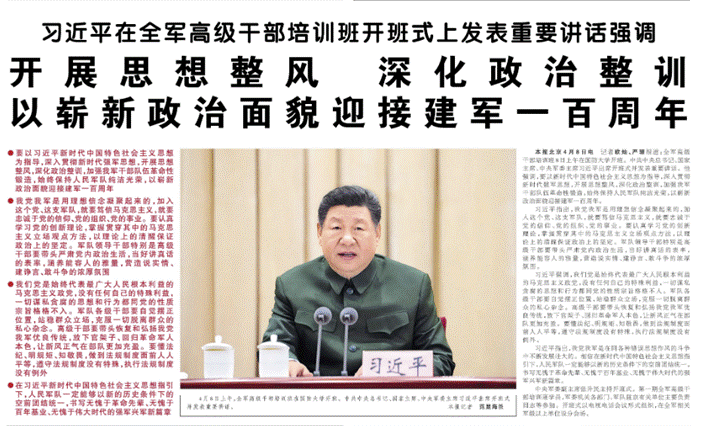
CCA Analysis: This is indeed notable, as it represents the first-of-a-kind military-wide training program overseen by Xi. It marks a significant escalation of Xi’s effort to consolidate CMC authority over the officer corps. The term zhengfeng (ideological rectification, 整风) harkens back to Mao’s Yan’an Rectification Movement during the 1940s, which Xi revitalized during the 2024 CMC Political Work Conference in Yan’an. Xi is positioning the program within a longer tradition of Party self-renewal through top-down political discipline and ideological consolidation.
Xi’s repeated emphasis on “struggle” against “ideological and behavioral tendencies” can be read multiple ways. There are rumors that the recent purges in the PLA are related to Xi’s dissatisfaction with PLA training and modernization. To the extent that those rumors are true, this new training course could be Xi’s way of strengthening oversight and discipline over PLA training. Second, it suggests that Xi is dissatisfied with feedback on training metrics and standards within the PLA. In that sense, it could be read as a signal that the PLA must step up its game or else come under additional scrutiny.
The program is clearly designed to respond to pervasive corruption within the PLA. Xi’s emphasis that regulations apply “equally to all” is an admission that some senior leaders in the PLA enjoyed special treatment. It is a direct response and a warning to the deep-seated patronage networks and rent-seeking culture of the PLA that business as usual is no longer tolerated. By connecting the campaign to the 2027 centenary milestone, Xi has elevated military compliance from a disciplinary matter to a historical obligation. The key question is whether this campaign will strengthen command cohesion and discipline through frank feedback or prompt senior officers to become even more risk-averse to avoid scrutiny.
The PLA Responds to Japanese Deployment of Long-Range Missiles
On March 31, Japan deployed the Type 25 surface-to-ship missile (SSM) at the Ground Self-Defense Force’s Kengun base in Kumamoto, prompting a stern response from China. The currently deployed Block 1 variant has a range of about 900 kilometers, while the Block 2 variant, expected to be completed by 2027, is projected to reach beyond 2,000 kilometers. Japanese Defense Minister Koizumi Shinjiro characterized the deployments as a necessary step to bolster Japan’s deterrent capabilities.
Days after the deployment, the PLA sent a group of PLA Navy (PLAN) ships to the Sea of Japan via the Tsushima Strait. The group included a Type 055 destroyer, two Type 052D destroyers, a Type 815A advanced electronic reconnaissance ship (AGI), and a Type 903A replenishment ship. This PLAN task force was likely a direct response to Japan’s posture enhancements.
This follows a broader trend of China and the PLA calling out “Japanese militarism.” One PLA Daily article accused Japan’s defense industry of accelerating military expansion. It singled out Mitsubishi Heavy Industries and Kawasaki Heavy Industries as having participated in wartime atrocities before “reinventing themselves” as defense contractors operating under “civilian cover.” It added that Japan has allocated 17.5 billion yen in 2025 for civilian-to-military technology conversion — roughly 18 times the 2022 figure, and that it established a U.S. DARPA-style Defense Innovation Science and Technology Institute in 2024 to channel civilian R&D into military applications. The article further warned that Japan’s plutonium stockpile was sufficient to produce approximately 5,500 nuclear warheads, stating that Japan already possesses nearly all the material and technical prerequisites for nuclear weapons production and could become “a de facto nuclear-armed state in an extremely short period” (能在极短时间内成为事实上的拥核国家).
One week later, PRC Foreign Ministry spokesperson Mao Ning (毛宁) condemned Japan’s planned revision of its Three Principles on Transfer of Defense Equipment and Technology as a “serious violation” of the Cairo Declaration, the Potsdam Proclamation, and the Japanese Instrument of Surrender. PRC Defense Ministry spokesperson Zhang Xiaogang (张晓刚) separately characterized Japan’s missile deployments as a “complete betrayal” of its pacifist constitution and warned that China maintained sufficient capability to make aggressors “pay an unbearable price.”
CCA Analysis: This recent incident is part of a broader campaign by China to smear Japan, and stems from the Japanese prime minister Takaichi’s Taiwan-related remarks in late 2025. The deployment of the Type 25 missiles had been planned for many years, and is part of Japan’s regional anti-access and denial deterrent modernization program. Japan sees this program as reducing dependence on U.S. military support and redistributing firepower platforms along the first island chain. From China’s perspective, such systems are an unwarranted escalation of offensive capabilities targeting China.
Furthermore, the PLA Daily’s criticism of Japanese dual-use technology transfer is in tension with China’s own Military-Civil Fusion strategy. For example, China’s 15th Five-Year Plan, revealed last month during the Two Sessions, explicitly calls for a “green channel” that promotes the transfer of civilian technology to military domains (健全前沿科技成果”民参军”绿色通道). It is reasonable to assume that Beijing sees the value of such pathways, after watching the United States leverage its own civil-military fusion programs. By invoking Japan’s WWII atrocities, Beijing’s playbook is to cast Japan’s current military developments as a continuation of the legacy of Japanese “militarism,” depicting Japan, not China, as the source of regional instability.
China’s Heavy Cargo Drone Completes Maiden Flight in China, Raising Questions About Military Applications
On March 31, one of China’s largest cargo drones, the Changying-8 (长鹰-8, CY-8), completed its maiden flight in Zhengzhou, Henan province. The aircraft has a take-off weight of 7 tons, a payload capacity of 3.5 tons, and a range exceeding 3,000 kilometers (approximately 200 to 300 meters for take-off and landing). Developed by a subsidiary of China North Industries Group Corporation Limited, it is capable of short take-off and landing operations on austere runways in high-altitude and island environments. Designed for dual military and civilian use, it reportedly allows a single operator to control up to eight CY-8s simultaneously. Mass production is expected before year-end.
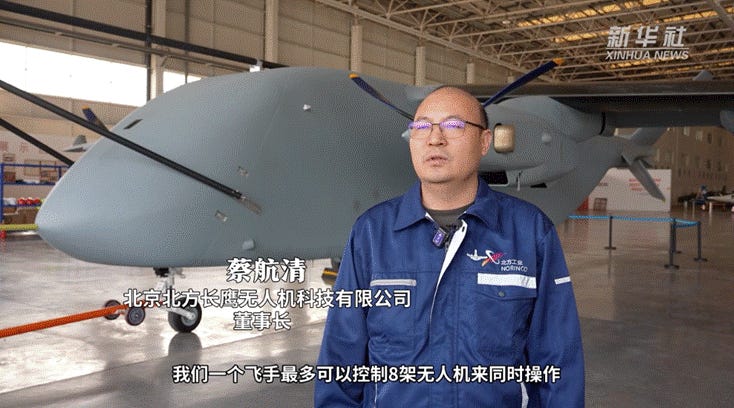
At the Ministry of Defense’s April 9 press conference, a reporter mentioned that Taiwanese public opinion described the CY-8 as a potential new “aircraft carrier killer” (反航母利器) and that there was concern in Taiwan that China’s unmanned combat system developments would enhance the PLA’s capacity to deter and strike against “Taiwan independence forces.” Without commenting on the drone’s specific military applications, Zhang stated that the PLA would resolutely oppose any form of separatism and external interference, and that capabilities relevant to “anti-secession and anti-intervention” (反分裂反干涉) missions would continue.
CCA Analysis: The CY-8 gives the PLA enhanced logistics capabilities in operationally constrained environments. Its 15-minute cargo loading cycle gives the PLA additional cargo capacity in geographic areas that have limited infrastructure. Although China has not officially specified its military applications, coverage by Chinese state media and PLA official social media accounts suggests military interest in the platform. As noted by both Chinese military commentators and the CY-8’s developers, operational roles are likely to include resupply and border patrol missions for a Taiwan or South China Sea contingency.
The characterization of the CY-8 as an “aircraft carrier killer” is traceable to Lai Yue-qian (賴岳謙), a Taiwanese political analyst whose remarks were picked up by Chinese media outlets, including during the Ministry of Defense press conference. As cross-Strait tensions have increased, China has used announcements of new weapons programs as a public relations campaign to warn Taiwanese “independence forces.” For example, our previous edition’s coverage of the two newly commissioned Type 055 destroyers included PLA references to Taiwan.
One of Lai’s arguments is that the CY-8 can operate as a military cargo drone designed to carry significant military hardware, and that its 3.5-tonne payload capacity could theoretically accommodate a single YJ-12 anti-ship missile, posing a threat to U.S. carrier strike groups. However, while technically feasible, significant limitations remain. A one-drone, one-missile model would be operationally inefficient since the CY-8 is a non-stealthy platform that would likely become an easy target for U.S. operations. Such an approach would also fail to exploit the aircraft’s large 18-cubic-meter cargo bay.
A more likely scenario is the CY-8 being deployed as part of a broader containerized drone swarm system. This concept mirrors the U.S. military’s Rapid Dragon system, which ejects pallets from the aircraft’s rear ramp via parachute. Once deployed, the system releases dozens or even hundreds of drones or loitering munitions to saturate carrier air defenses, creating a far more credible threat than a single missile.
China has demonstrated relevant capabilities in this domain. China Electronics Technology Group Corporation (中国电子科技集团公司) released footage of a containerized swarm system capable of launching 48 drones of varying types from a single vehicle. The system is so efficient that a single operator could control nearly 100 aircraft across missions.
Whether analogous systems could be adapted for airborne delivery remains an open question. But the technical trajectory is clear. If the PLA seeks to combine heavy anti-ship missiles with drone swarm delivery at scale, the CY-8’s 3.5-ton payload limit is a constraint. The Jiutian (九天) drone, which completed its maiden flight in December 2025, offers a more effective payload capacity (6 tons) for multi-missile or high-density swarm missions.